Oxymatrine.
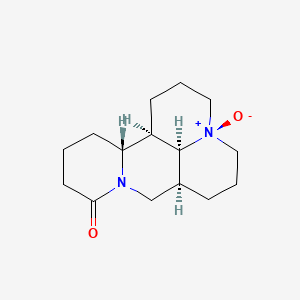
An alkaloid from a bitter Chinese root, studied mostly for everyday liver support and a healthy inflammatory response. Gut bacteria turn much of a dose into its relative matrine.
 Compound
- Category
- Compound
What Oxymatrine is, and what it does.
- Does it work
- Suits people already working with traditional Chinese herbs who want the isolated alkaloid. Of the 2,203 records at Europe PMC, most are laboratory and animal work.
- How much to take
- No daily amount is on record. This is a concentrated alkaloid with a narrow working margin, so start with what a qualified practitioner sets rather than with a guess.
- Time to feel it
- Nobody has published a human time course. Where liver markers have been watched, the change is read on a blood panel across weeks rather than noticed day to day.
- The first dose
- Day one is usually quiet apart from the taste, which is intensely bitter. Larger amounts can bring nausea, and that is the signal to ease back.
- With regular use
- There is no long-run human record to describe. Traditional use is a defined course with a break, not an indefinite daily habit.
- How well tolerated
- This alkaloid family has a narrow margin between experimental intakes and ones causing nausea and neurological effects, so dose conservatively and involve a clinician.
- How it feels
- Overwhelmingly bitter. Past that, most people report nothing subjective, which fits an ingredient whose effects have been tracked on laboratory markers.
- The overlooked benefit
- Its N-oxide group makes it far more water soluble than matrine, which is why a simple water decoction of the root pulls out oxymatrine preferentially.
The proof, claim by claim.
What these words mean
These words describe the research, not the molecule's worth. Research strength is how much work stands behind one claim, and it is never a product score.
- everyday liver supportAnimal study
- a healthy inflammatory responseAnimal study
2 more claims
- microbial conversion to matrine after oral dosingAnimal study
- narrow margin before neurological and gastrointestinal effectsNarrative review
Why these belong in the same formula, 5 pairings
Why these belong in the same formula. Each row says what the basis is, from settled biochemistry through to a trial that measured the pair.
Because gut bacteria perform the reduction of oxymatrine to matrine, the composition of that microbiota influences how much conversion happens and how quickly. Anything that shifts the gut community, including probiotic supplementation or recent antibiotics, can therefore shift the alkaloid profile reaching circulation. The direction of that shift has not been quantified for any specific probiotic strain. Read it as a source of variability rather than a benefit.
Sophora flavescens root is intensely bitter and is classically combined with licorice, which is used in that tradition to soften harsh botanicals and improve palatability. The pairing is documented as formulation custom rather than as a measured pharmacological interaction. Licorice carries its own considerations at sustained intake, including effects on potassium and blood pressure. Read the pairing as tradition, not as a demonstrated combination effect.
Both are plant alkaloids taken in concentrated extract form, and both carry meaningful gastrointestinal effects at higher intakes. Stacking two concentrated alkaloids raises the total load on gut tolerance and on hepatic handling without a documented complementary mechanism. Berberine additionally affects gut microbial composition, which matters here because microbiota drive the oxymatrine to matrine conversion. This is a caution about stacking, not a recommended pairing.
Oxymatrine and silymarin appear together in liver-oriented botanical products, largely because both have literature attached to hepatic outcomes. No study has measured the combination against either alone. Silymarin also inhibits several drug-metabolising enzymes in vitro, which is a reason to be careful about stacking with anything else being metabolised hepatically. Count this as market convention with an unmeasured interaction.
Ferulic acid appears alongside oxymatrine in laboratory work, most often as a comparator or co-treatment antioxidant rather than as a demonstrated partner. The two act through different chemistry, one an alkaloid and one a phenolic acid. Any additive antioxidant reading comes from cell and animal systems. There is no human combination data.
Nothing specific on file for Oxymatrine. Match the label to the daily amount above, and tell your doctor what you take.
Not medical advice. Show the label to your pharmacist.What Oxymatrine actually does.
It comes from a bitter Chinese medicinal root and is a slightly oxidised version of a related compound called matrine.
3 more mechanisms
The oxygen on the nitrogen makes it dissolve in water far better than its cousin, so water extracts are rich in it.
Your gut bacteria convert a good share of it into matrine before it reaches the bloodstream.
The gap between an experimental dose and an unpleasant one is not wide. Concentrated extracts deserve respect.
Where Oxymatrine comes from.
A compound pulled from a very bitter Chinese medicinal root. Once swallowed, gut bacteria turn much of it into a close relative called matrine, so you end up with both.
What this route gives you
Made from a plant. What ends up in the capsule tracks the harvest, so batch testing and a stated marker matter more here than with a made molecule.
5 steps on record
The dried root, known as ku shen, is cultivated across China and harvested from plants typically three years or older.
Water or dilute acid pulls the alkaloid fraction from milled root. Oxymatrine partitions readily into the aqueous phase because of the N-oxide group.
The crude alkaloid mixture is separated on ion exchange resin and the oxymatrine fraction is crystallised, then recrystallised to raise purity.
Matrine can be oxidised to oxymatrine with peroxide, which some producers use to shift the ratio of a natural extract toward oxymatrine.
Purified material is supplied either as the free alkaloid or converted to the hydrochloride salt for handling and dissolution.
The forms it comes in.
3 more forms
The essence, in one line each.
- Reports that oxymatrine altered gut microbial composition alongside changes in pain-related measures in an animal model.Animal study. Liu Z et al., 2024 (The Journal of Pain). PMID 38844152 ↗
2 more findings
- Network pharmacology prediction with laboratory follow-up pointing to TNF and NF-kappaB signalling as the pathways engaged by oxymatrine against a parasitic infection model.In vitro study. Zhang X et al., 2024 (Scientific Reports). PMID 38914662 ↗
- Matrine restored the activity of an antibiotic against resistant bacteria in laboratory testing. Oxymatrine appears as the related parent alkaloid.In vitro study. Wang Z et al., 2025 (Molecules). PMID 40430295 ↗
Chosen from the 3 we read for Oxymatrine.
The studies, linked.
1 source behind our Oxymatrine verdict, every one linked to PubMed, the journal or ClinicalTrials.gov.
- Clinical trialOxymatrine Plus Lamivudine Combination Therapy Versus Lamivudine Monotherapy for Chronic Hepatitis B Infected SubjectsClinicalTrials.gov ↗Phase 4, 192 participants, Completed
From clinical trials and PubMed, ranked by study type and citation weight, not cherry-picked.
FDA Disclaimer: These statements have not been evaluated by the Food and Drug Administration. This information is for educational purposes only and is not intended to diagnose, treat, cure, or prevent any disease. Consult your healthcare provider before starting any supplement regimen.