Panthenol.
Provitamin B5. Your body converts it to pantothenic acid, the backbone of coenzyme A, and on skin and hair it holds water in the outer layers.
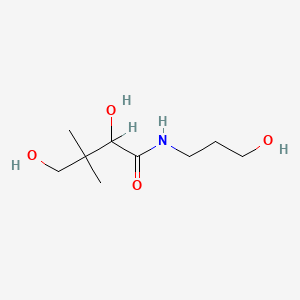 Compound
- Category
- Compound
What Panthenol is, and what it does.
- Does it work
- Suits anyone wanting B5 in a form that also works on skin and hair. Pantothenate is widespread in ordinary food, so oral use is a top-up on an already busy pathway.
- How much to take
- No daily amount is on record for panthenol itself. Only the D form converts, so a mixed material delivers about half the active weight for the same label figure.
- Time to feel it
- On skin, hydration measures shift within hours to days. Taken by mouth it feeds a pathway that is already running, so there is no felt onset to time.
- The first dose
- Topically, skin feels softer and less tight fairly quickly. Orally, day one is quiet, which is what you'd expect from a vitamin joining a pool your body keeps stocked.
- With regular use
- Weeks of topical use show up as better held skin hydration and less brittle hair. Oral use keeps coenzyme A production supplied, which registers as steady status.
- How well tolerated
- Well tolerated by mouth and on skin. Very large oral amounts of B5 can loosen stools. Check with your clinician first if you're pregnant or taking high-amount B vitamins.
- How it feels
- On skin it feels slippery and softening. Swallowed, there's no sensation attached to it, and that's normal for a vitamin working as an enzyme cofactor.
- The overlooked benefit
- Pantothenate shares its cell transporter with biotin and lipoic acid, so all three compete for the same doorway. Spacing large amounts apart is sensible.
The proof, claim by claim.
What these words mean
These words describe the research, not the molecule's worth. Research strength is how much work stands behind one claim, and it is never a product score.
- skin hydration and barrier comfortRandomised trial
- hair condition and manageabilityRandomised trial
2 more claims
- coenzyme A production and acyl transferNarrative review
- skin comfort after minor irritationRandomised trial
Why these belong in the same formula, 8 pairings
Why these belong in the same formula. Each row says what the basis is, from settled biochemistry through to a trial that measured the pair.
Panthenol is the alcohol analogue of pantothenic acid and is oxidised to the acid once absorbed, which is why it is described as provitamin B5. Supplying both delivers the same downstream vitamin rather than two different actives. That matters for totalling B5 intake across a stack. The conversion itself is settled biochemistry.
Coenzyme A is assembled from pantothenate, ATP and cysteine, with cysteine contributing the thiol group that does the actual acyl carrying. Pantothenate availability alone does not build CoA if the cysteine step is limited. The two sit on the same pathway at different points. This is textbook pathway architecture rather than a measured supplement pairing.
Pantothenate, biotin and lipoate all cross the intestinal and cellular membranes on the same sodium-dependent multivitamin transporter, SMVT. High intakes of one can compete with the others for that shared carrier. The competition is documented at the transporter level. Whether ordinary supplemental doses produce a measurable shortfall of the others has not been established. Note it as a mechanism worth spacing doses for, not as a demonstrated deficiency risk.
Lipoic acid uses the same sodium-dependent multivitamin transporter as pantothenate and biotin, so the same competition applies. Large single doses of any of the three occupy shared carrier capacity. The practical answer is separating them across the day rather than avoiding the combination. The transporter biology is settled. The clinical size of the effect is not.
Panthenol and hyaluronic acid are both water-binding humectants used to hold moisture in the upper skin layers, and they are routinely formulated together because they bind water by different means, one a small polyol and one a large polysaccharide. The pairing is a formulation convention with a physical basis. It describes topical behaviour and says nothing about oral intake.
Both are water-soluble, stable across the mildly acidic pH range topical products use, and non-reactive with each other, which is why they appear in the same aqueous phase of countless formulations. Compatibility is the reason for the pairing rather than a demonstrated combined effect. This is formulation chemistry.
Ceramides supply lipid material to the intercellular matrix while panthenol acts as a water-binding humectant, so the two address different halves of barrier behaviour. Formulators pair them for that reason. Each has its own supporting work. The combination itself has not been separately quantified. Read it as complementary formulation roles.
Coenzyme A, built from pantothenate, carries the acyl units that feed mitochondrial energy metabolism, and the recent panthenol work reports changes in coenzyme Q alongside the panthenol effect. The connection is mechanistic and drawn from a preclinical model. No human data exists for the pairing. Read it as mechanistic rather than clinical.
Nothing specific on file for Panthenol. Match the label to the daily amount above, and tell your doctor what you take.
Not medical advice. Show the label to your pharmacist.What Panthenol actually does.
It is a slightly different version of vitamin B5 that the body converts into the real thing.
3 more mechanisms
Vitamin B5 becomes coenzyme A, the molecule that shuttles fuel through your energy-producing machinery.
There are two mirror-image versions and only one works. A DL product gives you about half as much of the useful one.
It pulls and holds water, which is why it turns up in almost every moisturiser.
Where Panthenol comes from.
Made in a factory from simple chemical starting materials, not extracted from anything. The version that matters is D-panthenol, which your body turns into vitamin B5.
What this route gives you
Chemically synthesised. The molecule is identical to the one a plant or an animal makes, and building it deliberately means a known purity, a fixed dose and no crop contaminants. For several nutrients this is the only route that reaches a usable amount.
5 steps on record
Basic petrochemical building blocks are condensed to hydroxypivaldehyde, the entry point of the industrial route.
Cyanohydrin formation and hydrolysis close the ring to give racemic pantolactone.
The racemate is resolved, classically with a chiral base or enzymatically, to isolate D-pantolactone. Skipping this step is what yields DL material.
D-pantolactone is condensed with 3-aminopropanol to open the ring and form D-panthenol.
The finished material is a viscous hygroscopic liquid, usually supplied neat or as a 50 to 75 percent aqueous solution for handling.
The forms it comes in.
3 more forms
The essence, in one line each.
- Reports that panthenol lessened oxidative stress markers and fibrotic changes in an experimental model of obstructed bile flow, alongside a rise in coenzyme Q.Animal study. Semenovich DS et al., 2026 (International Journal of Molecular Sciences). PMID 42278441 ↗
Chosen from the 1 we read for Panthenol.
The studies, linked.
3 sources behind our Panthenol verdict, every one linked to PubMed, the journal or ClinicalTrials.gov.
- Clinical trialImpact of a Cream Containing Madecassoside and 5 % Panthenol in Post Photodynamic Therapy Procedure for Actinic Keratosis: A Randomized, Controlled TrialClinicalTrials.gov ↗20 participants, Completed
2 more linked trials
- Clinical trialPilot Double-blind Randomized Controlled Clinical Trial for the Prevention of Radiodermatitis in Breast and Head and Neck Cancer Patients in CyprusClinicalTrials.gov ↗100 participants, Unknown
- Clinical trialEfficacy of a Combination of Topical Antioxidants in Tretment of Photoaged Skin:A Randomized Controlled TrialClinicalTrials.gov ↗90 participants, Unknown
From clinical trials and PubMed, ranked by study type and citation weight, not cherry-picked.
Problems people have reported.
Read this carefully. These are 48,270 voluntary, unverified reactions reported to the FDA (openFDA). The number mostly reflects how popular Panthenol is, not how risky it is. A report is not proof Panthenol caused anything. It is a signal of what to watch for, nothing more.
3 more reported effects
Source: openFDA adverse-event reports. Voluntary reporting, not an incidence rate.
FDA Disclaimer: These statements have not been evaluated by the Food and Drug Administration. This information is for educational purposes only and is not intended to diagnose, treat, cure, or prevent any disease. Consult your healthcare provider before starting any supplement regimen.