Sennosides.
The active fraction of senna. Swallowed at night, colonic bacteria turn it into rhein anthrone, which raises propulsion and stool water by morning.
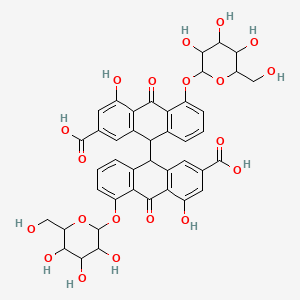 Compound
- Category
- Compound
What Sennosides is, and what it does.
- Does it work
- Suits a short, defined course when things slow down. If you want something for every single day, fibre, fluid and walking carry that load.
- How much to take
- No dose figure is on record here, so none is invented. Start with what the label on the product in your hand states, in the evening, and keep the course short.
- Time to feel it
- Usually overnight, roughly six to twelve hours. That interval is transit plus bacterial conversion. More material raises intensity, not speed.
- The first dose
- Very little through the day, then the effect arrives the next morning. Some people notice gurgling or mild cramping ahead of it.
- With regular use
- Built for short courses rather than daily months. Prolonged anthranoid use is associated with a brown colonic pigment seen at endoscopy, which fades after stopping.
- How well tolerated
- Short courses are generally well tolerated. Cramping and loose stools are the usual effects. Talk to a clinician if you're pregnant, breastfeeding or on a potassium-affecting medicine.
- How it feels
- Brief cramping, then relief. Some flatness afterwards if you don't drink enough to replace what the stool carried out.
- The overlooked benefit
- Sennoside A and B are mirror-image twins that end at the same active metabolite, so a label quoting one isomer understates total anthranoid content.
The proof, claim by claim.
What these words mean
These words describe the research, not the molecule's worth. Research strength is how much work stands behind one claim, and it is never a product score.
- Bowel regularity over a short courseMeta-analysis
- Stool consistency and colonic transitRandomised trial
2 more claims
- Bowel clearance before a scheduled procedureRandomised trial
- Colonic pigment deposition with long daily useCohort study
Why these belong in the same formula, 7 pairings
Why these belong in the same formula. Each row says what the basis is, from settled biochemistry through to a trial that measured the pair.
Sennosides A and B are both prodrugs. Bacterial beta-glucosidase releases the dianthrone, which is then reduced to rhein anthrone in the colon. Someone with a heavily disrupted colonic flora converts less of the same dose. This is settled pharmacology and it explains most of the person-to-person variability.
The colon normally reclaims potassium along with water. Faster transit with more luminal fluid leaves less opportunity for that. Repeated use over weeks is where blood potassium drops enough to matter, and it is a laboratory finding before it is a felt one. This is one of the strongest arguments for limiting the class to short courses.
Psyllium works mechanically by holding water and adding stool mass, and it holds up over long periods. Sennosides act on enteric nerves and colonic secretion and are designed for short use. Building the routine on fibre and reserving the stimulant for occasional use is the usual structure. The two taken together at the same moment make it harder to tell which is producing what.
Two different mechanisms converging on the same output stack rather than cancel. People often do not count a magnesium citrate supplement as part of their laxative load. Combining them also compounds fluid loss. Doses matter here: supplemental magnesium for other purposes is far below the osmotic laxative range.
Calcium absorption is a slow, partly saturable process that depends on contact time with the intestinal surface. Faster transit shortens that window. The direction is clear from mechanism. The magnitude in ordinary intermittent use has not been well quantified. Separating mineral doses from laxative timing sidesteps it.
Glycyrrhizin blocks 11-beta-hydroxysteroid dehydrogenase type 2, letting cortisol act at the mineralocorticoid receptor and driving potassium out through the kidney. Sennosides drive it out through the stool. Both routes at once is a real additive risk that crosses product categories. Deglycyrrhizinated licorice extracts do not carry it.
Cramping is the common complaint with stimulant laxatives, and the traditional formulation answer was a spasmolytic herb in the same cup. Chamomile, fennel and peppermint are the usual choices. The pairing is formulation convention with a plausible mechanism, not a trialled combination. It does not change conversion or potency.
Nothing specific on file for Sennosides. Match the label to the daily amount above, and tell your doctor what you take.
Not medical advice. Show the label to your pharmacist.What Sennosides actually does.
Sennosides carry sugar groups that make them too water-soluble to be absorbed, so they reach the colon essentially unchanged after passing through the small intestine.
3 more mechanisms
Colon bacteria remove the sugar groups and convert what remains into rhein anthrone. That converted compound is the one doing the work, which makes sennosides more of a precursor than a direct active.
Rhein anthrone speeds up colon movement through nerve stimulation and shifts water and salt handling toward the gut, both raising the water content of stool.
The overnight delay before you feel anything reflects the time it takes to reach the colon and get converted. A bigger dose doesn't shorten that wait, it just makes the eventual effect stronger.
Where Sennosides comes from.
This is the active fraction of senna. It does nothing on its own until bacteria in your colon convert it, which is why it acts overnight rather than within the hour. It is built for short-term use, not for every day.
What this route gives you
Made from a plant. What ends up in the capsule tracks the harvest, so batch testing and a stated marker matter more here than with a made molecule.
6 steps on record
Pods generally assay higher in sennosides than leaf. Alexandrian and Tinnevelly senna are the two main trade origins and differ in typical assay.
Anthranoid glycosides degrade and interconvert with heat and residual moisture, so drying conditions set the eventual assay as much as the harvest does.
The glycosides are polar and partition into aqueous solvent, leaving lipophilic plant material behind.
Precipitation as calcium salts stabilises the material and improves handling and assay reproducibility.
Batches are assayed, usually against sennoside B, and blended to hit a declared percentage.
Supplied either as a defined-percentage powder for tabletting or as milled crude herb for infusion.
The forms it comes in.
3 more forms
The essence, in one line each.
Chosen from the 1 we read for Sennosides.
The studies, linked.
3 sources behind our Sennosides verdict, every one linked to PubMed, the journal or ClinicalTrials.gov.
- Clinical trialDose-Adjusted EPOCH Chemotherapy and Rituximab (CD20+) in Adults and Children With Previously Untreated Patients With Aggressive Non-Hodgkin's LymphomaClinicalTrials.gov ↗Phase 2, 348 participants, Completed
2 more linked trials
- Clinical trialHigh-volume Polyethylene Glycol Solution (PEG) Versus Low-volume PEG Plus Stimulant Laxative Versus Sennosides for Colon Cleansing Before Colonoscopy: a Randomized, Single Blinded StudyClinicalTrials.gov ↗Phase 4, 240 participants, Completed
- Clinical trialAn Evaluation of the Efficacy and Safety of a Polyethylene Glycol (PEG) Based Bowel Protocol for the Management of Constipation in Peritoneal Dialysis Patients: A Pilot StudyClinicalTrials.gov ↗Phase 4, 25 participants, Completed
From clinical trials and PubMed, ranked by study type and citation weight, not cherry-picked.
Problems people have reported.
Read this carefully. These are 126,099 voluntary, unverified reactions reported to the FDA (openFDA). The number mostly reflects how popular Sennosides is, not how risky it is. A report is not proof Sennosides caused anything. It is a signal of what to watch for, nothing more.
3 more reported effects
Source: openFDA adverse-event reports. Voluntary reporting, not an incidence rate.
FDA Disclaimer: These statements have not been evaluated by the Food and Drug Administration. This information is for educational purposes only and is not intended to diagnose, treat, cure, or prevent any disease. Consult your healthcare provider before starting any supplement regimen.