Syringic acid.
A plant phenolic acid your own gut also makes: colonic bacteria break dark berry pigments down into it. Its role is donating hydrogen atoms to radicals.
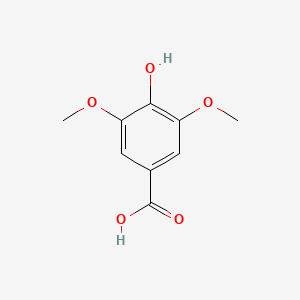 Compound
- Category
- Compound
What Syringic acid is, and what it does.
- Does it work
- Suits people who follow polyphenol chemistry and berry metabolites. Anyone eating dark berries and wholegrains regularly is already producing it internally.
- How much to take
- No dose figure is on record. The human dose-finding work has not been done, so a declared amount on a label is not anchored to a studied intake.
- Time to feel it
- Nobody has measured a time course in people. Berry-derived syringic acid turns up in blood hours after the meal, once bacteria have done the cleaving.
- The first dose
- Day one is quiet. What shifts is a metabolite pool measurable in blood and urine rather than anything that registers as a sensation.
- With regular use
- No human study has followed weeks of supplemental use. The longer-running work is animal and cell based, reading oxidative and glucose markers.
- How well tolerated
- No human tolerability study has been published for the isolated acid. As a normal part of berries, wine and wholegrains, dietary exposure is long standing.
- How it feels
- There is no subjective account on record. This one lives in laboratory measurements rather than in how your day goes.
- The overlooked benefit
- Its two methoxy groups block the metal-binding positions, so unlike caffeic acid it cannot chelate iron or copper. Grouping it with catechols gets it wrong.
The proof, claim by claim.
What these words mean
These words describe the research, not the molecule's worth. Research strength is how much work stands behind one claim, and it is never a product score.
- free radical scavenging in laboratory assaysIn vitro study
- marker of anthocyanin intake from dark berriesNarrative review
2 more claims
- glucose and oxidative markers in rodent modelsAnimal study
- product of colonic bacterial breakdown of malvidin pigmentsNarrative review
Why these belong in the same formula, 7 pairings
Why these belong in the same formula. Each row says what the basis is, from settled biochemistry through to a trial that measured the pair.
Malvidin carries the same 3,5-dimethoxy-4-hydroxyphenyl B-ring that becomes syringic acid when gut bacteria cleave the anthocyanin at the heterocyclic ring. Much of what is measured in blood after a berry meal is this metabolite, not the parent pigment. That makes bilberry a precursor source rather than a co-ingredient. It also means microbiota composition determines how much anyone actually forms.
The conversion of dietary anthocyanins into their phenolic acid metabolites depends on which bacteria are present, which is why metabolite output varies several-fold between people eating the same berries. Whether a specific probiotic raises syringic acid formation in a person has not been demonstrated. The dependency is real, the intervention is unproven. A review of anthocyanin microbial metabolism sets out this landscape.
Gallic acid has three hydroxyls on the ring. Syringic acid replaces two of them with methoxy groups. That substitution makes syringic acid less potent as a direct radical scavenger but more stable and more lipophilic. The two behave as members of the same chemical family with different kinetics. They are frequently measured together in plant extracts because they arise from related pathways.
Sinapyl and coniferyl alcohol units in lignin give rise to syringyl and guaiacyl phenolic acids respectively when the polymer is broken down. Ferulic acid and syringic acid therefore co-occur in cereal bran and in lignin-derived streams. They are typically consumed together rather than chosen separately. Their antioxidant behaviour overlaps without being identical.
When syringic acid quenches a radical it becomes a phenoxyl radical itself, stabilised by the two flanking methoxy groups. Ascorbate can hand back an electron and restore the parent molecule. This is standard antioxidant network chemistry applied by class rather than measured for syringic acid specifically. It describes chemistry in a test tube more confidently than anything in a person.
Phenolics that undergo oxidation to quinone intermediates are conjugated with glutathione as part of clearance. This is the same route that handles many plant phenolics and it means glutathione turnover rises with high phenolic intake. Note the direction: this is about how the body clears the compound, not about the two acting together on a target. Co-occurrence of the two in study data is often about this, not about synergy.
Quercetin and anthocyanins are both broken down by gut bacteria into low molecular weight phenolic acids that are absorbed far more readily than the parent compounds. Some of the circulating activity attributed to a flavonoid supplement is actually coming from this metabolite pool. Syringic acid is one member of it. This reframes the relationship as upstream and downstream rather than side by side.
Nothing specific on file for Syringic acid. Match the label to the daily amount above, and tell your doctor what you take.
Not medical advice. Show the label to your pharmacist.What Syringic acid actually does.
Its structure is built so that after it neutralises a reactive molecule, what is left behind is unusually stable.
3 more mechanisms
Eat dark berries and your gut bacteria break the pigment apart. Syringic acid is one of the pieces that gets absorbed.
It comes from the woody structural polymer in plants, so how much a plant has depends on what kind of lignin it builds.
The body tags it for excretion quickly, so most of what is in your blood is a modified version.
Where Syringic acid comes from.
You can extract it from plants, make it enzymatically from a wood-derived aldehyde, or make it yourself by eating dark berries and letting gut bacteria break the pigment down. Most people get it the third way without ever buying it.
What this route gives you
The same molecule is reached more than one way. Which route a given product used is a manufacturing choice, and the finished compound is the same either way.
5 steps on record
The biocatalytic route starts from lignin depolymerisation streams that yield syringaldehyde. The extraction route starts from dark berries, cereal bran, wine lees or olive material where the compound occurs naturally.
Aryl-alcohol oxidase in a whole-cell system oxidises the aldehyde to the carboxylic acid. Chemical oxidation routes exist as an alternative and produce more by-product.
For the plant route, aqueous ethanol or methanol pulls the phenolic acid fraction, often after acid or alkaline hydrolysis to release compounds bound to the cell wall matrix.
The crude fraction is separated by resin or preparative chromatography, then crystallised. Purity is verified by HPLC against a reference standard.
The isolated compound is dried and milled. Extract products are instead standardised to a stated total phenolic or syringic acid percentage without isolating it.
Getting Syringic acid from food.
The whole-food sources on file. A supplement closes the gap, it does not replace dinner.
A gram-for-gram figure (how much of each you would eat to match a dose) will appear here once it is sourced and reviewed. This page will not print a number it cannot cite.
The forms it comes in.
4 more forms
The essence, in one line each.
- A whole-cell biocatalytic system using aryl-alcohol oxidase converted lignin-derived syringaldehyde into syringic acid at high efficiency.In vitro study. Li Q et al., 2026 (Foods). PMID 41596866 ↗
3 more findings
- The review maps how gut bacteria degrade anthocyanins into small phenolic acids and argues that these metabolites, not the parent pigments, account for much of the measurable systemic exposure.Narrative review, in cells. Zeng Y et al., 2026 (Nutrients). PMID 42124012 ↗
- Spirulina, whose phenolic profile includes syringic acid, was associated with reduced markers of cardiac injury in the model used, supported by in silico docking.Animal study. Arrari F et al., 2026 (Journal of the Science of Food and Agriculture). PMID 41810752 ↗
- An Artemia extract containing syringic acid among its phenolics was linked to shifts in antioxidant defence and reproductive markers.Animal study. Higazy AE et al., 2026 (Veterinary Research Communications). PMID 41746445 ↗
Chosen from the 5 we read for Syringic acid.
The studies, linked.
1 source behind our Syringic acid verdict, every one linked to PubMed, the journal or ClinicalTrials.gov.
- Clinical trialA Randomized, Double-Blind, Split-Face Controlled Study to Evaluate the Anti-Wrinkle Efficacy and Safety of a Syringic Acid-Containing Emulsion in Healthy SubjectsClinicalTrials.gov ↗23 participants, Completed
From clinical trials and PubMed, ranked by study type and citation weight, not cherry-picked.
FDA Disclaimer: These statements have not been evaluated by the Food and Drug Administration. This information is for educational purposes only and is not intended to diagnose, treat, cure, or prevent any disease. Consult your healthcare provider before starting any supplement regimen.