Valerenic acid derivatives.
The marker compounds in valerian root. They make the brain's calming GABA signal land harder where it's already present, which is the basis for valerian at bedtime.
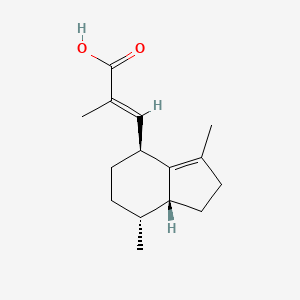 Compound
- Category
- Compound
What Valerenic acid derivatives is, and what it does.
- Does it work
- It suits anyone reading a valerian label and wanting to know what the standardisation figure means. The assay is what tells you what's actually in the extract.
- How much to take
- No daily amount is on record for the isolated acids. Start with the valerian extract's own direction and read the declared valerenic acid percentage.
- Time to feel it
- Valerian is usually taken about an hour before bed. Trials of it have run two to four weeks before measured changes in sleep quality appeared.
- The first dose
- Some people feel a mild drowsiness within an hour or two on the first night. Others notice nothing yet, and the smell of the root is famously strong.
- With regular use
- Sleep research on valerian tends to report change accumulating across two to four weeks of nightly use rather than on the first few nights.
- How well tolerated
- Generally well tolerated. Morning grogginess and vivid dreams get reported. Don't combine it with alcohol or sedative medication without talking to your clinician.
- How it feels
- A soft settling rather than a knockout. People describe it as easier to let go at bedtime, with a lingering heaviness the next morning for some.
- The overlooked benefit
- Because it only amplifies a signal already there, its effect depends on your own GABA tone, which is one honest reason valerian suits some people more than others.
The proof, claim by claim.
What these words mean
These words describe the research, not the molecule's worth. Research strength is how much work stands behind one claim, and it is never a product score.
- Sleep qualityMeta-analysis
- Falling asleep more easilyRandomised trial
2 more claims
- Calm and everyday stressRandomised trial
- Positive allosteric modulation at GABA-A receptorsIn vitro study
Why these belong in the same formula, 10 pairings
Why these belong in the same formula. Each row says what the basis is, from settled biochemistry through to a trial that measured the pair.
These sesquiterpenoid acids come from Valeriana officinalis root, so an isolate and a root extract deliver the same class of compound. Taking both stacks one active rather than combining two. Root extracts also carry valepotriates and volatile oils that an isolate does not. The overlap is chemical identity, not a complementary effect.
Allosteric modulators change how a receptor responds to its own transmitter rather than activating it directly, so the effect depends on GABA being present. Oral GABA crosses the blood brain barrier poorly, which limits how much a supplemental dose contributes centrally. The mechanistic pairing is coherent, the practical addition is uncertain. Read it as receptor pharmacology rather than as a demonstrated combined effect.
Theanine influences glutamatergic signalling and alpha-wave activity while valerenic acid modulates GABA-A. Formulators combine them in sleep and calm blends on the logic that the targets do not overlap. Trials of the specific pair are limited. Any additive drowsiness matters for driving and machinery.
Melatonin signals through MT1 and MT2 receptors and shifts sleep timing, which is not what a GABA-A modulator does. The pairing is common in sleep formulas for that reason. Combined next-morning grogginess is the practical thing to watch. The rationale is mechanistic complementarity, not head-to-head trial data.
Both botanicals converge on the same receptor complex from different chemical families. Traditional European calming formulas have paired them for a long time. Additive sedation is the expected direction, which is the point of the blend and also the caution. Anyone taking prescription sedatives or sleep medication should raise it with a clinician.
Slowing GABA breakdown leaves more transmitter present, and an allosteric modulator only works when transmitter is there. That makes the pairing mechanistically enabling rather than merely additive. The enzyme inhibition is described in laboratory work, not quantified in people at supplement doses. The combination is a long-standing traditional pairing as well.
Apigenin and valerenic acid occupy different sites on the same receptor complex, so their effects can combine. That is the basis of the classic evening tea blend. Sedation adds, and so does the caution about combining with sedative medication. The receptor binding is documented in laboratory work.
Magnesium sits at the NMDA channel pore and dampens excitatory signalling, a different lever from GABA-A modulation. The two are routinely combined in evening formulas on that basis. Magnesium correcting a shortfall is a different situation from magnesium added on top of adequate intake. State which one applies before claiming an effect.
Caffeine raises arousal by blocking adenosine receptors, which works against what a GABA-A modulator is taken for. Late-day caffeine will blunt the perceived effect of an evening dose. The two do not cancel at the same receptor, they push central arousal in opposite directions. Timing separation is the practical answer.
5-HTP feeds serotonin synthesis, which is upstream of melatonin and of sleep architecture generally, while valerenic acid acts at GABA-A. The combination appears in sleep blends. Serotonergic agents carry their own interaction concerns with prescription antidepressants, which is the more important flag here. Evidence for the specific pair is thin.
Nothing specific on file for Valerenic acid derivatives. Match the label to the daily amount above, and tell your doctor what you take.
Not medical advice. Show the label to your pharmacist.What Valerenic acid derivatives actually does.
Valerenic acid is a compound from valerian root, found alongside two related compounds in the plant.
3 more mechanisms
A compound that boosts a receptor's response only works when the receptor's natural signal is already present, rather than switching the receptor on by itself, so its effect depends on ongoing background activity of that signal.
Valerenic acid compounds are chemically distinct from valepotriates, a different group of compounds also found in valerian root that break down readily during storage.
Because the amount of valerenic acid varies by plant part, species and drying method, extracts are tested and standardized to a declared percentage rather than assumed from the weight of the root.
Where Valerenic acid derivatives comes from.
These are the compounds in valerian root that supplement labels measure. They do not switch on the brain's calming signal themselves, they make the receptor respond more strongly when that signal is already there.
What this route gives you
Made from a plant. What ends up in the capsule tracks the harvest, so batch testing and a stated marker matter more here than with a made molecule.
6 steps on record
Roots are lifted from second-year plants in autumn, when valerenic acid content in the underground parts is highest.
Roots are dried below about 40 degrees Celsius, since higher heat degrades valepotriates and drives off volatile constituents.
Milled root is percolated with an ethanol and water mixture that dissolves the sesquiterpenoid acids.
Solvent is removed under vacuum to a soft or dry extract, sometimes with further chromatographic enrichment of the acid fraction.
The extract is assayed for total valerenic acids and diluted with carrier to a stated percentage, commonly 0.8 percent.
Standardised extract is encapsulated or tabletted, often with a coating because of the characteristic odour.
The forms it comes in.
3 more forms
FDA Disclaimer: These statements have not been evaluated by the Food and Drug Administration. This information is for educational purposes only and is not intended to diagnose, treat, cure, or prevent any disease. Consult your healthcare provider before starting any supplement regimen.