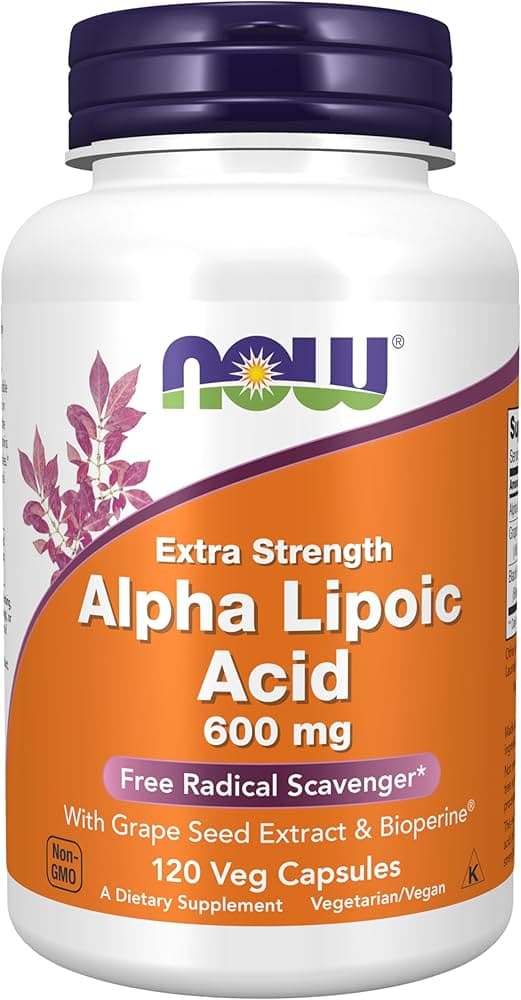
Strong evidence, strong doseNOW Foods, verified Oct 2026Formula verified. Independently reviewed.Independent review. Not commissioned by NOW Foods.
Alpha Lipoic Acid is the lead active here, studied most for healthy glucose metabolism. 16 human studies on Alpha Lipoic Acid back this formula, each one cited. Each serving carries 600 mg of Alpha Lipoic Acid, inside the range the published research used. Who it fits: for everyone, adults.
The brand submits the formula. We read the supplement facts panel and weigh dose, form and synergy against the clinical evidence. Labs test. IngredientMD verifies. The fee pays for review time, never for the outcome.
The panel on the left is the one we evaluated, line by line.
02
Every active, separately.
All 2 actives checked against the clinical evidence: dose, form, and what the research actually shows.
03
Then the formula as a whole.
Doses, ratios, and how the ingredients work together. That assessment is the verdict above: "Strong evidence, strong dose".
04
Earned, not bought.
The verdict is public and identical whether or not a brand pays. A formula that does not clear the bar gets nothing.
Read by the engine against 2.1 million data points from clinical trials, PubMed and more than a hundred vetted sources. No individual reviewer is named or implied.
The receipts
18
Human studies
600 mg
Alpha Lipoic Acid
5 mg
BioPerine
600 mg per serving sits inside the studied 200 mg-600 mg range
Meets the studied dose
Alpha Lipoic Acid, Ziegler et al., 2018
5 mg per serving sits inside the studied 5 mg-10 mg range
aged 20 and over kept added sugars under the Dietary Guidelines limit of 10 percent of daily calories, leaving more than half of US adults over that limit, in the What We Eat in America dietary recall component of NHANES 2015-2016.
USDA Agricultural Research Service, Food Surveys Research Group, 2019
The people it speaks toFieldwork 2017 to March 2020
95% of US adults
aged 20 and over ate one or more snacks on the day their diet was recorded, in the What We Eat in America dietary recall component of NHANES 2017 through March 2020.
USDA Agricultural Research Service, Food Surveys Research Group, 2024
was the median time it took adults to make a new daily health habit automatic across the studies a 2024 review pooled, with individuals ranging from 4 to 335 days.
Across 63 trials, alpha-lipoic acid lowered fasting blood glucose by about 5.3 mg/dL and body weight by about 0.6 kg, with no detectable change in blood pressure or LDL.
Across 24 trials in people with metabolic conditions, alpha-lipoic acid was linked to lower fasting glucose, with a standardized effect of -0.54, plus lower insulin resistance, triglycerides and LDL cholesterol.
Across 18 trials in adults with metabolic conditions, alpha-lipoic acid was linked to lower levels of an inflammation marker, with an effect size of -1.52, plus two related inflammation markers.
Across 10 trials in 529 participants, alpha-lipoic acid showed no detectable effect on the blood markers ferritin, serum iron, haemoglobin or total iron binding capacity, with a higher haemoglobin reading only in longer trials and selected subgroups.
International Journal for Vitamin and Nutrition Research
Pooling five randomised trials in 250 men, alpha-lipoic acid raised total sperm motility by about 13 percentage points and progressive motility by about 12, while sperm concentration and semen volume showed no detectable change.
Population figures from public health data. Context for the category, not a statement about any individual and not a claim about this product.
What this formula earned
Every one of these is a fact the engine could ground.
Each line below was derived from this formula's own record at the time of verification. Nothing here was written by the brand, and nothing can be added that the evidence does not carry.
Studied in people16 human studies on Alpha Lipoic Acid back this formula, each one cited.
A mechanism that is settledHow Alpha Lipoic Acid and BioPerine work is settled pharmacology.
Recent work on the recordThe most recent study on this record was published in 2014.
Serving amount inside the studied rangeEach serving carries 600 mg of Alpha Lipoic Acid, inside the range the published research used.
A stated daily maintenance amountAlpha Lipoic Acid is here at a daily maintenance amount, which is what a daily supplement is for.
Why this formatIt is a capsule, so the amount per serving is fixed and travels without measuring.
The exact form, describedThe label names its forms exactly: Alpha-lipoic acid (racemic), Standardised piperine extract. The record says what each one is and what it suits.
Full label disclosureEvery ingredient on this label carries its own declared amount.
Where it comes from and how it is madeAlpha Lipoic Acid is made by synthetic.
Positions this formula already qualifies forThis formula already qualifies for positions beyond the one it is sold into, on the evidence it carries.
A position nobody is holding yetSome of those positions are ones almost nobody is selling to yet.
What the trials show
What the trials show about timing.
Time-to-effect windows the engine read from the trial record. Each is a window a named study measured, cited and dated, never written by the brand.
Active and windowResearch strength
Alpha Lipoic Acidwithin about 30 minutes of a single doseMeasured within a day
In an open-label randomized crossover study, 24 healthy adults took single 600 mg doses of racemic alpha-lipoic acid in different oral forms, and both enantiomers were absorbed rapidly, with median time to peak plasma concentration between 0.33 and 0.5 hours and blood sampling complete by 8 hours.
Windows measured in the cited trials. Context for how the active behaves over time, not a statement about any individual and not a claim about this product.
General timing
How each ingredient usually behaves over time.
Two ingredients, from each one's own page.
Alpha Lipoic AcidAbout four to twelve weeks
Marker changes build over four to twelve weeks of daily use. Studies measuring nerve comfort in hands and feet typically read out at around five weeks.
There is nothing to time on its own. Piperine changes how much of its partner compound reaches your blood, so the timeline you watch is that partner's.
How each ingredient usually behaves over time, from its own page on IngredientMD. General timing for the ingredient, not a measurement of this product.
Chemical form
The same ingredient, carried differently.
What each form is, and where it fits in a formula. Measured findings carry the study that reported them.
Alpha-lipoic acid (racemic)
A 50:50 mixture of the R and S enantiomers of lipoic acid, sold as the free acid. The same molecule is also labelled thioctic acid.
Fits
A low-cost form to produce and the one used across most of the older clinical literature, which makes it a straightforward default for a general-purpose formula.
Trade-off
Half of the labelled material is the S enantiomer, which does not occur naturally, and as a free acid it can polymerise when exposed to heat or stomach acid.
In an open-label four-way crossover in 24 adults, a racemic solution produced higher peak plasma concentrations of both enantiomers than the 200, 300, and 600 mg tablet forms.
Descriptions of the form itself, read from the cited studies. Not a comparison between products and not a statement about any individual.
Format
Capsule
It is a capsule, so the amount per serving is fixed and travels without measuring.
Best forMost standard doses, and anywhere a short, clean label is the point.
Questions shoppers ask
Is NOW Alpha Lipoic Acid 600mg independently verified?
Yes. IngredientMD reviewed this formula independently and verified it in Oct 2026. The verdict is earned, not bought: brands can't edit or purchase it.
What's in NOW Alpha Lipoic Acid 600mg?
NOW Alpha Lipoic Acid 600mg is built on Alpha Lipoic Acid, BioPerine. Each ingredient links to its own evidence page on IngredientMD.
Were ingredient interactions checked?
Yes. The combination was screened against 2 documented interactions for these actives in IngredientMD's interaction database.
Who is IngredientMD?
IngredientMD is an independent supplement-science platform. We analyze ingredients and formulas against clinical research, and we verify products only when they clear our bar. Labs run the tests. We review the results.
Sell a formula this good?
Put an earned verification on your own product page.
These statements have not been evaluated by the Food and Drug Administration. This product is not intended to diagnose, treat, cure, or prevent any disease. This record is not medical advice. Always consult your healthcare provider before starting any supplement regimen.