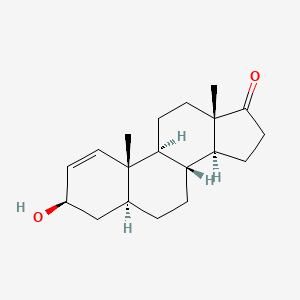
1-androsterone.
It's a synthetic androgen precursor. After absorption, enzymes convert it to 1-testosterone, which acts at the androgen receptor. It's sold for muscle and strength, not as a nutrient.
 Compound
- Category
- Compound
What 1-androsterone is, and what it does.
- Does it work
- It sits in a controlled-substance category in the United States and is banned in tested sport at all times. Anyone facing a drug test needs that fact before anything else.
- How much to take
- No dose figure is on record, and no controlled human dosing study sets one. Anyone using it should be doing so with a clinician who can watch the markers.
- Time to feel it
- Effects from this class are described over weeks rather than days, and blood markers move before anything else does.
- The first dose
- Day one is usually uneventful. The first changes show on a lipid panel and on liver enzyme markers rather than in how you feel.
- With regular use
- Weeks of use lower LH signalling and the body's own testosterone output, and this class shifts HDL cholesterol downward and liver enzyme markers upward.
- How well tolerated
- This class is hard on lipid and liver markers, and suppression of your own hormone output is expected rather than unusual. Not for anyone pregnant, under 18, or unmonitored.
- How it feels
- People on this class report more drive and aggression, oilier skin and a shorter temper. Those are androgenic effects, not a sign of something going well.
- The overlooked benefit
- Its double bond sits at the 1,2 position rather than 4,5, which makes it a poor substrate for aromatase. It doesn't follow testosterone's usual conversion route.
The proof, claim by claim.
What these words mean
These words describe the research, not the molecule's worth. Research strength is how much work stands behind one claim, and it is never a product score.
- lean body mass alongside resistance trainingRandomised trial
- suppression of endogenous testosterone productionNarrative review
1 more claim
- urinary metabolites detectable in doping controlNarrative review
Why these belong in the same formula, 8 pairings
Why these belong in the same formula. Each row says what the basis is, from settled biochemistry through to a trial that measured the pair.
Prohormone products routinely bundle milk thistle because androgen precursors undergo extensive hepatic first-pass metabolism and some carry documented liver strain. Silymarin has established antioxidant activity in liver tissue. Including it does not remove the underlying hepatic burden and should not be read as making the primary compound suitable for use. The pairing is formulation convention rather than a demonstrated protective combination.
N-acetylcysteine supplies cysteine, the rate-limiting amino acid for glutathione synthesis, and glutathione is central to hepatic phase two conjugation. Compounds cleared through the liver draw on that capacity. This is settled biochemistry about liver conjugation, not evidence that adding NAC makes an androgen precursor advisable. The pairing appears in stack design for that reason.
Oral androgen precursors suppress HDL cholesterol, an effect well described across the androgen class. Omega-3 fatty acids act mainly on triglycerides, which is a different lipid fraction. So the pairing does not cancel the specific change the precursor causes. That mismatch is worth stating plainly because the combination is often sold as offsetting.
Zinc participates in testicular steroid synthesis and in the regulation of aromatase, the enzyme that converts androgens to oestrogens. Low zinc status is associated with reduced endogenous androgen production. That biochemistry is settled, and it is separate from the question of whether exogenous androgen precursors are a reasonable thing to take. Zinc does not offset suppression of the hypothalamic-pituitary-gonadal axis.
Androgens and their metabolites are cleared largely as glucuronide conjugates. Calcium D-glucarate inhibits intestinal beta-glucuronidase, which reduces deconjugation and reabsorption of those conjugates. The direction of effect is toward faster net clearance. The magnitude in people taking androgen precursors has not been measured.
DIM shifts oestrogen hydroxylation toward the 2-hydroxy pathway and away from 16-alpha-hydroxylation. It is included in androgen precursor stacks on the assumption of managing aromatised metabolites. DIM does not inhibit aromatase itself, so it changes what happens to oestrogens rather than how much is formed. That distinction is usually lost in product marketing.
Tongkat ali is combined with androgen precursors in products positioned around male hormone support. Its own human evidence base is small and mostly short-duration. Stacking a botanical acting on endogenous production with a compound that suppresses endogenous production works against itself directionally. That contradiction is worth flagging rather than presenting the pair as complementary.
Short human studies have reported that boron intake shifts the ratio of free to bound testosterone by lowering sex hormone binding globulin. The trials are small and the endpoint is a hormone measurement rather than a functional outcome. Boron is a common inclusion in androgen-positioned stacks for this reason. The evidence sits well below anything that would justify a firm claim.
Nothing specific on file for 1-androsterone. Match the label to the daily amount above, and tell your doctor what you take.
Not medical advice. Show the label to your pharmacist.What 1-androsterone actually does.
It is a lab-made steroid precursor, not something found in food.
3 more mechanisms
Your body converts it into an active androgen. The thing in the capsule is the raw material, not the finished hormone.
Its ring structure differs from testosterone, so the usual enzymes that convert testosterone to oestrogen or DHT do not act on it the same way.
Taking outside androgens tells your own production to shut down. That shutdown does not end the day you stop.
Where 1-androsterone comes from.
It starts as a plant sterol and is then chemically rebuilt in a factory. Nothing about it is natural in the sense the label implies.
What this route gives you
Chemically synthesised. The molecule is identical to the one a plant or an animal makes, and building it deliberately means a known purity, a fixed dose and no crop contaminants. For several nutrients this is the only route that reaches a usable amount.
4 steps on record
Diosgenin from wild yam or phytosterols from soy, the standard industrial entry points into steroid synthesis.
Sterol side-chain cleavage produces a steroid nucleus, which is then functionalised to introduce the 1,2 double bond and the 3-beta-hydroxy, 17-keto pattern. No plant makes this molecule.
Purification removes synthesis intermediates and related steroid impurities. Purity varies considerably across the unregulated supply chain.
Filled as a powder, sometimes with a delivery aid, sometimes formulated into a transdermal carrier.
FDA Disclaimer: These statements have not been evaluated by the Food and Drug Administration. This information is for educational purposes only and is not intended to diagnose, treat, cure, or prevent any disease. Consult your healthcare provider before starting any supplement regimen.