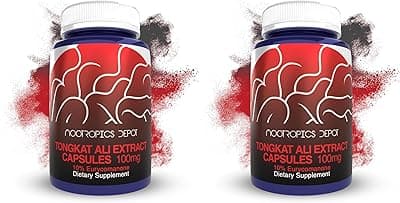
Tongkat Ali.
May modestly support healthy testosterone levels. Aims to gently support healthy testosterone levels, which can help with libido, energy, and stress.
Reviewed March 2026
- Category
- Herb
- Also filed under
- May support healthy testosterone levelsMay improve libidoMay reduce stress
What Tongkat Ali is, and what it does.
- Does it work
- Maybe. It's not a steroid. Think of it as a potential tune-up, not an engine swap. Some human studies show modest benefits.
- How much to take
- 200-400 mg of a standardized extract daily. Consistency is more important than timing.
- Time to feel it
- Most trials run four to eight weeks before anything registers. Hormone and cortisol readings shift on a lab report before drive or mood does.
- The first dose
- Nothing. This isn't pre-workout. It needs weeks to build up and show any effect.
- With regular use
- After 4-8 weeks, some people report feeling more resilient to stress, with a modest bump in libido and general vitality.
- How well tolerated
- Generally well tolerated for healthy people. The main watch-outs are for those with existing hormone conditions or on certain medications.
- How it feels
- A slow burn. You won't feel a 'kick'. It's more about a gradual improvement that you might only notice in hindsight.
- The overlooked benefit
- The stress side is the better documented one. Several small trials report lower cortisol readings alongside the hormone numbers people buy it for.
200 to 400mg a day is where Tongkat Ali works.
Source: Leisegang 2022 systematic review + Talbott 2013
The proof, claim by claim.
These words describe the research, not the molecule's worth. Research strength is how much work stands behind one claim, and it is never a product score.
Research is promising but not conclusive. Some studies show benefits for testosterone and libido, while others show minimal effects. More large-scale, well-controlled trials are needed.
- support for testosterone already in the normal rangeRandomised trial
- everyday stress and cortisol readingsRandomised trial
- libido and male sexual wellbeingRandomised trial
- muscle strength during resistance trainingRandomised trial
- sperm quality measures in menRandomised trial
Questions people ask about Tongkat Ali.
- Is this a steroid?
- No. It works with your body's systems, it doesn't replace them. The effect is much, much milder.
- Will it make me aggressive?
- Highly unlikely. The hormonal shift isn't dramatic enough to cause 'roid rage' or anything similar.
- Do I need to cycle it?
- Some people do, like 8 weeks on, 4 off. There's no hard evidence it's necessary, but it's a reasonable approach.
- Can women take it?
- Some do for energy and libido, but it's less studied. Best to talk with a doctor first due to its hormonal effects.
- Best time of day to take it?
- Doesn't really matter. Pick a time and stick with it every day. Morning is common.
- How do I know if it's working?
- It's subtle. Track your energy, mood, and libido over 2 months. You're looking for small, positive trends, not a big event.
Why these belong in the same formula. Each row says what the basis is, from settled biochemistry through to a trial that measured the pair.
Zinc is a required cofactor in the enzyme steps that produce testosterone and in normal sperm formation, so it underwrites the same hormonal machinery tongkat ali is taken to support. When zinc status runs low the body cannot sustain normal testosterone output, which is why the two are commonly formulated together.
Boron shifts how much testosterone circulates bound to sex hormone binding globulin, leaving a larger share in the free, active fraction. That works alongside tongkat ali, which is used to support free testosterone levels, so the two act on the same free hormone balance from different angles.
Ashwagandha helps moderate the cortisol response to everyday stress, and because a high cortisol load pulls against normal testosterone balance, pairing it with tongkat ali supports the hormonal and stress axes at the same time. This is a long-standing adaptogen and hormonal-support formulation pattern.
Magnesium lowers the affinity of sex hormone binding globulin for testosterone, leaving more of it unbound. Tongkat ali acts higher up on the release side, so the two work at different points of the same axis.
Vitamin D receptors are present in Leydig cells and support normal steroidogenic enzyme expression. This complements tongkat ali quassinoids acting on the release side of the same pathway.
Fenugreek saponins are reported to act on aromatase and 5-alpha reductase handling while tongkat ali acts on free testosterone availability. The two occupy different steps of the same normal pathway.
Maca supports normal libido without altering circulating androgen levels, so it adds a separate mechanism alongside tongkat ali.
Icariin has weak phosphodiesterase-5 inhibitory activity, which keeps cyclic GMP signalling running in vascular smooth muscle. That is a different lever from the androgen availability route tongkat ali works on.
Citrulline raises plasma arginine and supplies the substrate for endothelial nitric oxide synthase, supporting normal blood flow. Tongkat ali contributes nothing to that substrate pool, so the two do not overlap.
Rhodiola moderates the stress response that suppresses gonadal signalling, while tongkat ali acts on androgen availability. The pairing addresses the upstream and downstream ends of the same axis.
DHEA supplies the upstream precursor for androgen synthesis, and tongkat ali works on how much of the resulting testosterone circulates unbound. Together they cover supply and availability.
Panax ginseng root standardised to ginsenosides is a frequent partner for Eurycoma longifolia in Southeast Asian tonic formulations and in modern male vitality products. The two are botanically unrelated and their marker compounds differ entirely. The pairing is convention plus overlapping intended use, not a measured combination.
Cordyceps militaris and Cordyceps sinensis preparations appear alongside tongkat ali in energy and performance blends. Their constituents, chiefly cordycepin and polysaccharides, share no pathway with quassinoids. Co-formulation is the only established link.
Eleutherococcus senticosus root is combined with tongkat ali in blends aimed at fatigue and training tolerance. Its eleutherosides are unrelated to eurycomanone chemistry. Nothing has measured the two together.
Schisandra chinensis berry, standardised to schisandrins, is a traditional tonic partner in multi-herb formulas that also carry tongkat ali. Schisandra lignans are known inducers of certain hepatic enzymes, which matters when several botanicals are taken together. Read this as a formulation and metabolism consideration rather than a benefit.
Arginine is the substrate that nitric oxide synthase converts to nitric oxide and citrulline, supporting normal vascular tone. It is combined with tongkat ali in products aimed at circulation and performance. The arginine mechanism is settled. The combination itself has not been measured.
Creatine monohydrate buffers ATP resynthesis through the phosphocreatine system and has one of the deepest human literatures in sports nutrition. It appears with tongkat ali in training formulas. The two act on entirely different systems, so any benefit is additive by composition rather than by interaction.
Selenium is incorporated as selenocysteine into glutathione peroxidases and into selenoprotein P, and reproductive tissue is among the tissues with high selenoprotein expression. It is included in male-focused blends for that reason. The cofactor role is established. Nothing measures it in combination with this botanical.
Coenzyme Q10 shuttles electrons between complexes I and II and complex III in the mitochondrial respiratory chain and also acts as a lipid-phase antioxidant. It appears in energy-positioned blends alongside tongkat ali. The pairing is compositional.
Pyridoxal 5-phosphate is the cofactor for transaminases and for the decarboxylases that make dopamine, and dopaminergic tone is part of normal hormonal axis regulation. B6 is a standard inclusion in male vitality formulas. This is enzymology, not an outcome claim.
A single published case report describes an atrial rhythm disturbance considered probably related to a tongkat ali product. A case report cannot establish causation and describes one person. Stacking additional stimulant load on top of a botanical implicated in such a report is a caution worth stating plainly rather than a measured interaction.
Anhydrous caffeine is the standard stimulant in pre-workout blends that also carry tongkat ali. Total stimulant exposure is what matters when several sources appear in one serving. Given the single published cardiac case report involving this botanical, cumulative stimulant load deserves explicit disclosure on a label.
One case report describes liver injury attributed to a tongkat ali product, and product adulteration cannot be excluded in such reports. Silymarin is frequently co-formulated in botanical stacks for hepatic support, but no measurement shows it changes anything about this pairing. Nothing here suggests one ingredient offsets a risk from the other.
Tyrosine is the precursor for dopamine and noradrenaline via tyrosine hydroxylase, and dopaminergic signalling participates in hypothalamic control of the gonadal axis. Tyrosine is combined with tongkat ali in drive and focus positioned products. Precursor supply is not the same as a hormonal effect.
Ascorbate is concentrated in adrenal tissue and serves as a cofactor for dopamine beta-hydroxylase in catecholamine synthesis. It is a common inclusion in stress and vitality formulations carrying tongkat ali. The cofactor role is textbook. The combination is unmeasured.
Ginger rhizome appears with Eurycoma longifolia root in traditional decoctions and in modern blends built on that tradition. Their constituents are unrelated. This is documented custom rather than measured pharmacology.
Piperine inhibits several cytochrome P450 enzymes and UDP-glucuronosyltransferases, raising systemic exposure to co-administered compounds that those enzymes clear. Added to a botanical blend it can increase exposure to constituents that were dosed without it. That is a pharmacokinetic effect on everything in the capsule, wanted or not.
Talk to a doctor before taking Tongkat Ali if any of these apply to you: May interact with certain medications, Consult a doctor if you have pre-existing hormonal conditions, Not recommended for pregnant or breastfeeding women. These are flags to check first, not effects Tongkat Ali is known to cause.
Not medical advice. Show the label to your pharmacist.What Tongkat Ali actually does.
The root's main active compounds are quassinoids, mostly eurycomanone, alongside canthin-6-one alkaloids and eurypeptides. Eurycomanone is what commercial extracts get standardised to, and because it pulls into water, hot water extraction is the usual commercial route.
Quassinoids are degraded triterpenes and they taste markedly bitter. That bitterness is a chemical property of the whole class, which is why unmasked root extracts are hard to formulate into an unflavoured drink.
The hormone axis running from hypothalamus to pituitary to gonads works on negative feedback. Gonadal steroids signal back to the hypothalamus and pituitary, so anything you put into that loop gets regulated rather than simply added on top.
A label like 100:1 or 200:1 only states how much starting root went into each unit of finished extract, and on its own it says nothing about eurycomanone content. A stated marker percentage is the specification that actually describes the material.
Where Tongkat Ali comes from.
The root of a Southeast Asian tree is dug up, cleaned, dried and simmered to pull the active compounds into water. That liquid is boiled down and dried into a powder that goes into capsules. How old the root was and how the extract was made change what ends up in the capsule.
Made from a plant. What ends up in the capsule tracks the harvest, so batch testing and a stated marker matter more here than with a made molecule.
The taproot of a slow-growing understorey tree native to Malaysia, Indonesia, Thailand and Vietnam. Root age is a major driver of constituent content, and wild harvest pressure has made cultivated and managed sources more common.
Harvested roots are washed free of soil, chipped or sliced and dried down to a stable moisture level before storage or extraction.
Milled root is extracted, most commonly with hot water because the quassinoids are water soluble. Ethanol and water mixtures are used where a broader constituent profile is wanted.
The extract liquor is filtered to remove plant solids, then concentrated under reduced pressure before drying.
The concentrate is spray dried, often onto a carrier such as maltodextrin, and released against a chromatographic assay for eurycomanone. Identity is confirmed botanically and heavy metals are tested because root material accumulates soil contaminants.
The dried extract powder is blended with excipients and filled into capsules or compressed into tablets.
Whether root material was wild harvested or cultivated, the root age, and the measured eurycomanone percentage behind an extract ratio claim are commonly left off a label. Adulteration of this category with undeclared pharmaceutical compounds has been reported in the marketed-product literature.
The forms it comes in.
The essence, in one line each.
- Pooling five randomized trials, Eurycoma longifolia supplementation raised total testosterone in men, a standardized mean difference of 1.35 (95% CI 0.57 to 2.14).Systematic review and meta-analysis. Leisegang et al., 2022 (Medicina). PMID 36013514 ↗
- Over four weeks in moderately stressed adults, tongkat ali root extract lowered salivary cortisol by about 16% and eased tension, anger and confusion mood scores.Randomised trial. Talbott et al., 2013 (Journal of the International Society of Sports Nutrition). PMID 23705671 ↗
- Over 12 weeks in healthy men aged 40 to 65, a combination of a standardized Eurycoma longifolia extract (Physta) with Polygonum minus improved sexual performance and erection hardness scores compared with placebo.Randomised trial. Udani et al., 2014 (Evidence-Based Complementary and Alternative Medicine). PMID 24550993 ↗
- In 138 women aged 40 to 55, 100 mg of a standardised Eurycoma longifolia water extract for 12 weeks lowered total MENQOL symptom scores by 33.9% from their own baseline, with physical and sexual domain scores improving and reproductive hormone levels unchanged.Randomised trial. Muniandy et al., 2025 (World Journal of Clinical Cases). PMID 41283187 ↗
- In 45 men averaging 47 years with low androgen levels, 200 mg of Eurycoma longifolia daily for six months raised total testosterone and self-reported erectile function scores, with the clearest change when it was paired with concurrent training.Randomised trial. Leitão et al., 2021 (Maturitas). PMID 33541567 ↗
- A randomised, placebo-controlled evaluation of a standardised Eurycoma longifolia water extract (Physta) measuring self-reported well-being outcomes in perimenopausal and postmenopausal women.Randomised trial. Muniandy et al., 2023 (BMJ Open). PMID 37914304 ↗
- Supplementation was associated with more consolidated sleep and wake bouts in wild-type animals, with the effect not detected in the mutant line tested, which the authors read as pointing to a specific signalling requirement.Animal study. Sakai et al., 2024 (Sleep Advances). PMID 39055967 ↗
- A single patient developed atrial flutter judged probably related to a tongkat ali product. A case report describes one person and cannot establish causation.Case report. Ali et al., 2025 (Cureus). PMID 41080360 ↗
- A single case of liver injury was attributed to a tongkat ali product. The report is one person, product content was not independently characterised, and causation cannot be established from it.Case report. Kaliounji et al., 2024 (Cureus). PMID 38646387 ↗
- An analysis of widely marketed online male sexual health supplements found tongkat ali among the commonly used ingredients, with the authors noting that supporting human data for most listed ingredients is limited and that ingredient disclosure is inconsistent.Narrative review. Balasubramanian et al., 2019 (The Journal of Sexual Medicine). PMID 31036522 ↗
These are the studies our verdict leans on, chosen from the 305 we read for Tongkat Ali. The full linked list is below.
The studies, linked.
1 source behind our Tongkat Ali verdict: peer-reviewed studies and registered clinical trials. Every one links straight to PubMed, the journal, or ClinicalTrials.gov. Read them yourself.
- Clinical trialA Phase II, Randomized, Double Blind, Placebo-Controlled, Three-arm, Multi-center Clinical Trial to Investigate the Efficacy and Safety of Tongkat Ali Maca Plus for the Improvement of Sexual Well-being and Quality of Life in MenClinicalTrials.gov ↗197 participants, Completed
Evidence surfaced via Semantic Scholar (Allen Institute for AI) and ClinicalTrials.gov. Ranked by study type and citation weight, not cherry-picked.
Problems people have reported.
Read this carefully. These are 34 voluntary, unverified reactions reported to the FDA (openFDA). The number mostly reflects how popular Tongkat Ali is, not how risky it is. A report is not proof Tongkat Ali caused anything. It is a signal of what to watch for, nothing more.
Source: openFDA adverse-event reports. Voluntary reporting, not an incidence rate.
FDA Disclaimer: These statements have not been evaluated by the Food and Drug Administration. This information is for educational purposes only and is not intended to diagnose, treat, cure, or prevent any disease. Consult your healthcare provider before starting any supplement regimen.