3-Phenyllactic Acid.
An acid that lactic bacteria make from phenylalanine. In food it holds back moulds and spoilage yeasts, and in a person it reads as a signal of what the gut microbes are doing.
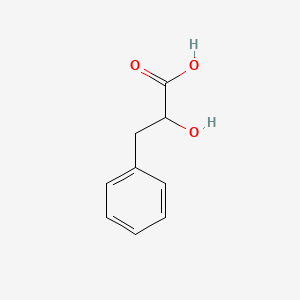 Compound
- Category
- Compound
What 3-Phenyllactic Acid is, and what it does.
- Does it work
- Interesting if you follow fermentation or gut microbe markers. No human supplement trial sits behind it, so it stands as food chemistry with a microbial readout.
- How much to take
- No dose figure is on record for people. Sourdough, yoghurt and honey supply it in small amounts alongside everything else fermentation puts there.
- Time to feel it
- Nobody has measured a time course in people. In food its antifungal effect tracks acidity rather than any clock you would follow.
- The first dose
- Day one shows up in the food rather than in you. It is one of the acids keeping a fermented product from spoiling on the shelf.
- With regular use
- Across weeks its level in a stool or urine sample tracks how your bacteria handle aromatic amino acids. That is a marker, not an outcome.
- How well tolerated
- It is eaten routinely in fermented foods with no signal of a problem at those amounts. Isolated supplemental use has not been studied, so speak to a doctor first.
- How it feels
- There is no described sensation. It registers in a laboratory measure of microbial metabolism, and in how long a loaf stays free of mould.
- The overlooked benefit
- It is only undissociated at low pH, which is why the antifungal effect belongs to sour foods. Raise the pH and the same amount does much less.
The proof, claim by claim.
What these words mean
These words describe the research, not the molecule's worth. Research strength is how much work stands behind one claim, and it is never a product score.
- Antifungal activity against food spoilage moulds and yeastsIn vitro study
- Production by lactic acid bacteria from phenylalanineIn vitro study
1 more claim
- Biomarker of microbial aromatic amino acid metabolismNarrative review
Why these belong in the same formula, 6 pairings
Why these belong in the same formula. Each row says what the basis is, from settled biochemistry through to a trial that measured the pair.
Lactic acid bacteria and bifidobacteria transaminate phenylalanine to phenylpyruvate, then reduce it to 3-phenyllactic acid. Substrate availability is the main limit on how much of the acid a culture makes, which is why fermentation media are often phenylalanine-supplemented. In the gut, dietary and endogenous phenylalanine reaching the colon is the source. The pathway runs in the bacteria, not in human tissue.
Bifidobacterium longum subsp. infantis is one of the better characterised producers of aromatic lactic acids including the phenyl form, and its output is tied to how it handles aromatic amino acids. This makes the compound a marker of a particular microbial activity rather than something usually swallowed on its own. Pairing the organism with substrate is the practical route to raising it.
Lactobacillus plantarum produces 3-phenyllactic acid during fermentation, and much of the antifungal activity attributed to its culture supernatants tracks with this and related acids. It is one reason fermented foods carry the compound. The activity is documented in food and culture systems rather than in people.
Across mixed cultures, aromatic lactic acid output depends on which species are present and on aromatic amino acid supply. A general probiotic blend may raise or may not raise this specific metabolite, since the capacity is strain-dependent. Anyone targeting it should look at strain-level data rather than assume it from a genus name.
Adding a fermentable fibre changes which organisms dominate colonic fermentation and how much protein and amino acid fermentation happens. That can shift aromatic metabolite output in either direction. The link to this specific compound is inferred from pathway logic, and it has not been measured directly in humans.
Protein intake determines how much phenylalanine is available, including the fraction that escapes small intestinal absorption and reaches colonic bacteria. More undigested protein reaching the colon means more aromatic amino acid fermentation. This is a plausible upstream lever, not a demonstrated way to move the metabolite in people.
Nothing specific on file for 3-Phenyllactic Acid. Match the label to the daily amount above, and tell your doctor what you take.
Not medical advice. Show the label to your pharmacist.What 3-Phenyllactic Acid actually does.
3-Phenyllactic acid is made by lactic acid bacteria and bifidobacteria from an amino acid, and human tissue doesn't make meaningful amounts of it on its own.
3 more mechanisms
It shows up naturally in fermented foods, honey and sourdough, with the amount depending on which microbes did the fermenting and what raw materials were available.
As a weak acid, it stays in its uncharged form at low pH, which is why its antifungal effect in food depends on how acidic the environment is.
In food microbiology, this is one of the compounds behind the antifungal effect of lactic acid bacteria against molds and spoilage yeasts.
Where 3-Phenyllactic Acid comes from.
Bacteria make it. Give a lactic culture the amino acid phenylalanine and it converts it in two steps into this acid, which is why the compound turns up in sourdough, yoghurt and honey. Chemists can also make it in a flask from a related molecule, though that version is a fifty-fifty mix of two mirror images.
What this route gives you
Produced by a cultured organism rather than harvested. The strain is selected and the conditions are controlled, so batches sit closer together than a field crop.
5 steps on record
Fermentation media are supplied with free phenylalanine or with protein hydrolysates that release it.
Lactic acid bacteria convert phenylalanine to phenylpyruvate and then reduce it to the lactic acid derivative.
Cells are removed and the acid is recovered from the cell-free broth by solvent extraction or resin capture.
The acid is concentrated and crystallised, with enantiomeric composition set by the producing strain.
Purity and enantiomeric ratio are confirmed by chromatography before release.
Getting 3-Phenyllactic Acid from food.
The whole-food sources on file. A supplement closes the gap, it does not replace dinner.
A gram-for-gram figure (how much of each you would eat to match a dose) will appear here once it is sourced and reviewed. This page will not print a number it cannot cite.
The forms it comes in.
3 more forms
The essence, in one line each.
- Aromatic lactic acid production by Bifidobacterium longum subsp. infantis was characterised, linking output to the organism's handling of aromatic amino acids.In vitro study. Plenge TG et al., 2026 (Applied and Environmental Microbiology). PMID 42089606 ↗
Chosen from the 3 we read for 3-Phenyllactic Acid.
FDA Disclaimer: These statements have not been evaluated by the Food and Drug Administration. This information is for educational purposes only and is not intended to diagnose, treat, cure, or prevent any disease. Consult your healthcare provider before starting any supplement regimen.