6,7-Dihydroxybergamottin.
It's the grapefruit compound behind the citrus warning on medicine labels. It shuts down a gut wall enzyme that would otherwise break compounds down before they reach your blood.
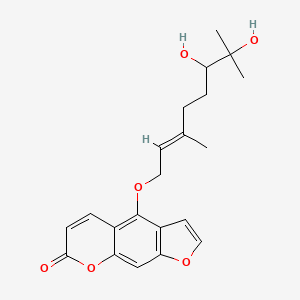 Compound
- Category
- Compound
What 6,7-Dihydroxybergamottin is, and what it does.
- Does it work
- It suits formulators studying how much of a compound survives the gut wall. Anyone taking prescription medicine should speak to a pharmacist before adding grapefruit-derived extracts.
- How much to take
- No dose figure is on record, and none should be guessed, because the amount directly changes how much of anything else you take reaches your blood.
- Time to feel it
- The enzyme block starts within about an hour of intake and takes roughly one to three days to fade, since the enzyme returns only as new protein is made.
- The first dose
- Nothing you would notice from the compound itself. What changes on day one is how much of everything taken with it gets through the gut wall.
- With regular use
- Taken daily it holds intestinal enzyme activity down, because recovery depends on making new enzyme. Nobody has measured long-term use of the isolated compound in people.
- How well tolerated
- The real caution here is interaction, not toxicity. It raises blood levels of many prescription medicines. Check with a pharmacist before combining it with anything.
- How it feels
- There's no sensation attached to it. Its effect shows up as a measured change in the blood level of whatever else you took alongside it.
- The overlooked benefit
- It also blocks uptake transporters, which pushes certain compounds the other way and lowers how much of them gets in. So it doesn't simply raise everything.
The proof, claim by claim.
What these words mean
These words describe the research, not the molecule's worth. Research strength is how much work stands behind one claim, and it is never a product score.
- Mechanism-based inhibition of intestinal CYP3A4In vitro study
- Oral exposure to CYP3A4 substrates after grapefruit intakeRandomised trial
2 more claims
- P-glycoprotein and OATP transporter inhibitionIn vitro study
- Furanocoumarin content across citrus cultivars and juice processingNarrative review
Why these belong in the same formula, 7 pairings
Why these belong in the same formula. Each row says what the basis is, from settled biochemistry through to a trial that measured the pair.
6,7-dihydroxybergamottin is a mechanism-based inhibitor of intestinal CYP3A4, the same enzyme quercetin inhibits at higher concentrations. Taken together they can raise the systemic exposure of anything that depends on gut-wall CYP3A4 for first-pass clearance. That is a plausible interaction to flag, not a benefit to seek. Anyone on prescription medicine should raise it with a pharmacist before combining citrus furanocoumarin material with concentrated flavonoid supplements.
Piperine is added to formulas specifically to slow gut-wall metabolism and raise the absorbed fraction of a co-ingredient. 6,7-dihydroxybergamottin does something similar through irreversible inactivation of CYP3A4. Stacking two absorption-modifying agents compounds an effect that is already hard to predict per person. The practical read is caution about medicine timing rather than an argument for combining them.
Curcumin is cleared fast at the gut wall and in the liver, which is why formulators bolt on absorption modifiers. Inhibiting intestinal CYP3A4 and efflux transport is one mechanistic route to a higher plasma curve. This is mechanism, not a demonstrated clinical pairing, and it also widens exposure to anything else in the stack. Read it as pharmacology rather than a dosing recommendation.
Hyperforin drives CYP3A4 expression upward through pregnane X receptor activation, so chronic use raises the clearance of many co-ingested compounds. Dihydroxybergamottin destroys existing enzyme molecules, lowering clearance until new protein is made. Combining them gives an unstable net effect that depends on timing and duration. This is one of the clearer reasons to keep citrus furanocoumarin exposure and enzyme-inducing botanicals apart.
CYP3A4 performs 23- and 24-hydroxylation steps that help clear vitamin D metabolites. Slowing that enzyme slows one arm of vitamin D disposal. The size of the shift in normal dietary exposure is small and has not been quantified in humans for this specific compound. It belongs on the page as mechanism, with no dosing implication attached.
Berberine absorption is limited mainly by efflux back into the gut lumen and by first-pass metabolism. Furanocoumarins that suppress both steps raise the absorbed fraction in principle. Nobody has measured that combination in people, so the claim stops at plausible mechanism. The same shift would apply to any other co-administered CYP3A4 substrate, which is the part worth noticing.
Silymarin shows CYP and glucuronidation inhibition in vitro, although human data at ordinary supplement doses look modest. Adding a mechanism-based CYP3A4 inactivator on top narrows the margin further. The interaction is theoretical at supplement-level intakes. It is listed so a formulator sees the overlap rather than assuming independence.
Nothing specific on file for 6,7-Dihydroxybergamottin. Match the label to the daily amount above, and tell your doctor what you take.
Not medical advice. Show the label to your pharmacist.What 6,7-Dihydroxybergamottin actually does.
It permanently switches off a batch of a gut enzyme, and your body has to build new enzyme to recover, which takes a day or two.
3 more mechanisms
The effect happens in the gut lining, so it matters for things you swallow, not things injected.
Two grapefruit products can carry very different amounts of this compound.
It blocks two different transport doors at once, and they do not both push exposure the same way.
Where 6,7-Dihydroxybergamottin comes from.
It comes from grapefruit, mostly the peel. It is the part of grapefruit responsible for the warning label on many medicines.
What this route gives you
Made from a plant. What ends up in the capsule tracks the harvest, so batch testing and a stated marker matter more here than with a made molecule.
5 steps on record
Highest concentrations sit in the peel and the albedo of Citrus paradisi, with lower amounts in juice sacs. Pomelo and sour orange also carry it.
Bergamottin carries a geranyloxy side chain. Enzymatic and hydrolytic modification of that chain yields the 6,7-dihydroxy derivative.
Methanol, ethanol or supercritical carbon dioxide pulls the furanocoumarin fraction out of dried peel.
Preparative HPLC separates 6,7-dihydroxybergamottin from bergamottin and the paradisin dimers, which co-elute closely.
Content is reported as a percentage of the extract. Without an assay figure the furanocoumarin load of a citrus ingredient is unknown.
Getting 6,7-Dihydroxybergamottin from food.
The whole-food sources on file. A supplement closes the gap, it does not replace dinner.
A gram-for-gram figure (how much of each you would eat to match a dose) will appear here once it is sourced and reviewed. This page will not print a number it cannot cite.
The forms it comes in.
2 more forms
FDA Disclaimer: These statements have not been evaluated by the Food and Drug Administration. This information is for educational purposes only and is not intended to diagnose, treat, cure, or prevent any disease. Consult your healthcare provider before starting any supplement regimen.