Adenosine triphosphate.
Taken by mouth it does not top up the inside of your cells. It acts outside the cell at purinergic receptors, where trials have looked at blood flow and training output.
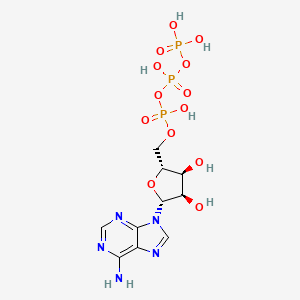 Compound
- Category
- Compound
What Adenosine triphosphate is, and what it does.
- Does it work
- Suits trained lifters after a stimulant-free angle on blood flow and training volume. Its effects sit in measured performance rather than in a felt hit.
- How much to take
- No dose figure is on record. The disodium salt in a coated form is what trials have used, taken once daily on an empty stomach before training.
- Time to feel it
- Blood flow measures shift within about an hour of a dose. Changes in training output in trials took roughly twelve weeks of daily use.
- The first dose
- Nothing obvious on day one. The first measurable change is blood flow through the working muscle, which shows on ultrasound rather than in how you feel.
- With regular use
- Twelve-week trials in trained lifters reported better maintained power and training volume. The trials are few, and several came from the same research group.
- How well tolerated
- Well tolerated in trials running three months of daily use, with mild gut upset the main complaint. Check with your clinician if you take anything affecting blood flow.
- How it feels
- Most people feel nothing specific. The reported difference is holding output across later sets, which you see in the training log more than in the body.
- The overlooked benefit
- Your body recycles its whole ATP pool many times a day, so no capsule adds to it. That is why the research angle is signalling outside the cell, not refuelling inside it.
The proof, claim by claim.
What these words mean
These words describe the research, not the molecule's worth. Research strength is how much work stands behind one claim, and it is never a product score.
- muscle blood flow during and after trainingRandomised trial
- strength and power maintenance across a training blockRandomised trial
3 more claims
- training volume toleranceRandomised trial
- extracellular purinergic signallingNarrative review
- cellular energy transfer from phosphate bond hydrolysisNarrative review
Why these belong in the same formula, 14 pairings
Why these belong in the same formula. Each row says what the basis is, from settled biochemistry through to a trial that measured the pair.
Free ATP is essentially not a substrate for most kinases and ATPases. Magnesium chelates the beta and gamma phosphates to form Mg-ATP, which is the form the enzyme actually binds and hydrolyses. This is one of the most settled relationships in biochemistry, and it is the reason magnesium status shows up in almost every discussion of cellular energy.
Phosphocreatine donates its phosphate to ADP through creatine kinase, regenerating ATP faster than any other route in the first seconds of intense effort. Loading creatine raises the phosphocreatine pool and so raises the size of that buffer. Supplemental ATP itself does not reach the muscle cytosol, so creatine is the practical way to influence the same pool.
ATP is adenine plus ribose plus three phosphates. De novo adenine nucleotide synthesis runs through phosphoribosyl pyrophosphate, which is built from ribose-5-phosphate, and that step is slow. Supplying ribose bypasses part of the rate limit on rebuilding a depleted nucleotide pool. Whether that translates into anything a person notices is a separate question and the human data is thin.
Ubiquinone shuttles electrons from complexes I and II to complex III, and that electron flow is what builds the proton gradient ATP synthase uses. Without adequate CoQ10 the gradient collapses and oxidative phosphorylation stalls. The relationship is upstream: CoQ10 supports the machinery that makes ATP rather than adding ATP directly.
Glycolysis and the TCA cycle capture energy as NADH, which complex I oxidises to start the electron flow that ends in ATP synthesis. The NAD pool has to be continuously regenerated or the whole chain backs up. This is why NAD precursors get discussed alongside cellular energy, though the link to any felt effect is not established.
Riboflavin becomes FAD and FMN, which sit inside complex I and complex II of the electron transport chain. Low riboflavin status impairs electron entry at both points. It is a cofactor relationship, so more riboflavin above sufficiency does not push output higher.
Pyruvate cannot enter the TCA cycle without pyruvate dehydrogenase, and that complex needs thiamine pyrophosphate. Deficiency shunts pyruvate to lactate and cuts off the main aerobic ATP route. Alpha-ketoglutarate dehydrogenase inside the cycle needs it too.
Lipoic acid is built into both of the big mitochondrial dehydrogenase complexes as lipoamide, where it carries the acyl group between subunits. Supplemental lipoic acid is not what supplies that bound cofactor, which the body synthesises, so the practical link to ATP output is weaker than the biochemistry suggests.
Long-chain fatty acids cannot cross into the mitochondrial matrix on their own. Carnitine palmitoyltransferase attaches them to carnitine for transport, and inside they are beta-oxidised to acetyl-CoA feeding ATP production. The step is obligatory, which is why primary carnitine deficiency presents as an energy-metabolism disorder.
Extracellular ATP is rapidly dephosphorylated to adenosine, which signals at A1 and A2A receptors and contributes to the sensation of fatigue. Caffeine blocks those receptors. Anyone reasoning about ATP as a signalling molecule rather than an energy currency should note the two act in opposite directions at that receptor.
ATP synthase condenses ADP with inorganic phosphate, so phosphate availability sets a hard ceiling on how fast ATP can be regenerated. Severe phosphate depletion produces measurable muscle weakness for exactly this reason. In people eating normally, phosphate is not the limiting factor.
Rapid glycolytic ATP turnover releases protons faster than the cell can buffer them, and the falling pH inhibits phosphofructokinase, which slows ATP regeneration further. Bicarbonate raises extracellular buffering and helps export those protons. It does not add ATP, it delays the point where acidosis limits it.
Beta-alanine is rate-limiting for carnosine synthesis, and carnosine buffers protons inside the muscle fibre where they are generated. That extends the window over which glycolysis can regenerate ATP at a high rate. The mechanism is buffering, not energy supply.
Alkaline phosphatase and related ecto-enzymes that hydrolyse extracellular ATP to ADP, AMP and adenosine are zinc metalloenzymes. Zinc status therefore affects how quickly an extracellular ATP signal is terminated. This is relevant to ATP as a signalling molecule and says nothing about intracellular energy stores.
Nothing specific on file for Adenosine triphosphate. Match the label to the daily amount above, and tell your doctor what you take.
Not medical advice. Show the label to your pharmacist.What Adenosine triphosphate actually does.
ATP is the cell's go-to energy currency. Breaking off its last phosphate releases energy that powers muscle contraction, moving things across cell membranes, and building new molecules.
3 more mechanisms
The body's total ATP supply at any moment is small but gets rebuilt from ADP many times a day rather than stored, so the pool size doesn't tell you much about capacity.
ATP taken by mouth gets broken down in the gut and blood before it reaches tissue. It doesn't enter cells intact or add to the internal supply, so any effect would have to come from outside-the-cell signaling or from providing raw materials, not direct delivery.
Three systems rebuild ATP on different timescales, from seconds to minutes to ongoing, and they overlap rather than switching on and off cleanly.
Where Adenosine triphosphate comes from.
It is grown, not mined. Yeast or engineered bacteria are fed sugar and build the molecule, then it gets pulled out of the cells and cleaned up by charge, because ATP, ADP and AMP differ only in how many phosphates they carry. What you buy is the sodium salt, because the pure acid is too unstable to bottle.
What this route gives you
Built by fermentation, the same way vitamin B12 and many amino acids are made at scale. Controlled conditions, consistent output.
6 steps on record
Commercial ATP has historically been extracted from yeast, which carries a high adenine nucleotide load, or produced by microbial fermentation from glucose.
Adenosine or AMP is phosphorylated enzymatically to the triphosphate, or an engineered organism accumulates the nucleotide directly.
Biomass is lysed and the nucleotide fraction separated from protein and cell debris.
ATP is separated from ADP, AMP and adenosine by charge, since the three differ in phosphate count. Incomplete separation is the main purity issue in this material.
Content is confirmed by HPLC against a reference standard, with ADP and AMP reported as the relevant related substances.
Neutralised to the disodium salt, dried and packaged with moisture protection.
Getting Adenosine triphosphate from food.
The whole-food sources on file. A supplement closes the gap, it does not replace dinner.
A gram-for-gram figure (how much of each you would eat to match a dose) will appear here once it is sourced and reviewed. This page will not print a number it cannot cite.
The forms it comes in.
3 more forms
The essence, in one line each.
- A review of succinic acid for exercise performance and recovery discusses its position as a TCA cycle intermediate feeding mitochondrial ATP production, while noting the human performance evidence remains limited.Systematic review. Jedrejko et al., 2026 (Nutrients). PMID 41830040 ↗
Chosen from the 6 we read for Adenosine triphosphate.
The studies, linked.
8 sources behind our Adenosine triphosphate verdict, every one linked to PubMed, the journal or ClinicalTrials.gov.
- Clinical trialA Functional Magnetic Resonance Imaging Study to Investigate ATP-sensitive Cough Neural Pathways in Patients With Chronic Cough HypersensitivityClinicalTrials.gov ↗58 participants, Completed
7 more linked trials
- Clinical trialFreeman-Sheldon Syndrome Quality of Life Study (FSS-QLS): Cross-sectional Study of Concomitant Disorder-Specific Contributors to Quality of Life and Clinical OutcomeClinicalTrials.gov ↗6 participants, Terminated
- Clinical trialA Phase I Study And Pharmacokinetics Of Adenosine 5'- Triphosphate (ATP) When Administered By Intravenous Infusion On A Multiple Weekly Dose Schedule To Patients With Advanced Malignancies (Solid Tumors)ClinicalTrials.gov ↗Phase 1, Completed
- Clinical trialAdenosine Triphosphate and Capsaicin Cough Provocation Test for Identifing Patients With Chronic Cough Who Have Differential Responses to Purinergic Receptor Antagonists: a Randomized, Cross-over, Single-blind TrialClinicalTrials.gov ↗200 participants, Unknown
- Clinical trialHuman Leucocytic Antigen Typing and Mutation of Adenosine Triphosphate Sensitive Potassium Channel Gene in Diabetic Patients Diagnosed Under the Age of One Year.ClinicalTrials.gov ↗100 participants, Unknown
- Clinical trialA Preliminary Clinical Study on the Rapid Antidepressant Effects of Adenosine Triphosphate (ATP) and Phosphocreatine Combinated With FluoxetineClinicalTrials.gov ↗Phase 2, 42 participants, Unknown
- Clinical trialAdjuvant Chemotherapy Based on the Adenosine Triphosphate Tumor ChemosensitivityClinicalTrials.gov ↗Phase 2, Withdrawn
- Clinical trialFreeman-Sheldon Syndrome Evaluation and Diagnosis in Clinical Settings (FSS-EDICT) I: a Case-Control, Cross-Sectional Study of Baseline and Stress Physiology ParametersClinicalTrials.gov ↗Withdrawn
From clinical trials and PubMed, ranked by study type and citation weight, not cherry-picked.
Problems people have reported.
Read this carefully. These are 1,134 voluntary, unverified reactions reported to the FDA (openFDA). The number mostly reflects how popular Adenosine triphosphate is, not how risky it is. A report is not proof Adenosine triphosphate caused anything. It is a signal of what to watch for, nothing more.
3 more reported effects
Source: openFDA adverse-event reports. Voluntary reporting, not an incidence rate.
Adenosine triphosphate under a brand name
Companies sell adenosine triphosphate under their own names. Each one below says what it is, who makes it and which verified products carry it.
FDA Disclaimer: These statements have not been evaluated by the Food and Drug Administration. This information is for educational purposes only and is not intended to diagnose, treat, cure, or prevent any disease. Consult your healthcare provider before starting any supplement regimen.