beta-zeacarotene.
It's a minor yellow pigment from corn that your body can convert into a little vitamin A, and it quenches reactive oxygen in fatty tissue while it's there.
 Compound
- Category
- Compound
What beta-zeacarotene is, and what it does.
- Does it work
- It suits people eating yellow maize or taking a mixed carotenoid oil, where it adds to the total provitamin A. It turns up inside a blend rather than on its own.
- How much to take
- No daily amount is on record for beta-zeacarotene by itself. It arrives as part of the carotenoid mix in yellow maize or a mixed carotenoid oil, taken with some fat.
- Time to feel it
- There's no felt onset. Carotenoids accumulate in blood and fatty tissue over weeks, which is where a lab panel would pick them up.
- The first dose
- Day one is quiet. It joins the carotenoid pool travelling on your lipoproteins, and the change is in blood chemistry rather than in sensation.
- With regular use
- Weeks of daily intake with fat raise circulating carotenoids and add a small amount of vitamin A activity, which your body dials back once retinoid stores are full.
- How well tolerated
- Well tolerated at food-level intakes, and conversion slows when vitamin A stores are adequate. Very high carotenoid intakes can tint the skin yellow-orange, which fades.
- How it feels
- There's no sensation attached to it. It's a pigment doing quiet chemistry in your fat-soluble compartments, showing up on a carotenoid panel rather than in mood or energy.
- The overlooked benefit
- Because the cleaving enzyme is feedback regulated by vitamin A status, provitamin A carotenoids don't pile up as preformed vitamin A the way retinyl esters can.
The proof, claim by claim.
What these words mean
These words describe the research, not the molecule's worth. Research strength is how much work stands behind one claim, and it is never a product score.
- provitamin A activity via central cleavage to retinalIn vitro study
- singlet oxygen quenching in lipid membranesIn vitro study
2 more claims
- contribution to total provitamin A carotenoids in yellow maizeNarrative review
- fat-dependent absorption through mixed micelles and chylomicronsNarrative review
Why these belong in the same formula, 8 pairings
Why these belong in the same formula. Each row says what the basis is, from settled biochemistry through to a trial that measured the pair.
Beta-zeacarotene is a hydrocarbon carotene with essentially no water solubility. Without fat in the same meal it stays trapped in the food matrix and passes through. Long-chain fats do this job more effectively than medium-chain ones because they drive chylomicron assembly, so MCT alone is a partial vehicle rather than an optimal one. Any fat source in the meal serves the same purpose.
Lecithin emulsifies carotene into fine droplets and contributes phospholipid to the mixed micelle that carries it to the enterocyte. This is why carotenoid beadlets and emulsions routinely include a phospholipid or a surfactant. The effect is on how much reaches the gut wall, not on what the molecule does afterwards.
Beta-zeacarotene and beta-carotene are structurally close and share the micelle-to-SR-B1 route into the enterocyte. Loading one at supplemental doses lowers the fraction of the other that gets across. The same competition is documented between other carotenoid pairs. Practically this matters at isolated high doses, far less at food-level intakes from maize.
Lutein is more polar than beta-zeacarotene and sits at the micelle surface, but both still queue for the same limited uptake capacity. Co-dosing at supplement strengths reduces the appearance of each in plasma relative to dosing alone. Separating them across meals sidesteps the issue.
Sterols crowd carotenoids out of the micelle, and lower plasma carotenoid concentrations are a well-documented consequence of regular sterol or stanol intake. Beta-zeacarotene follows the same physics as the carotenoids that have been measured. Taking the carotenoid source at a meal without added sterols avoids the clash.
An eleven double-bond polyene is exactly the kind of structure that oxidises fast in air and light. Tocopherol is the standard stabiliser used to keep carotenoid preparations intact through shelf life. In the body both partition into lipoproteins, where tocopherol chain-breaking limits carotenoid degradation. This is formulation and lipid-phase chemistry, not a claimed effect in a person.
Beta-zeacarotene carries one unsubstituted beta-ionone ring, so BCO1 cleavage can yield retinal, though at lower efficiency than the two-ring beta-carotene. Converting and moving that retinoid onward relies on zinc-dependent dehydrogenases and on hepatic retinol-binding protein, whose synthesis falls with low zinc status. Poor zinc status therefore blunts what a provitamin A carotenoid can contribute. This is settled nutritional biochemistry.
The ascorbate to tocopherol recycling step is well described, and carotenoid radicals sit in the same lipid compartment. Direct measurement of ascorbate regenerating a carotene radical cation is mostly in vitro work. Read the pairing as chemically plausible rather than demonstrated in people.
Nothing specific on file for beta-zeacarotene. Match the label to the daily amount above, and tell your doctor what you take.
Not medical advice. Show the label to your pharmacist.What beta-zeacarotene actually does.
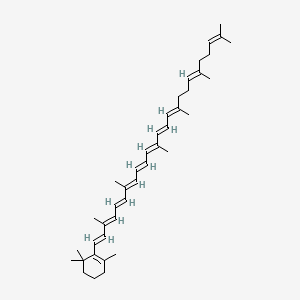
Beta-zeacarotene has one intact ring on one end and a modified ring on the other. That single working ring is what lets an enzyme split it to release one vitamin A molecule, so it gives you roughly half the vitamin A potential of beta-carotene per molecule, before you even account for how well it's absorbed.
3 more mechanisms
It's absorbed the standard way fat-soluble compounds are: released from food, mixed into bile-salt droplets, taken up by gut cells, packaged for transport, then carried in the blood. Every step depends on fat, which is why cooking corn with oil increases how much of these pigments you actually absorb.
Its chain of connected double bonds makes it good at soaking up a reactive form of oxygen in fatty environments, and that same structure also makes it break down easily with oxygen, light or processing.
The enzyme that converts this pigment to vitamin A is dialed back when your vitamin A stores are already adequate, which is why these plant pigments don't build up as stored vitamin A the way animal-derived vitamin A does.
Where beta-zeacarotene comes from.
One of the lesser yellow pigments in corn. It is a cousin of beta-carotene, the body can turn some of it into vitamin A, and you will almost never see it on a label by itself.
What this route gives you
Made from a plant. What ends up in the capsule tracks the harvest, so batch testing and a stated marker matter more here than with a made molecule.
4 steps on record
Formed in plastids by the plant carotenoid pathway. It sits on the branch running from phytoene through zeta-carotene and neurosporene, and it accumulates as a minor product rather than an endpoint.
Partial desaturation followed by cyclisation of one end group gives the single beta-ionone ring that defines the molecule.
Where a concentrate is made at all, it is pulled as part of a total carotenoid fraction rather than separated on its own.
Most intake is from food. Supplement exposure comes inside mixed carotenoid preparations.
Getting beta-zeacarotene from food.
The whole-food sources on file. A supplement closes the gap, it does not replace dinner.
A gram-for-gram figure (how much of each you would eat to match a dose) will appear here once it is sourced and reviewed. This page will not print a number it cannot cite.
The forms it comes in.
2 more forms
FDA Disclaimer: These statements have not been evaluated by the Food and Drug Administration. This information is for educational purposes only and is not intended to diagnose, treat, cure, or prevent any disease. Consult your healthcare provider before starting any supplement regimen.