Docusate Sodium.
A surfactant that lets water and fat mix into stool so it stays soft. It doesn't make the bowel move. It changes the texture of what's already there.
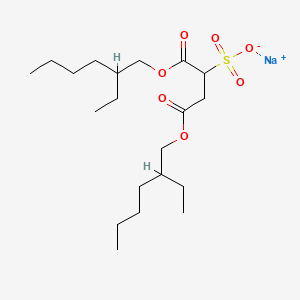 Compound
- Category
- Compound
What Docusate Sodium is, and what it does.
- Does it work
- It suits people who want a softening approach rather than a stimulant one. It only does its job alongside genuinely good fluid intake.
- How much to take
- No dose figure is on record here. Drinking enough water with it matters as much as the amount, because the softening depends on water getting in.
- Time to feel it
- Where it works, softening usually shows across one to three days rather than within hours.
- The first dose
- Day one is often uneventful. It acts on stool already forming, so any change turns up over the following days.
- With regular use
- Over weeks it's a maintenance softener. Several randomised trials failed to detect a difference from placebo on stool frequency and consistency.
- How well tolerated
- Well tolerated, with occasional cramping or a bitter taste. Don't pair it with mineral oil, since a surfactant increases absorption of what it is taken with.
- How it feels
- Nothing while you're taking it. The only read-out is what happens in the bathroom over the next day or two.
- The overlooked benefit
- Most docusate people swallow isn't a laxative at all. It's a wetting agent inside tablets helping them dissolve, at levels far below any bowel effect.
The proof, claim by claim.
What these words mean
These words describe the research, not the molecule's worth. Research strength is how much work stands behind one claim, and it is never a product score.
- stool softening by lowering surface tension at the stool and water interfaceNarrative review
- stool frequency and consistency compared with placeboRandomised trial
2 more claims
- wetting agent and dissolution aid in tablet formulationNarrative review
- increased intestinal absorption of co-administered lipophilic compoundsNarrative review
Why these belong in the same formula, 7 pairings
Why these belong in the same formula. Each row says what the basis is, from settled biochemistry through to a trial that measured the pair.
Psyllium works by holding water in the stool mass through gel formation, while docusate works as a surfactant lowering surface tension so water and lipid mix into the stool. Two different physical routes to the same softening endpoint, which is why they get combined. Both depend entirely on adequate fluid intake to do anything. The 2025 paper is a narrative review, so it summarises rather than tests the combination.
As a surfactant, docusate lowers interfacial tension and can increase the apparent solubility of fat-soluble compounds sharing the gut lumen with it. Direction of the net effect depends on transit time, since faster transit reduces contact time even as solubilisation improves. Fat-soluble vitamins are the class where this matters. The interaction is mechanistic and dose-dependent rather than a measured outcome.
Retinol and the carotenoids are absorbed through micellar packaging, which a surfactant alters. Whether more or less is absorbed depends on how much transit time is shortened at the same time. Long-term regular use of any softening or stimulant laxative is the situation where fat-soluble vitamin status is worth watching. Occasional use is a different picture.
Mineral oil is intended to stay in the lumen and is not meant to be absorbed. Docusate as a surfactant increases its systemic uptake, which is the specific reason the combination is discouraged in standard references. This is one of the better-characterised docusate interactions. Read it as a caution, not a pairing.
Osmotic agents pull water into the lumen. Docusate helps that water incorporate into the stool mass rather than passing alongside it. The mechanisms are complementary rather than redundant. Combining them raises the total effect and the potential for fluid and electrolyte shift. Anyone using both regularly should be watching hydration.
Colonic secretion of potassium rises with stool output, so sustained laxative use is a route of potassium loss. This is a well-described consequence of chronic laxative use of any class. It is a reason to limit duration rather than a reason to add potassium alongside. Occasional use does not raise the same concern.
Pancreatic lipase acts at the oil and water interface, and its activity depends on how that interface is organised. An anionic surfactant changes interfacial properties, which can shift lipolysis in either direction depending on concentration. A 2020 sheep study reported changes in ruminal digestive enzyme activity with docusate, though ruminant digestion is a poor model for the human gut. Read the mechanism as plausible and the animal data as separate.
Nothing specific on file for Docusate Sodium. Match the label to the daily amount above, and tell your doctor what you take.
Not medical advice. Show the label to your pharmacist.What Docusate Sodium actually does.
Docusate sodium is a surfactant that lowers the surface tension where water meets stool, letting water and fat mix into the stool more easily.
3 more mechanisms
Its effect is purely physical rather than a drug action on nerves. It doesn't stimulate gut contractions the way stimulant laxatives such as senna do.
Because it works by pulling water into the stool, it does very little if you're not drinking enough fluid, which is the most common reason people find it doesn't seem to help.
As a surfactant, it can also increase how much of a fat-soluble compound taken at the same time gets absorbed, which is why combining it with mineral oil is specifically flagged as a caution.
Where Docusate Sodium comes from.
A synthetic detergent, chemically related to the surfactants in household products, made to pharmaceutical purity. It does not make the bowel move. It lets water mix into the stool, which is why it does nothing if you are not drinking enough. Several trials have failed to find it beating placebo, and a number of clinical guidelines have moved away from it as a first choice.
What this route gives you
Chemically synthesised. The molecule is identical to the one a plant or an animal makes, and building it deliberately means a known purity, a fixed dose and no crop contaminants. For several nutrients this is the only route that reaches a usable amount.
6 steps on record
Petrochemical starting materials. This is a wholly synthetic surfactant with no natural source.
Maleic anhydride is esterified with two equivalents of 2-ethylhexanol to give dioctyl maleate.
Sodium bisulfite adds across the double bond to give the sulfosuccinate, which is where the surfactant character comes from.
Neutralised to the sodium, calcium or potassium salt, then washed and dried. Residual 2-ethylhexanol and unreacted intermediates are the purity specifications that matter.
Assayed against USP or equivalent monograph specifications for content, residual solvents and heavy metals. It is a monographed pharmaceutical substance rather than a botanical extract.
Softgels are the dominant consumer format. The same material is used at much lower concentrations as a tablet excipient across many unrelated products.
The counter-ion is usually stated, but the sodium content per dose often is not spelled out, which matters for anyone limiting sodium.
The forms it comes in.
4 more forms
The essence, in one line each.
- Docusate affected feed intake, ruminal microbial populations and digestive enzyme activities in sheep.Animal study. Yu C et al., 2020 (Journal of Animal Physiology and Animal Nutrition). PMID 32383244 ↗
Chosen from the 2 we read for Docusate Sodium.
The studies, linked.
7 sources behind our Docusate Sodium verdict, every one linked to PubMed, the journal or ClinicalTrials.gov.
- Clinical trialDose-Adjusted EPOCH Chemotherapy and Rituximab (CD20+) in Adults and Children With Previously Untreated Patients With Aggressive Non-Hodgkin's LymphomaClinicalTrials.gov ↗Phase 2, 348 participants, Completed
6 more linked trials
- Clinical trialA Multi-center, Randomized, Single-blind Clinical Study of the Comparative Safety and Efficacy of Docusate Sodium and Sorbitol Rectal Solution and Glycerine Enemas in Patients With ConstipationClinicalTrials.gov ↗Phase 3, 300 participants, Completed
- Clinical trialEfficacy of One Dose of Laxative on Post-Operative Constipation Following Total Knee ArthroplastyClinicalTrials.gov ↗Phase 2, 154 participants, Completed
- Clinical trialTreatment of Non-Anemic Iron Deficiency in Pregnancy: a Double-Blind Randomized Control TrialClinicalTrials.gov ↗150 participants, Completed
- Clinical trialDouble-Blind Randomized Controlled Trial of MiraLAX Versus Placebo to Prevent Constipation Following Urogynecologic Surgery in Women Receiving Routine Docusate SodiumClinicalTrials.gov ↗131 participants, Completed
- Clinical trialEffect of Prunes on Gastrointestinal Function After Gynecological Surgery: A Randomized Controlled TrialClinicalTrials.gov ↗Phase 4, 77 participants, Terminated
- Clinical trialRandomized, Double-Blind, Placebo-Controlled Trial of Oral Docusate for Preventing/Treating Constipation in Palliative Care Patients.ClinicalTrials.gov ↗70 participants, Completed
From clinical trials and PubMed, ranked by study type and citation weight, not cherry-picked.
Problems people have reported.
Read this carefully. These are 167,907 voluntary, unverified reactions reported to the FDA (openFDA). The number mostly reflects how popular Docusate Sodium is, not how risky it is. A report is not proof Docusate Sodium caused anything. It is a signal of what to watch for, nothing more.
3 more reported effects
Source: openFDA adverse-event reports. Voluntary reporting, not an incidence rate.
FDA Disclaimer: These statements have not been evaluated by the Food and Drug Administration. This information is for educational purposes only and is not intended to diagnose, treat, cure, or prevent any disease. Consult your healthcare provider before starting any supplement regimen.