Flavin mononucleotide.
Vitamin B2 carrying a phosphate. Your cells use it as the flavin cofactor at the entry point of the respiratory chain, where food energy becomes usable cellular energy.
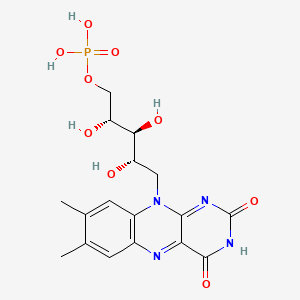 Compound
- Category
- Compound
What Flavin mononucleotide is, and what it does.
- Does it work
- Suits anyone whose diet runs thin on dairy, eggs and greens, and people eating plant-based. Also used where a water-soluble B2 is needed in a liquid or a drink mix.
- How much to take
- No daily amount is on record here. Riboflavin uptake saturates in the low tens of milligrams per dose, so a steady daily maintenance amount does more than one big one.
- Time to feel it
- Riboflavin status corrects within days of steady intake, but it reads on a blood level or an enzyme-activity measure rather than as a feeling.
- The first dose
- The visible thing on day one is bright yellow-green urine, which is simply what you didn't absorb. The cofactor work goes on quietly inside cells.
- With regular use
- Weeks of daily intake keep the flavin pool topped up for complex I and the enzymes that need it, including the one handling folate. That shows on a nutrient panel.
- How well tolerated
- Well tolerated, and what you don't use is excreted rather than stored. It also serves as a yellow food colour. Check with your doctor if pregnant or on medication.
- How it feels
- No sensation beyond the coloured urine. Where it shows is in riboflavin status and energy-metabolism markers, not in how any given afternoon goes.
- The overlooked benefit
- Vitamin B6 can't be activated without a flavin enzyme, and the folate pathway needs one too. Low B2 quietly drags on both, which makes it worth covering.
The proof, claim by claim.
What these words mean
These words describe the research, not the molecule's worth. Research strength is how much work stands behind one claim, and it is never a product score.
- Normal energy-yielding metabolismNarrative review
- Cofactor at complex I of the respiratory chainNarrative review
3 more claims
- Correction of low riboflavin status with oral intakeRandomised trial
- Activation of vitamin B6 and the folate pathway enzymesNarrative review
- Support for normal iron handlingRandomised trial
Why these belong in the same formula, 10 pairings
Why these belong in the same formula. Each row says what the basis is, from settled biochemistry through to a trial that measured the pair.
Riboflavin taken orally is dephosphorylated in the gut before absorption, then rephosphorylated inside cells by riboflavin kinase using ATP to give FMN. Supplemental FMN follows the same route: it is hydrolysed to riboflavin at the brush border and reassembled intracellularly. So the two are not additive in any meaningful sense, they are the same nutrient at different points in one pathway. This is textbook vitamin B2 biochemistry.
Pyridoxine 5'-phosphate oxidase is an FMN-dependent flavoprotein, and without adequate FMN the conversion of pyridoxine and pyridoxamine phosphates to pyridoxal 5'-phosphate is impaired. This is a direct dependency, not a general nutrient synergy. It explains why B6 status can look poor in someone whose riboflavin status is inadequate. Supplying P5P directly bypasses the step.
MTHFR uses FAD as its cofactor, and FAD is made from FMN by FAD synthase. Riboflavin status therefore influences MTHFR activity, an effect that is more pronounced in people carrying the thermolabile 677TT variant of the enzyme. The relationship is between the flavin cofactor and folate cycling, not between two interchangeable supplements. It is one of the clearer nutrient-genotype interactions in the one-carbon field.
Flavin-dependent reductases participate in releasing iron from ferritin and in mobilising stored iron, and low riboflavin status has been described as blunting the response to iron repletion. The effect is on iron utilisation rather than on iron absorption at the transporter. This is a nutrient interdependency worth flagging when iron status fails to respond as expected. It is mechanistic and observational rather than an established dosing rule.
Kynurenine 3-monooxygenase in the tryptophan to niacin route is an FAD-dependent flavoprotein. Inadequate riboflavin therefore restricts endogenous niacin synthesis from dietary tryptophan, which is part of why B vitamin deficiencies historically travelled together. Preformed niacin sidesteps the step entirely. Straightforward cofactor dependency.
Regenerating reduced glutathione from its oxidised disulfide requires glutathione reductase, which carries FAD. The erythrocyte glutathione reductase activation coefficient is the standard functional test of riboflavin adequacy for exactly this reason. Poor flavin status means slower recycling of the cell's main thiol buffer. This is measurable biochemistry, not a marketing pairing.
Flavoproteins in fatty acid beta-oxidation pass electrons through electron transfer flavoprotein and ETF-ubiquinone oxidoreductase into the coenzyme Q pool of the respiratory chain. Both FAD and FMN sit in that chain, FMN specifically as the prosthetic group of complex I. The two therefore work in series on the same electron path rather than doing separate jobs. Read it as bioenergetic architecture, not as a stacking claim.
Xanthine oxidase and aldehyde oxidase each carry both a molybdenum cofactor and FAD in the same protein, so both trace nutrients are needed for a functional enzyme. A shortfall in either limits activity. This is structural rather than a dose-response synergy. It is a useful illustration that cofactor nutrients are not independent.
Mammalian thioredoxin reductase requires both a selenocysteine residue at its active site and an FAD prosthetic group, so the enzyme depends on adequate status of both nutrients. It sits alongside the glutathione system in cellular thiol redox control. Neither nutrient substitutes for the other. Structural cofactor dependency again, not a combination effect.
Zinc influences thiol redox status and the activity of several flavin-associated systems, but the relationship is indirect and not well quantified in people. It appears here because the two are routinely formulated together rather than because a specific dependency has been mapped. The honest position is that this is a formulation co-occurrence with a thin mechanistic thread. Nothing here supports a claim of combined benefit.
Nothing specific on file for Flavin mononucleotide. Match the label to the daily amount above, and tell your doctor what you take.
Not medical advice. Show the label to your pharmacist.What Flavin mononucleotide actually does.
FMN is just riboflavin with a phosphate attached, made inside cells and then converted onward to FAD, so riboflavin, FMN and FAD all exist as one small interconverting pool rather than as separate nutrients.
3 more mechanisms
Taking FMN by mouth doesn't put FMN itself into the bloodstream, gut enzymes strip the phosphate off first, and it's absorbed as free riboflavin, so swallowing FMN is effectively the same as absorbing riboflavin.
Riboflavin absorption relies on transporters that max out at roughly the low tens of milligrams per dose, so anything above that mostly gets excreted, which is why high-dose products can turn urine bright yellow-green.
FMN's biggest structural job is as a fixed, built-in part of a key enzyme complex in the cell's main energy-producing chain, not as something floating freely and available on demand.
Where Flavin mononucleotide comes from.
It is vitamin B2 with a phosphate group attached. The phosphate makes it dissolve in water, which is why it turns up in liquids and injections. Your gut takes that phosphate straight back off before absorbing it, then your cells reattach it, so what you swallow ends up as ordinary B2 either way.
What this route gives you
Built by fermentation, the same way vitamin B12 and many amino acids are made at scale. Controlled conditions, consistent output.
6 steps on record
Industrial riboflavin production is overwhelmingly fermentative. Carbon sources are plant-derived sugars or vegetable oils depending on the organism used.
Engineered Bacillus subtilis or the fungi Ashbya gossypii and Candida famata overproduce riboflavin into the broth. This route displaced the older multi-step chemical synthesis on cost and waste grounds.
Riboflavin is separated from the broth, crystallised and dried. Purity at this stage determines the quality of anything phosphorylated afterwards.
Riboflavin is phosphorylated chemically, usually with phosphorus oxychloride, then converted to the sodium salt. Chemical phosphorylation is not fully regioselective, so commercial riboflavin-5'-phosphate typically contains a proportion of other phosphate isomers and of free riboflavin.
Pharmacopoeial monographs set limits for total phosphate isomers and residual riboflavin. A product stating an FMN milligram figure without reference to a monograph is not stating the same thing.
Handled and packaged with light protection throughout, since flavins photodegrade.
Getting Flavin mononucleotide from food.
The whole-food sources on file. A supplement closes the gap, it does not replace dinner.
A gram-for-gram figure (how much of each you would eat to match a dose) will appear here once it is sourced and reviewed. This page will not print a number it cannot cite.
The forms it comes in.
3 more forms
The essence, in one line each.
- Systematic review of riboflavin deficiency and supplementation effects on energy metabolism, drawing predominantly on preclinical studies. FMN is named as the coenzyme form rather than as the intervention.Systematic review. da Silva-Araújo ER et al., 2025 (Nutrition Reviews). PMID 38719205 ↗
2 more findings
- Reviews riboflavin metabolism and flavin cofactor handling in neurological contexts, including the genetic transporter defects that alter FMN and FAD availability.Narrative review. Tao Z et al., 2025 (Frontiers in Neurology). PMID 40963932 ↗
- Riboflavin refeeding after a deficient period restored reproductive and embryonic development measures in ducks, showing the deficiency effects were responsive to repletion.Animal study. Zhang B et al., 2026 (Animal Nutrition). PMID 41716835 ↗
Chosen from the 5 we read for Flavin mononucleotide.
The studies, linked.
1 source behind our Flavin mononucleotide verdict, every one linked to PubMed, the journal or ClinicalTrials.gov.
- Clinical trialViability Assessment Using Flavin Mononucleotide (FMN) Measured in Perfusate and Bile During Normothermic Machine Perfusion: an International, Multi-center Validation StudyClinicalTrials.gov ↗850 participants, Recruiting
From clinical trials and PubMed, ranked by study type and citation weight, not cherry-picked.
FDA Disclaimer: These statements have not been evaluated by the Food and Drug Administration. This information is for educational purposes only and is not intended to diagnose, treat, cure, or prevent any disease. Consult your healthcare provider before starting any supplement regimen.