Lauric arginate.
It's a food preservative rather than an active you take for an effect. It holds microbial growth down on a food surface or in a film, then digests to lauric acid, arginine and ethanol.
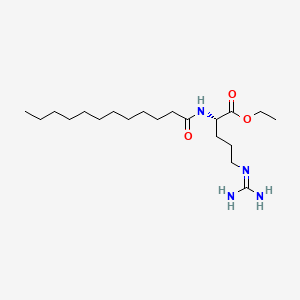 Compound
- Category
- Compound
What Lauric arginate is, and what it does.
- Does it work
- This one is for the formulator. It matters to whoever makes the product and keeps it stable through its shelf life, not to a person choosing an ingredient for a benefit.
- How much to take
- There's no daily amount to take. It's a processing ingredient used at whatever level a food maker specifies within regulator-set limits, not a serving you dose yourself.
- Time to feel it
- It acts on the food before you eat it, so there's no personal time course. Its effect shows up as microbial counts measured in the product.
- The first dose
- Day one is the food tasting as it should. The effect is recorded on a plate count in a laboratory rather than as anything happening in you.
- With regular use
- Over weeks its contribution stays inside the product, holding surface microbial growth down. After digestion its parts join the normal routes for fatty acids and amino acids.
- How well tolerated
- Digestive esterases split it into lauric acid, arginine and ethanol, all ordinary dietary constituents. Use levels in food are set by regulators, and concentrated material is irritant to handle.
- How it feels
- Nothing subjective attaches to it. At use levels it isn't tasted, and the experience you have is the food's rather than the preservative's.
- The overlooked benefit
- Its performance depends on the matrix: the positive charge binds proteins and anionic gums, which lowers the free active fraction, so the same amount behaves differently in different foods.
The proof, claim by claim.
What these words mean
These words describe the research, not the molecule's worth. Research strength is how much work stands behind one claim, and it is never a product score.
- Surface antimicrobial activity in food matricesIn vitro study
- Hydrolysis to lauric acid, arginine and ethanol after ingestionAnimal study
2 more claims
- Lower free active concentration in anionic matricesIn vitro study
- Membrane permeability disruption at microbial cell surfacesIn vitro study
Why these belong in the same formula, 6 pairings
Why these belong in the same formula. Each row says what the basis is, from settled biochemistry through to a trial that measured the pair.
Lauric arginate is a cationic surfactant that partitions into the interface of an oil-in-water emulsion, while tocopherols sit in the oil phase. In food preservation systems the two address different spoilage routes, microbial and oxidative, without competing for the same location. This is a processing-aid pairing rather than anything a person would take as a supplement combination.
Lauric arginate carries a positive charge across normal food pH because of the guanidinium group on arginine. Raising pH toward alkaline conditions changes the charge environment and the strength of its electrostatic association with negatively charged microbial surfaces. Formulators adjust buffering deliberately for this reason. The relationship is about the ingredient's function in a matrix, not about anything happening in a person.
Pectin is anionic at food pH and binds cationic surfactants electrostatically. That complexation ties up lauric arginate and reduces the free surfactant available at the interface, which is why antimicrobial performance drops in high-pectin matrices. It is a genuine antagonism worth flagging in any formulation that carries both.
Lecithin contains anionic phospholipid species such as phosphatidylserine and phosphatidylinositol alongside the zwitterionic phosphatidylcholine. Those anionic fractions pair electrostatically with the cationic head of lauric arginate, which can reduce the free concentration of both. In practice this shows up as reduced antimicrobial activity in lecithin-emulsified systems.
Lauric arginate is an ethyl ester of lauroyl arginine, and ester bonds are substrates for gut and pancreatic esterases. Hydrolysis breaks the molecule into lauric acid, arginine and ethanol, which are ordinary dietary components. This is the reason the compound does not persist intact after ingestion, and it is also why it has no plausible systemic surfactant role in a person.
Carvacrol and thymol from oregano partition into microbial membranes, and lauric arginate disrupts the same membrane from the outer surface. Combining them is a standard approach in antimicrobial food packaging films. The evidence base is laboratory and food-matrix work, not human. This is about food preservation, not about anything measured in people.
Nothing specific on file for Lauric arginate. Match the label to the daily amount above, and tell your doctor what you take.
Not medical advice. Show the label to your pharmacist.What Lauric arginate actually does.
Lauric arginate is a manufactured surfactant made from lauric acid, the amino acid arginine, and an ethyl ester group, with a positive charge on one end and a fat-loving tail on the other.
3 more mechanisms
Its antimicrobial action is physical, not metabolic. The positively charged head sticks to microbial cell surfaces while the fatty tail inserts into the membrane, disrupting it. This is a surface-contact effect within a food matrix.
Once swallowed, digestive enzymes break its ester bonds down into lauric acid, arginine, and ethanol, all ordinary dietary building blocks that enter normal metabolic pathways, so the intact molecule isn't expected to reach the bloodstream in any meaningful amount.
Because it carries a fixed positive charge, it binds to negatively charged parts of a food, like certain fibers, proteins, and fats, and that binding lowers how much stays free and active, which is why its effect depends on what it's mixed into.
The forms it comes in.
2 more forms
The essence, in one line each.
- Combining lauric arginate with light or thermal treatment produced greater antimicrobial effect than either alone, with membrane damage and oxidative stress reported as the mechanism.In vitro study. Yang X et al., 2019 (Applied and Environmental Microbiology). PMID 31253679 ↗
1 more finding
- A bilayer antimicrobial film incorporating preservative agents extended the shelf life of refrigerated meat and poultry in a food-matrix test.In vitro study. Hongkulsup C et al., 2025 (Preventive Nutrition and Food Science). PMID 41492429 ↗
Chosen from the 2 we read for Lauric arginate.
FDA Disclaimer: These statements have not been evaluated by the Food and Drug Administration. This information is for educational purposes only and is not intended to diagnose, treat, cure, or prevent any disease. Consult your healthcare provider before starting any supplement regimen.