Menthol.
It switches on the cold receptor in your sensory nerves, so you feel cool without anything actually getting cooler. It also relaxes gut smooth muscle.
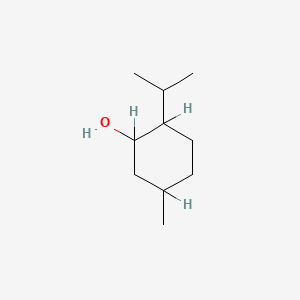 Compound
- Category
- Compound
What Menthol is, and what it does.
- Does it work
- It suits athletes working in heat who want perceived effort and thermal discomfort to drop, and anyone using a mint preparation for digestive comfort or fresher breath.
- How much to take
- No daily amount is on record. Follow the label on your lozenge, capsule or rinse and start low, because the cooling turns to burning as concentration climbs.
- Time to feel it
- Seconds to a couple of minutes. This is one of the few ingredients where the effect is immediate and unmistakable.
- The first dose
- You feel it straight away. Cold mouth, cold skin, airways that feel more open, all of it receptor-driven rather than a real temperature change.
- With regular use
- It acts dose by dose rather than building up. Gut-directed mint preparations are usually run as defined courses over a few weeks.
- How well tolerated
- Well tolerated in usual amounts. Uncoated capsules can bring on reflux, since the same relaxation loosens the oesophageal sphincter. Keep it off young children's faces.
- How it feels
- Unmistakably cold, then tingling, then edging toward burning if you overdo it. Breathing feels easier even when airflow measures barely move.
- The overlooked benefit
- It makes hot work feel cooler without lowering core temperature, which is useful for comfort and pacing and means it is not a substitute for actually cooling down.
The proof, claim by claim.
What these words mean
These words describe the research, not the molecule's worth. Research strength is how much work stands behind one claim, and it is never a product score.
- perceived exertion and thermal comfort during exercise in heatMeta-analysis
- endurance performance with a mouth rinseRandomised trial
4 more claims
- gut smooth muscle relaxation and digestive comfortMeta-analysis
- perceived nasal airflowRandomised trial
- topical cooling sensation via TRPM8Randomised trial
- cough reflex sensitivityRandomised trial
Why these belong in the same formula, 8 pairings
Why these belong in the same formula. Each row says what the basis is, from settled biochemistry through to a trial that measured the pair.
A carbohydrate-electrolyte drink addresses fluid and sodium replacement, a physiological input, while menthol acts on cold receptors and changes how the drink and the heat feel. Those are different targets, which is exactly why the combination was tested. The reported effects sit on hydration and recovery measures, and thermal perception is a perceptual endpoint rather than a measure of core temperature.
Caffeine antagonises adenosine receptors and lowers perceived exertion through a central route. Menthol works peripherally at TRPM8 cold receptors in the mouth and skin, changing thermal sensation without lowering core temperature. Because the routes are separate, the perceptual effects can add. Neither one is cooling the body, and that distinction matters when heat strain is the actual risk.
Peppermint oil is largely menthol by weight alongside menthone, menthyl acetate and cineole. Taking both means taking menthol twice, which is worth knowing when a product lists them separately. Peppermint oil also relaxes the lower oesophageal sphincter, which is why enteric coating exists for gut-directed use and why reflux is the common complaint with uncoated capsules.
Capsaicin activates TRPV1 and produces a burning sensation. Menthol activates TRPM8 and produces cooling. Applied together they compete perceptually, and topical products that combine them are exploiting the confusion rather than the sum. There is also cross-desensitisation between the two channel populations, so repeated exposure to one blunts the response to the other.
Camphor activates TRPV3 and at higher concentrations desensitises TRPV1, while menthol drives TRPM8. Together they produce the layered warm-then-cool sensation typical of rub preparations. This is a sensory and counterirritant effect on skin, not an anti-inflammatory action on the tissue underneath.
Gingerols and shogaols activate TRPV1, the warm channel, producing a warming oral sensation. Menthol drives the cold channel in the opposite direction. Taken together during heat exposure the perceptual effects work against each other, which is a reason not to combine them in a pre-exercise mouth rinse.
Sodium bicarbonate acts as an extracellular buffer against the acidosis of high-intensity work, a chemical effect with nothing to do with thermal perception. Menthol changes how the effort and the heat feel. The practical link is palatability: bicarbonate tastes unpleasant and menthol is sometimes used to mask it, which is a flavour role rather than an ergogenic one.
L-theanine affects central measures such as alpha wave activity and subjective calm through a slow oral route. Menthol acts within seconds at peripheral cold receptors in the mouth. Nothing has tested them together, and the pairing rests on the observation that they operate on different timescales and different systems.
Nothing specific on file for Menthol. Match the label to the daily amount above, and tell your doctor what you take.
Not medical advice. Show the label to your pharmacist.What Menthol actually does.
It flips the switch on your cold receptors. Your mouth or skin reports cold to your brain while nothing has actually got any cooler.
3 more mechanisms
It makes you feel cooler without making you cooler. That is worth knowing in real heat, because feeling fine is not the same as being fine.
Past a certain strength it stops feeling pleasantly cool and starts to sting. That is a second receptor being pulled in.
It relaxes the smooth muscle in your gut by limiting calcium entry. The same relaxation at the top of the stomach is why uncoated peppermint capsules give some people heartburn.
Where Menthol comes from.
It is the cooling compound in mint. It gets pulled out of cornmint oil by chilling until crystals form, and it also gets built from scratch in a reactor. The natural and synthetic versions are the same molecule when the stereochemistry matches.
What this route gives you
The same molecule is reached more than one way. Which route a given product used is a manufacturing choice, and the finished compound is the same either way.
5 steps on record
Natural menthol is crystallised from cornmint oil, mainly from India and China. Synthetic routes start from citronellal derived from citronella or from petrochemical myrcene, or from thymol.
Cornmint oil is chilled so that menthol crystallises out of the oil, a purely physical separation. The synthetic routes use asymmetric catalysis or hydrogenation to build the same molecule with defined stereochemistry.
Crude crystals are recrystallised, or the synthetic product is distilled, to remove isomenthol, neomenthol and residual terpenes.
Pharmacopoeial menthol is specified by optical rotation and melting point. L-menthol is the isomer with the strong cooling activity. Racemic menthol contains both enantiomers.
Supplied as crystals, dissolved in oil or alcohol, complexed with cyclodextrin for water dispersibility, or encapsulated for controlled release in gum and lozenges.
Getting Menthol from food.
The whole-food sources on file. A supplement closes the gap, it does not replace dinner.
A gram-for-gram figure (how much of each you would eat to match a dose) will appear here once it is sourced and reviewed. This page will not print a number it cannot cite.
The forms it comes in.
5 more forms
The essence, in one line each.
- A meta-analysis of 10 trials found that rinsing the mouth with menthol did not significantly change overall exercise capacity and performance.Systematic review. Gavel EH et al., 2024 (Sports Medicine Open). PMID 38381237 ↗
4 more findings
- In a network meta-analysis of 15 trials on exercise in the heat, menthol given by ingestion, mouth rinse, or topically did not lead to statistically significant improvements in performance, though ingestion showed a trend for improving endurance and mouth rinsing showed a trend for improving power output.Network meta-analysis. Zhu Y et al., 2026 (Frontiers in Nutrition). PMID 42232581 ↗
- A review of nutritional supplements for endurance performance and subjective perception in athletes exercising in heat, naming menthol among the strategies discussed.Narrative review. Li J et al., 2025 (Nutrients). PMID 40647246 ↗
- A review of nutritional strategies for performance maintenance and recovery in football played in hot conditions, with menthol among the approaches covered.Narrative review. Dai X et al., 2026 (Nutrients). PMID 42280339 ↗
- Menthol supplementation in feedlot diets was examined for effects on faecal prevalence of antimicrobial-resistant Escherichia coli.Animal study. Aperce CC et al., 2016 (PLoS One). PMID 28030622 ↗
Chosen from the 7 we read for Menthol.
The studies, linked.
11 sources behind our Menthol verdict, every one linked to PubMed, the journal or ClinicalTrials.gov.
- Clinical trialA Randomized, Controlled, Multi-center Study to Demonstrate Reductions in Exposure to Selected Smoke Constituents in Smokers Switching to THS 2.2 Menthol or Smoking Abstinence Compared to Smoking Menthol Conventional Cigarettes, for 90 DaysClinicalTrials.gov ↗160 participants, Completed
10 more linked trials
- Clinical trialThe Effect on Thirst, Nausea-Vomiting, Hemodynamic Parameters, and Comfort Levels of Menthol Lozenge Applied After Extubation to Patients to Undergoing Cardiovascular SurgeryClinicalTrials.gov ↗118 participants, Completed
- ClinicalTrials.gov ↗
- Clinical trialEffect of a Menthol Gel (Biofreeze) on the Symptoms Associated with Knee Osteoarthritis: a Double-blind Randomized Control Trial.ClinicalTrials.gov ↗Phase 2, 70 participants, Completed
- ClinicalTrials.gov ↗
- Clinical trialFlavors and E-cigarette Effects in Adolescent Smokers- STUDY 2ClinicalTrials.gov ↗Phase 1, 56 participants, Completed
- Clinical trialEfficacy and Safety of a Food Supplement With Standardized Menthol, Limonene, and Gingerol Content in Patients With Irritable Bowel Syndrome: a Double-blind, Randomized, Placebo-controlled TrialClinicalTrials.gov ↗56 participants, Completed
- Clinical trialA Randomized, Open-Label, Multi-Center, Cross-Over Study of Adult Electronic Nicotine Delivery Systems (ENDS) Consumers to Assess Nicotine Uptake, Measures of Abuse Liability, and Puffing Topography With RELX Infinity ENDSClinicalTrials.gov ↗29 participants, Completed
- Clinical trialA Randomised Double Blind, Placebo Controlled Study of the Efficacy of Topical Menthol for Pain Relief During Topical Photodynamic TherapyClinicalTrials.gov ↗Phase 4, 10 participants, Completed
- Clinical trialEffect of Menthol to Non-Menthol Cigarette Switching on Subclinical Inflammatory Biomarkers of Cardiovascular Health: Simulating a Menthol Cigarette BanClinicalTrials.gov ↗68 participants, Recruiting
- Clinical trialEfficacy of Distal Topical Application of a Traditional Chinese Medicinal Ingredient for Atopic Dermatitis and Its Exosome-Mediated Regulatory Mechanisms: Basic and Clinical StudiesClinicalTrials.gov ↗Phase 2, 44 participants, Active not recruiting
From clinical trials and PubMed, ranked by study type and citation weight, not cherry-picked.
Problems people have reported.
Read this carefully. These are 229,444 voluntary, unverified reactions reported to the FDA (openFDA). The number mostly reflects how popular Menthol is, not how risky it is. A report is not proof Menthol caused anything. It is a signal of what to watch for, nothing more.
3 more reported effects
Source: openFDA adverse-event reports. Voluntary reporting, not an incidence rate.
FDA Disclaimer: These statements have not been evaluated by the Food and Drug Administration. This information is for educational purposes only and is not intended to diagnose, treat, cure, or prevent any disease. Consult your healthcare provider before starting any supplement regimen.