Neotame.
It makes food and drink sweet without sugar. A few milligrams do the work of a spoonful, and it adds no meaningful energy at the levels used.
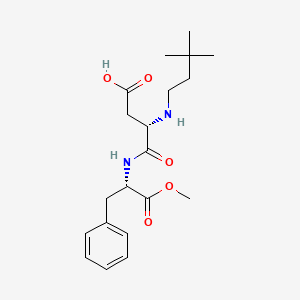 Compound
- Category
- Compound
What Neotame is, and what it does.
- Does it work
- Suits people cutting sugar who want sweetness that holds up in baking and in acidic drinks. On its own it contributes taste rather than nutrition.
- How much to take
- There's no daily amount to take. It's a sweetener used in the low milligrams per serving, because it is thousands of times sweeter than sugar by weight.
- Time to feel it
- Sweetness lands on the tongue in seconds. There is nothing else to wait for with this one.
- The first dose
- Day one is taste and nothing more. It carries no meaningful energy, so it shows up in the recipe rather than in how you feel.
- With regular use
- Weeks of use keep sugar out of a sweetened product. Whether non-nutritive sweeteners shift gut bacteria over time is still an open research question.
- How well tolerated
- Well tolerated at the low milligrams used, and it releases very little free phenylalanine, unlike aspartame. If you avoid sweeteners generally, read the label.
- How it feels
- Clean, intense sweetness with a slight lingering edge some people pick up. No cooling effect and none of the bitterness other sweeteners can carry.
- The overlooked benefit
- It survives baking and months in an acidic drink where aspartame degrades. That heat and pH stability is why it appears where a peptide sweetener normally can't go.
The proof, claim by claim.
What these words mean
These words describe the research, not the molecule's worth. Research strength is how much work stands behind one claim, and it is never a product score.
- Sweetness intensity relative to sucroseNarrative review
- Minimal free phenylalanine release compared with aspartameNarrative review
2 more claims
- Blood glucose response after intakeRandomised trial
- Gut microbiota changes with non-nutritive sweetenersAnimal study
Why these belong in the same formula, 5 pairings
Why these belong in the same formula. Each row says what the basis is, from settled biochemistry through to a trial that measured the pair.
Review work on non-caloric sweeteners and the gut microbiome describes shifts in bacterial species composition across the sweetener class. Whether neotame specifically alters the survival or colonisation of an administered probiotic strain has not been measured. The mechanism is plausible because both act in the same compartment. Read it as an open question, not a demonstrated interaction.
Inulin is fermented by colonic bacteria into short-chain fatty acids. Non-nutritive sweeteners are described in review literature as altering the composition of that same bacterial community. Any net effect on fermentation would depend on which populations shift and by how much. This has not been tested for neotame, and pairing them is a formulation decision rather than a demonstrated synergy.
Neotame has a slow onset and a lingering finish, so formulators blend it with faster-onset sweeteners to shape the sweetness curve. Blends also let each component sit at a lower level than it would alone. This is well established industrial practice with a clear sensory rationale. It says nothing about physiological effect.
Aspartame is hydrolysed in the gut to release free phenylalanine, which is why it carries a warning for people with phenylketonuria. Neotame's bulky N-3,3-dimethylbutyl group sterically blocks the peptidases that would perform that cleavage, so very little free phenylalanine is liberated. That structural difference is the whole point of the molecule and the reason its regulatory labelling differs from aspartame's. The relationship is chemical, not a nutritional pairing.
Neotame is used at concentrations thousands of times below sugar, so on its own it leaves a powder or beverage with no body. A bulking polyol restores the volume and texture that sugar would have contributed. The two occupy different roles in the same formula. This is manufacturing convention with a straightforward physical basis.
Nothing specific on file for Neotame. Match the label to the daily amount above, and tell your doctor what you take.
Not medical advice. Show the label to your pharmacist.What Neotame actually does.
Neotame is built from the same building blocks as aspartame, with one extra chemical group added, and that single change is what makes it different.
3 more mechanisms
That extra bulky group blocks the enzymes that would normally break the molecule apart, so neotame releases very little of the amino acid phenylalanine compared with aspartame, which is why its label rules differ.
Neotame works by binding the sweet taste receptor on your tongue, and it's reported to be thousands of times sweeter than table sugar by weight, so only tiny amounts are needed in a serving.
It's mainly broken down by enzymes into another compound and cleared out in urine and stool. It doesn't build up in the body and provides essentially no calories at the amounts used.
Where Neotame comes from.
Neotame is aspartame with an extra chemical group bolted onto one end. That addition does two things: it makes it thousands of times sweeter, so a serving needs only a few milligrams, and it stops the body from breaking it down into phenylalanine the way aspartame does. It is made in a chemical plant, not extracted from anything. There is no botanical version of this molecule.
What this route gives you
Chemically synthesised. The molecule is identical to the one a plant or an animal makes, and building it deliberately means a known purity, a fixed dose and no crop contaminants. For several nutrients this is the only route that reaches a usable amount.
5 steps on record
Neotame is made from aspartame itself, which is in turn built from L-aspartic acid and L-phenylalanine methyl ester. The second feedstock is the aldehyde that supplies the neohexyl group.
The aldehyde condenses with the free amine of aspartame's aspartyl residue and the resulting imine is reduced, typically by catalytic hydrogenation, to install the N-3,3-dimethylbutyl group. This is the step that creates the steric block on peptidase cleavage.
The product is crystallised and washed to remove residual aspartame, catalyst and reaction by-products.
Purity, residual solvent, heavy metals and unreacted starting material are tested against a food-additive monograph specification.
Supplied neat for large users or blended onto a carrier so it can be dosed at production scale.
The forms it comes in.
2 more forms
The essence, in one line each.
- The authors review reported shifts in gut bacterial species and proposed mechanisms across the non-caloric and low-caloric artificial sweetener class, with neotame named among the compounds covered.Narrative review. Feng J et al., 2024 (Metabolites). PMID 39452925 ↗
2 more findings
- A systematic review of non-nutritive sweetener effects in pigs, reporting outcomes across the sweetener class in a livestock production context.Animal study. Jansen MR et al., 2024 (Animals). PMID 39457961 ↗
- Non-nutritive sweeteners in weaned pig diets were associated with changes in growth measures, stool consistency and intestinal metabolic markers.Animal study. Jansen MR et al., 2026 (Journal of Animal Science). PMID 41537250 ↗
Chosen from the 3 we read for Neotame.
FDA Disclaimer: These statements have not been evaluated by the Food and Drug Administration. This information is for educational purposes only and is not intended to diagnose, treat, cure, or prevent any disease. Consult your healthcare provider before starting any supplement regimen.