Rebaudioside A.
Reb A is the sweet molecule taken out of stevia leaf. It makes food and drink taste sweet without contributing usable energy, because you do not break it down into sugar.
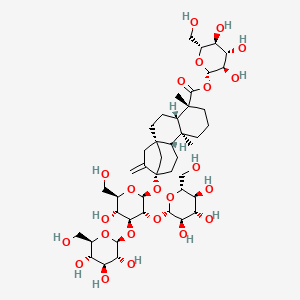 Compound
- Category
- Compound
What Rebaudioside A is, and what it does.
- Does it work
- It suits anyone sweetening food or drink without sugar, and people who find other sweeteners taste off. Some people pick up a liquorice-like finish and prefer another one.
- How much to take
- There is no daily amount to take, because it is a sweetener rather than a nutrient. It is a few hundred times sweeter than sugar, so milligrams do what grams of sugar do.
- Time to feel it
- Sweetness arrives within a second or two, a touch later than sugar does, and the finish lingers longer.
- The first dose
- Day one is a change in taste. It is not absorbed as sugar, so there is no post-meal glucose story attached to it on day one or any other day.
- With regular use
- Over weeks it shows up as sugar you did not eat rather than as anything you feel. Gut bacteria cleave it, and steviol glucuronide leaves in urine without building up.
- How well tolerated
- Well tolerated at the amounts used in food and drink. Spoonable blends usually carry a sugar alcohol as the bulking ingredient, and that is what unsettles some stomachs.
- How it feels
- Clean and intensely sweet, with a slower start and a longer tail than sugar. A minority taste a liquorice or slightly bitter edge at the finish.
- The overlooked benefit
- It holds up to about 200 degrees Celsius and across the pH of most drinks, so its sweetness survives baking and pasteurisation where some sweeteners fade over a shelf life.
The proof, claim by claim.
What these words mean
These words describe the research, not the molecule's worth. Research strength is how much work stands behind one claim, and it is never a product score.
- Sweetness without contributing usable energyRandomised trial
- Post-meal glucose response compared with sugarRandomised trial
3 more claims
- Appetite and later energy intake when it replaces sugarRandomised trial
- Colonic bacterial cleavage to steviol and urinary excretion as the glucuronideIn vitro study
- Sweet taste receptor activation at the T1R2 and T1R3 heterodimerIn vitro study
Why these belong in the same formula, 5 pairings
Why these belong in the same formula. Each row says what the basis is, from settled biochemistry through to a trial that measured the pair.
Rebaudioside A is sweet at concentrations far too low to provide any volume, so a bulking sweetener carries it in powders and tablets. Erythritol is the usual partner because its cooling effect partly masks the lingering finish steviol glycosides are known for. This is standard practice in the category rather than a physiological interaction.
In powdered blends inulin does the volume job that a high-intensity sweetener cannot. It is also fermented by colonic Bacteroides, the group most implicated in hydrolysing steviol glycosides to steviol. So the pairing is both a texture decision and a shift in the fermentation environment where the sweetener is processed.
Rebaudioside A passes the small intestine essentially intact and is hydrolysed by gut bacteria, mainly Bacteroides species, to free steviol which is then absorbed and glucuronidated. Changing the microbial community plausibly changes the rate of that step. Whether an added probiotic strain shifts it measurably has not been shown, so this is mechanistic reasoning about a documented pathway.
Rebaudioside A is heat and pH stable across the range protein powders see, which is why it displaced older sweeteners in the category. Protein systems also carry their own bitterness, and glycoside blends are tuned against it. This is formulation convention.
Rebaudioside A carries a bitter and licorice-like tail alongside its sweetness, and caffeine is a separate bitterant. In energy drinks and coffee formats the two bitter signals stack rather than cancel, which is why blends and masking agents are used. Purely a sensory interaction with no metabolic component.
Nothing specific on file for Rebaudioside A. Match the label to the daily amount above, and tell your doctor what you take.
Not medical advice. Show the label to your pharmacist.What Rebaudioside A actually does.
Rebaudioside A is a stevia-derived sweet compound built on a shared plant backbone, with four sugar units attached, which is what sets it apart from another stevia compound called stevioside.
3 more mechanisms
It triggers the sweet taste receptor on the tongue at a different spot than sugar does, giving a sweetness far beyond that of table sugar by weight, with a different onset and finish than sugar has.
Human digestive enzymes can't break these sugar-plant compounds apart, so they pass through the small intestine mostly intact until gut bacteria strip off the sugar units and release the core compound.
The core compound that's absorbed gets tagged by the liver and mostly leaves the body in urine, with very little of the original compound building up.
Where Rebaudioside A comes from.
It starts as a leaf. The leaves are steeped in hot water, the colour and plant taste are stripped out with carbon and resins, and the sweet molecules are crystallised apart from one another until one of them, rebaudioside A, is left as a white powder. It is a few hundred times sweeter than sugar, so what is in the packet on your table is mostly the bulking ingredient. Check which one that is.
What this route gives you
The same molecule is reached more than one way. Which route a given product used is a manufacturing choice, and the finished compound is the same either way.
6 steps on record
Cultivated principally in China, Paraguay, Argentina, Kenya and increasingly the United States. Dried leaf carries roughly 4 to 20 percent total steviol glycosides depending on variety and growing conditions
Dried leaf is extracted with hot water, giving a crude extract containing the full mix of steviol glycosides plus chlorophyll, pigments and plant acids
The extract is passed over adsorbent resins and treated with activated carbon or ion exchange to strip pigments and off-flavour compounds
Reb A is separated from stevioside and minor glycosides by repeated crystallisation from alcohol or water. Alternatively enzymes or engineered yeast convert Reb A to Reb M or D
Purity is declared as percent Reb A on a dry basis by HPLC against a reference standard, with limits on residual solvent and total glycoside content
Free-flowing and odourless, blended onto a bulking carrier for consumer formats or supplied neat to manufacturers
Suppliers rarely declare the carrier ratio in consumer blends, and the distinction between leaf-crystallised and enzymatically bioconverted glycosides is often absent from front-of-pack labelling.
Getting Rebaudioside A from food.
The whole-food sources on file. A supplement closes the gap, it does not replace dinner.
A gram-for-gram figure (how much of each you would eat to match a dose) will appear here once it is sourced and reviewed. This page will not print a number it cannot cite.
The forms it comes in.
3 more forms
The essence, in one line each.
- Rebaudioside A and the related rebaudioside Aα differed in physicochemical characteristics, and the paper compared how each was handled in vivo.Animal study. Kim HJ et al., 2025 (npj Science of Food). PMID 41238664 ↗
3 more findings
- Synthetic and non-synthetic sweeteners are described as having differing effects on gut microbial diversity and function, with steviol glycosides discussed among the non-synthetic group.Narrative review. Kidangathazhe A et al., 2025 (Frontiers in Microbiology). PMID 40443994 ↗
- Non-nutritive sweeteners were examined for effects on sweet taste receptor expression and reproductive parameters in a female animal model.Animal study. Zhu S et al., 2025 (Reproductive Toxicology). PMID 40652992 ↗
- Stevia rebaudiana material is discussed as a candidate prebiotic and feed additive in aquaculture and animal nutrition.Narrative review. Shehata AI et al., 2025 (Aquaculture Nutrition). PMID 40919451 ↗
Chosen from the 4 we read for Rebaudioside A.
The studies, linked.
4 sources behind our Rebaudioside A verdict, every one linked to PubMed, the journal or ClinicalTrials.gov.
- Clinical trialThe Effects of Steviol Glycosides on Acute Appetite Hormone Release in Men and Women with Normal Weight, Overweight and Type 2 DiabetesClinicalTrials.gov ↗69 participants, Completed
3 more linked trials
- Clinical trialInvestigation of the Acute Effect of Rebaudioside A on the Glucose Excursion During an Oral Glucose Tolerance Test in 30 Patients With Type 2 Diabetes Mellitus (AREBAG)ClinicalTrials.gov ↗Phase 1, 30 participants, Completed
- Clinical trialDo Sweeteners Need to be Tasted to Affect Appetite? A Pilot StudyClinicalTrials.gov ↗17 participants, Completed
- Clinical trialAn Open-label, Sequential Supplementation Study Comparing the Bioavailability of Two Doses of cogniVida™ With One Dose of Rebaudioside A in Healthy Male SubjectsClinicalTrials.gov ↗Phase 1, 10 participants, Completed
From clinical trials and PubMed, ranked by study type and citation weight, not cherry-picked.
FDA Disclaimer: These statements have not been evaluated by the Food and Drug Administration. This information is for educational purposes only and is not intended to diagnose, treat, cure, or prevent any disease. Consult your healthcare provider before starting any supplement regimen.