Schisandrin.
Schisandrin is a lignan pulled from schisandra berries. In cell and animal work it switches on the Nrf2 antioxidant pathway and supports liver enzyme activity.
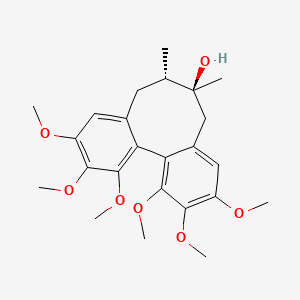 Compound
- Category
- Compound
What Schisandrin is, and what it does.
- Does it work
- Suits people already using schisandra who want a named lignan figure on the label. If you take prescription medicines, this one needs a conversation with your doctor first.
- How much to take
- No daily amount is on record for us to quote. Start at the lower end of your pack and take it with a meal containing fat, since it does not dissolve in water.
- Time to feel it
- No human timeline has been measured. The research behind it is rodent and fish work, so a felt schedule is not something anyone has established.
- The first dose
- Taken with a fatty meal, day one passes uneventfully. How much you absorb varies a lot between people and between dry powder and oil-based formats.
- With regular use
- Weeks of daily use is where the antioxidant enzyme changes seen in animals would sit. Whether that happens in people at supplement amounts has not been shown.
- How well tolerated
- The real caution is drug interactions: this lignan class acts on CYP3A enzymes and intestinal P-glycoprotein, so levels of some medicines can shift. Ask your doctor.
- How it feels
- Most people report no distinct sensation. What it does shows up in laboratory measures of antioxidant enzyme activity rather than in how a day feels.
- The overlooked benefit
- It is fat soluble, so the same milligram number on a softgel and on a dry powder can deliver quite different exposure. The fat in your meal matters.
The proof, claim by claim.
What these words mean
These words describe the research, not the molecule's worth. Research strength is how much work stands behind one claim, and it is never a product score.
- Nrf2 antioxidant pathway activationIn vitro study
- Liver enzyme and glutathione handling supportAnimal study
1 more claim
- Interaction with CYP3A drug metabolismIn vitro study
Why these belong in the same formula, 7 pairings
Why these belong in the same formula. Each row says what the basis is, from settled biochemistry through to a trial that measured the pair.
An isolated schisandrin dose and a standardised berry extract are two ways of delivering the same molecule, one alone and one inside its native lignan mixture. Whole extract also carries gomisins, schisandrol and organic acids that the isolate does not. Stacking both means counting total lignan intake across the two, which labels rarely make easy. The pairing is formulation choice rather than an interaction.
Schisandra lignans shift Nrf2 into the nucleus in cell and rodent work, which raises transcription of glutamate-cysteine ligase and other glutathione-handling enzymes. N-acetylcysteine supplies the cysteine those enzymes need, which is usually the rate-limiting input. On paper the two hit different steps of the same pathway. This has not been tested as a combination in people, so read it as mechanistic rather than clinical.
Silymarin and Schisandra lignans both reduce markers of hepatocyte oxidative stress in rodent models, through partly separate routes. They are combined in commercial liver formulas as a matter of practice. Human head-to-head or combination data are thin. The relevant caution is that both interact with drug-metabolising enzymes, so the combination compounds that.
Lignans of this class dissolve far better in lipid than in gut fluid, and taking them with fat raises the fraction that partitions into mixed micelles for uptake. Medium-chain triglyceride is one convenient vehicle among several. Any dietary fat drives the same mechanism. Absorption of Schisandra lignans is measurably higher when taken with a fatty meal than fasted. This is a pharmacokinetic point, not an effect claim.
CoQ10 and schisandrin both need fat present to be absorbed reasonably, so a single oil-based softgel serves both. Putting them in a dry capsule together wastes both. There is no interaction between the two molecules. The shared constraint is the reason they co-formulate well. Read it as a delivery argument.
Schisandra lignans have shown both inhibition and induction of cytochrome enzymes depending on the lignan, the dose and the timeframe studied. Where CYP1A2 activity drops, caffeine clears more slowly and its effects run longer at the same dose. This has been characterised in animals and in vitro rather than measured as a caffeine kinetics study in people. Anyone sensitive to caffeine timing should regard the pairing as unpredictable rather than neutral.
Both compounds change how much of a co-administered substrate survives first pass in cell and rodent models. Combining two modulators of the same transporters makes the net effect on anything else in the regimen harder to predict rather than simply larger. The direction depends on dose and timing. This is a reason for caution in people on prescription medicines, not a reason to expect a benefit.
Nothing specific on file for Schisandrin. Match the label to the daily amount above, and tell your doctor what you take.
Not medical advice. Show the label to your pharmacist.What Schisandrin actually does.
Schisandrin is a lignan compound from schisandra fruit, its structure is what makes it fat-soluble and poorly water-soluble, which shapes both how it's absorbed and how it interacts with liver enzymes.
3 more mechanisms
Compounds in this lignan class interact with a major liver enzyme family and with a gut-wall transport protein, a pharmacokinetic property meaning the compound can shift blood levels of medicines cleared through those same routes, in either direction depending on dose and duration.
In cell systems, these lignans free up a protein called Nrf2, letting it enter the nucleus and boost antioxidant enzyme production. This step is well characterized in vitro, but whether it produces a measurable change in people at supplement doses has not been shown.
Schisandrin taken by mouth is poorly and unevenly absorbed, due to low water solubility plus heavy first-pass breakdown, taking it with fat raises how much gets absorbed, which is why softgel and oil-based formats behave differently from dry powder at the same stated dose.
Where Schisandrin comes from.
It is one of the active molecules in schisandra berries, pulled out and concentrated. It does not dissolve in water, so take it with food that has fat in it. The studies behind it are in fish and rodents, not people.
What this route gives you
Made from a plant. What ends up in the capsule tracks the harvest, so batch testing and a stated marker matter more here than with a made molecule.
6 steps on record
Ripe red berries from the vine, cultivated mainly in northeastern China, Korea and the Russian Far East, then dried
Berries are sun or oven dried and milled. The lignans concentrate in the seed rather than the pulp, so seed content drives yield
Ethanol carries the full lignan and organic acid profile. CO2 extraction favours the lipophilic lignans and leaves the acids behind
For isolates, column chromatography separates the individual lignans, which are otherwise structurally close enough to co-elute in crude fractions
The extract is assayed by HPLC and adjusted with carrier to the declared percentage of the marker lignan
Sold as dry standardised powder for capsules and tablets, or dispersed in lipid for softgels
Getting Schisandrin from food.
The whole-food sources on file. A supplement closes the gap, it does not replace dinner.
A gram-for-gram figure (how much of each you would eat to match a dose) will appear here once it is sourced and reviewed. This page will not print a number it cannot cite.
The forms it comes in.
5 more forms
The essence, in one line each.
- Schisandrin B reduced markers of oxidative stress and inflammatory signalling and lessened tissue damage in animals fed a high-glucose diet.Animal study. Fu M et al., 2026 (Frontiers in Veterinary Science). PMID 42182905 ↗
2 more findings
- The authors report that schisandrin B stabilised ACOD1 in liver macrophages and shifted itaconate signalling, lessening graft rejection in their transplant model.Animal study. Wang Y et al., 2026 (Phytomedicine). PMID 41795300 ↗
- A multi-herb formula containing Schisandra shifted gut microbiota composition and immune cell balance and reduced arterial plaque burden in the model used.Animal study. Li Y et al., 2026 (Phytomedicine). PMID 42030803 ↗
Chosen from the 3 we read for Schisandrin.
FDA Disclaimer: These statements have not been evaluated by the Food and Drug Administration. This information is for educational purposes only and is not intended to diagnose, treat, cure, or prevent any disease. Consult your healthcare provider before starting any supplement regimen.