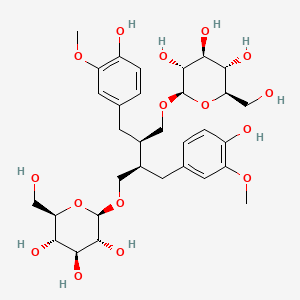
Secoisolariciresinol-diglucoside.
This is flaxseed's main lignan. Gut bacteria turn it into enterodiol and enterolactone, weak plant oestrogens studied for hormonal balance and for lipids already in the normal range.
 Compound
- Category
- Compound
What Secoisolariciresinol-diglucoside is, and what it does.
- Does it work
- Suits people who want flax lignans without eating ground seed every day, and women interested in gentle plant oestrogen support. Daily ground flax already supplies it.
- How much to take
- No daily amount is on record for the isolated compound. Start with a lignan-standardised flax product taken daily with food, since steady intake is what keeps the conversion going.
- Time to feel it
- This isn't a felt ingredient. Enterolactone in blood and urine rises within days of steady intake, and that marker is how research follows what you're taking.
- The first dose
- Day one is quiet. The molecule reaches your colon largely unchanged, and bacteria begin stripping its two sugars off, which is where the real conversion starts.
- With regular use
- Weeks of daily intake hold enterolignan levels up rather than letting them spike and fall. Changes register on hormone and lipid measures rather than as a sensation.
- How well tolerated
- Well tolerated at food-level intakes. Because the end products are weak phytoestrogens, anyone pregnant, breastfeeding or on hormone medication should check with a doctor first.
- How it feels
- Nothing registers directly from the lignan. Ground flax that carries it usually brings steadier regularity through its fibre, and that's the part people actually notice.
- The overlooked benefit
- How much you convert depends on your gut bacteria, and it varies several-fold between people on the same intake. A recent course of antibiotics sharply lowers production.
The proof, claim by claim.
What these words mean
These words describe the research, not the molecule's worth. Research strength is how much work stands behind one claim, and it is never a product score.
- bacterial conversion to the enterolignans enterodiol and enterolactoneNarrative review
- weak phytoestrogen activity at oestrogen receptorsIn vitro study
3 more claims
- support for blood lipids already in the normal rangeMeta-analysis
- antioxidant activity of the lignan and its metabolitesIn vitro study
- enterohepatic recycling extending enterolignan residence timeNarrative review
Why these belong in the same formula, 6 pairings
Why these belong in the same formula. Each row says what the basis is, from settled biochemistry through to a trial that measured the pair.
The gut microbiota performs the deglycosylation, demethylation and dehydroxylation steps that turn the plant lignan into the mammalian lignans. People differ several-fold in how much enterolactone they produce from the same intake, and that difference tracks with microbial composition. A probiotic does not guarantee higher conversion, because the specific taxa involved are not fully mapped. What is settled is that conversion is bacterial, so anything that flattens the microbiota lowers output.
Enterolignan production happens in the colon, where fermentable substrate drives bacterial density and activity. Inulin-type fructans are established substrate for that community. The link from more substrate to more enterolactone is inferred rather than directly demonstrated for this pairing. It is a reasonable formulation choice, not a measured effect.
Cold pressing sends the alpha-linolenic acid into the oil and leaves the water-soluble SDG in the meal. Straight flaxseed oil therefore carries almost no lignan unless the maker adds a lignan-rich fraction back in. That is why some products are labelled high-lignan flax oil. It is a formulation fact worth knowing when reading a label.
Deglycosylation is the entry step and it requires bacterial beta-glucosidase, an activity well described in Lactobacillus species. The later demethylation and dehydroxylation steps involve other taxa, so no single strain completes the pathway. Adding one strain does not reliably raise enterolactone in people. Read this as one step in a chain rather than a solution to low conversion.
Enterolactone formation requires several sequential bacterial reactions in the colon. Anything that shortens transit reduces the window for those reactions. Psyllium is mostly a gelling rather than a rapidly fermented fibre, so the size of any effect is unclear and has not been measured for this pair. It is worth flagging rather than acting on.
Enterolactone is a weak phytoestrogen and interest in lignans for bone density rests on that receptor interaction. Calcium supplies the mineral substrate itself. These are unrelated mechanisms that happen to share an endpoint of interest. Human evidence that lignan intake changes bone density measures is not established.
Nothing specific on file for Secoisolariciresinol-diglucoside. Match the label to the daily amount above, and tell your doctor what you take.
Not medical advice. Show the label to your pharmacist.What Secoisolariciresinol-diglucoside actually does.
This is the main plant lignan in flaxseed, made of a core structure with two sugar units attached. In the seed it's mostly bound up with another acid rather than existing freely.
3 more mechanisms
The compound itself isn't the active form. Gut bacteria strip off its sugar units and then modify it further to produce the lignans that actually do things in the body.
Those bacterial lignans are weak plant estrogens. They bind estrogen receptors far more weakly than your body's own estrogen and can act as either a mild booster or a blocker depending on the tissue and hormone levels around it.
These bacterial lignans get recycled through the liver and gut repeatedly, tagged by the liver, released in bile, untagged by gut bacteria and partly reabsorbed, which is why they stay in the blood longer than a single pass would predict.
Where Secoisolariciresinol-diglucoside comes from.
It comes from flaxseed. When the oil is pressed out, this compound stays behind in the leftover cake, so that is what gets extracted. A mild alkali step snips it free from the larger molecule it sits in, and the result is dried into a powder.
What this route gives you
Made from a plant. What ends up in the capsule tracks the harvest, so batch testing and a stated marker matter more here than with a made molecule.
7 steps on record
Flaxseed, either brown or golden cultivars, which differ modestly in lignan content.
Oil is removed by mechanical pressing or solvent defatting. Because SDG is water soluble it stays behind in the press cake.
The defatted meal is extracted with aqueous ethanol or methanol to pull the lignan macromolecule out of the matrix.
Dilute base cleaves the ester bonds linking SDG to hydroxymethylglutaric acid in the native oligomer, releasing the free diglucoside.
Macroporous resin and chromatographic steps concentrate SDG and remove cyanogenic glycosides and mucilage.
SDG content is quantified by high performance liquid chromatography and the extract is adjusted to a stated percentage.
Finished as a dry lignan complex powder for capsules, or suspended into flax oil for a high-lignan liquid.
Getting Secoisolariciresinol-diglucoside from food.
The whole-food sources on file. A supplement closes the gap, it does not replace dinner.
A gram-for-gram figure (how much of each you would eat to match a dose) will appear here once it is sourced and reviewed. This page will not print a number it cannot cite.
The forms it comes in.
3 more forms
The essence, in one line each.
- In a 6-month randomised trial in older adults, a flaxseed lignan complex did not change markers of inflammation, lipids, or functional measures compared to placebo, but it did lower systolic blood pressure by about 15 mmHg in a subgroup of participants whose starting systolic blood pressure was 140 mmHg or higher.Randomised trial. Di Y et al., 2017 (Journal of the American College of Nutrition). PMID 28922068 ↗
3 more findings
- In a randomised crossover trial in 46 healthy adults, 60 days of a flaxseed lignan extract (50 mg secoisolariciresinol diglucoside) did not change circulating bile acid concentrations compared to a placebo.Randomised trial. Navarro SL et al., 2020 (Nutrients). PMID 32575611 ↗
- Taking a flaxseed lignan extract for 60 days changed the expression of 32 genes in cells shed from the colon, but did not produce detectable changes in gene expression in colon tissue biopsies, compared to a placebo.Randomised trial. Lampe JW et al., 2019 (American Journal of Clinical Nutrition). PMID 31175806 ↗
- The review places flaxseed lignans among edible seed micronutrients whose availability depends heavily on the food matrix and on processing.Narrative review. Raza N et al., 2026 (Food Science and Nutrition). PMID 41625268 ↗
Chosen from the 4 we read for Secoisolariciresinol-diglucoside.
FDA Disclaimer: These statements have not been evaluated by the Food and Drug Administration. This information is for educational purposes only and is not intended to diagnose, treat, cure, or prevent any disease. Consult your healthcare provider before starting any supplement regimen.