Secoisolariciresinol diglycoside.
Flaxseed's principal lignan, spelled two ways for the same molecule. It's a precursor: gut bacteria convert it into enterodiol and enterolactone, the weak plant oestrogens that act.
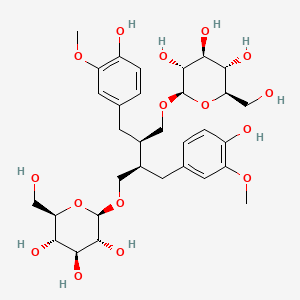 Compound
- Category
- Compound
What Secoisolariciresinol diglycoside is, and what it does.
- Does it work
- Suits people who want flax lignans in a measured form rather than by the tablespoon, and anyone comparing two labels and wondering whether the two spellings mean two things.
- How much to take
- No daily amount is on record for the purified compound. Start with a lignan-standardised flax product taken daily with a meal, because steady intake keeps the gut conversion running.
- Time to feel it
- Nothing here arrives as a sensation. Enterolactone in blood climbs over the first days of steady intake, and that measure is what research tracks instead.
- The first dose
- Nothing shows on the surface. The molecule travels to the colon intact and bacteria start removing its two sugars, the step that has to happen before anything else can.
- With regular use
- Across weeks, enterolignan levels settle at a higher plateau thanks to enterohepatic recycling. What changes appears on hormone and blood lipid panels rather than in your day.
- How well tolerated
- Well tolerated at the intakes people get from food. The end products are weak phytoestrogens, so pregnancy, breastfeeding or hormone medication are reasons to ask a doctor first.
- How it feels
- No direct sensation from the lignan itself. Taken as ground seed, the fibre alongside it usually makes itself known as steadier regularity within a few days.
- The overlooked benefit
- It's water soluble, so it stays in the press cake when flax oil is pressed. A plain bottle of flaxseed oil carries very little unless a lignan fraction was added back.
The proof, claim by claim.
What these words mean
These words describe the research, not the molecule's worth. Research strength is how much work stands behind one claim, and it is never a product score.
- identity as the same compound as secoisolariciresinol diglucoside, abbreviated SDGNarrative review
- ester linkage into an oligomer with 3-hydroxy-3-methylglutaric acid in the intact seedNarrative review
3 more claims
- colonic bacterial conversion to enterodiol and enterolactoneNarrative review
- weak oestrogen receptor binding by the enterolignan productsIn vitro study
- support for blood lipids already in the normal rangeMeta-analysis
Why these belong in the same formula, 6 pairings
Why these belong in the same formula. Each row says what the basis is, from settled biochemistry through to a trial that measured the pair.
Deglycosylation, demethylation and dehydroxylation are all bacterial steps performed in the colon. Individuals with the same intake differ several-fold in enterolactone output, and antibiotic exposure collapses production, which is direct evidence the step is microbial. A probiotic does not reliably raise conversion because the responsible taxa are not fully identified. What holds is the dependence itself.
Freeing secoisolariciresinol from its two attached glucose units requires bacterial beta-glucosidase, an activity well described in Bifidobacterium species. The later demethylation and dehydroxylation steps involve different organisms, so no single strain completes the sequence. Adding one strain addresses one step of several.
Enterolignan formation happens where bacterial density and fermentative activity are highest. Fructooligosaccharides are established substrate for that community. The step from more substrate to more enterolactone is inference rather than measurement. It is a defensible formulation choice with no human confirmation for this specific pairing.
Flaxseed supplies alpha-linolenic acid, which converts to EPA at a low and variable rate in humans, and to DHA at lower rates still. Marine oil supplies EPA and DHA directly and bypasses that conversion. The lignan fraction is a separate constituent that survives oil pressing into the meal. Pairing them covers two different things from the same seed's reputation.
Fermentation of resistant starch lowers colonic pH and raises short chain fatty acid production, both of which shape which bacteria are active. Whether that shift favours the enterolignan-producing taxa specifically has not been shown. Read this as mechanistically plausible rather than demonstrated.
Enterolignans are glucuronidated in the liver, secreted in bile and partly deconjugated by bacterial beta-glucuronidase before reabsorption. Calcium D-glucarate is used specifically to inhibit that bacterial glucuronidase. Inhibiting it would be expected to reduce enterolignan reabsorption and shorten their circulation. Whether that happens at supplement doses has not been measured, but the direction is the interesting part.
Nothing specific on file for Secoisolariciresinol diglycoside. Match the label to the daily amount above, and tell your doctor what you take.
Not medical advice. Show the label to your pharmacist.What Secoisolariciresinol diglycoside actually does.
Secoisolariciresinol diglycoside and diglucoside are just two names for the same compound, shortened to SDG, and it's flaxseed's main lignan.
3 more mechanisms
In the raw seed, SDG is bound up in a larger structure, which is why extraction methods use a mild alkaline step to free it.
SDG doesn't do much on its own. Gut bacteria strip it down and convert it into enterodiol, which gets further changed into enterolactone.
These converted compounds act as weak, plant-based estrogen mimics, much less potent than the body's own estrogen, and depending on the tissue they can either mimic or block hormone signaling.
Where Secoisolariciresinol diglycoside comes from.
It comes from flaxseed, specifically the dry cake left after the oil is pressed out. Alcohol pulls it from the cake, a mild alkali frees it from the bigger molecule it is stuck to, and the cleaned-up result is dried into a powder.
What this route gives you
Made from a plant. What ends up in the capsule tracks the harvest, so batch testing and a stated marker matter more here than with a made molecule.
7 steps on record
Flaxseed, brown or golden, grown mainly in Canada, Russia, Kazakhstan and China.
Oil is separated by cold pressing or solvent defatting. The water-soluble lignan stays in the residual meal rather than following the oil.
Defatted meal is extracted with aqueous ethanol or methanol to bring the lignan macromolecule into solution.
Dilute base cleaves the ester linkages to 3-hydroxy-3-methylglutaric acid, releasing free SDG from the native oligomer.
Macroporous resin and further chromatography concentrate SDG while removing mucilage, sugars and the seed's cyanogenic glycosides.
SDG is quantified by high performance liquid chromatography and the concentrate is diluted with carrier to the labelled percentage.
Supplied as a lignan complex powder for capsules and tablets, or suspended into flax oil.
Getting Secoisolariciresinol diglycoside from food.
The whole-food sources on file. A supplement closes the gap, it does not replace dinner.
A gram-for-gram figure (how much of each you would eat to match a dose) will appear here once it is sourced and reviewed. This page will not print a number it cannot cite.
The forms it comes in.
3 more forms
The essence, in one line each.
- The authors review dietary SDG from flaxseed and conclude the supporting human data remain preliminary.Narrative review. Dobrowolska K et al., 2021 (Roczniki Panstwowego Zakladu Higieny). PMID 33882661 ↗
5 more findings
- In healthy young women, the conversion of flaxseed's lignan precursors into mammalian lignans was dose-dependent, but was not affected by processing the flaxseed into a muffin or bread.Open-label trial. Nesbitt PD et al., 1999 (American Journal of Clinical Nutrition). PMID 10075344 ↗
- In a 60-day randomised trial in adults with a history of a specific colon condition, a preparation containing phytoestrogens and insoluble fiber was associated with a significant increase in colonic estrogen receptor beta protein, a tissue marker.Randomised trial, in patients with previous sporadic colonic adenomas. Principi M et al., 2013 (World Journal of Gastroenterology). PMID 23885143 ↗
- In a randomised crossover trial in 46 healthy adults, 60 days of a flaxseed lignan extract (50 mg of secoisolariciresinol diglucoside per day) did not lead to detectable changes in plasma bile acid concentrations compared to a placebo.Randomised trial. Navarro SL et al., 2020 (Nutrients). PMID 32575611 ↗
- In a trial with 42 healthy adults, 60 days of a flaxseed lignan extract (50 mg secoisolariciresinol diglucoside per day) led to changes in gene expression in exfoliated colon cells found in feces, but not in tissue from the colon wall itself.Randomised trial. Lampe JW et al., 2019 (American Journal of Clinical Nutrition). PMID 31175806 ↗
- The review situates flaxseed lignans among edible seed compounds whose bioavailability depends on the food matrix and on how the seed is processed.Narrative review. Raza N et al., 2026 (Food Science and Nutrition). PMID 41625268 ↗
Chosen from the 6 we read for Secoisolariciresinol diglycoside.
FDA Disclaimer: These statements have not been evaluated by the Food and Drug Administration. This information is for educational purposes only and is not intended to diagnose, treat, cure, or prevent any disease. Consult your healthcare provider before starting any supplement regimen.