Arginine pyroglutamate.
A near-neutral, easily dissolved arginine salt. Arginine is the substrate your body oxidises to nitric oxide, which is why this form turns up in blood-flow and pump formulas.
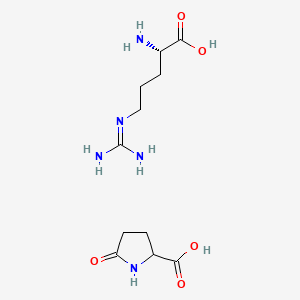 Compound
- Category
- Compound
What Arginine pyroglutamate is, and what it does.
- Does it work
- Suits people who want arginine in a powder that isn't harshly acidic or alkaline, and lifters building a pre-workout. Compare forms on arginine content, not on powder weight.
- How much to take
- No dose figure is on record for this salt. Start from the arginine it actually delivers, because the pyroglutamate counter-ion carries a real share of the weight.
- Time to feel it
- Plasma arginine rises within an hour or two of a dose. Whether that becomes something you notice around training varies a lot from person to person.
- The first dose
- It mixes cleanly without the bite of the hydrochloride. Some people notice warmth or a fuller pump in a working set, and for others day one is uneventful.
- With regular use
- Weeks of daily use is where nitric oxide and blood-flow measures get tracked. Gut and liver arginase blunt how much arrives, so the changes measured are modest.
- How well tolerated
- Generally well tolerated. Larger single doses upset the gut, since much of the dose is broken down there. Check with a clinician if you take blood pressure or nitrate medicine.
- How it feels
- Subtle. Some people report warmth in the hands or a fuller feeling in the muscle mid-set, and the effect is inconsistent between people and between days.
- The overlooked benefit
- The pyroglutamate half isn't inert packaging. It ring-opens to glutamate and sits on the gamma-glutamyl cycle that turns over glutathione.
The proof, claim by claim.
What these words mean
These words describe the research, not the molecule's worth. Research strength is how much work stands behind one claim, and it is never a product score.
- nitric oxide production from arginineNarrative review
- blood pressure already in the normal rangeMeta-analysis
3 more claims
- growth hormone response to oral arginine pyroglutamateRandomised trial
- exercise performance and blood flow during trainingRandomised trial
- first-pass arginase degradation limiting oral arginine deliveryNarrative review
Why these belong in the same formula, 12 pairings
Why these belong in the same formula. Each row says what the basis is, from settled biochemistry through to a trial that measured the pair.
Oral citrulline bypasses the intestinal and hepatic arginase that degrades a large share of an oral arginine dose, then is converted to arginine in the kidney. That is why citrulline raises plasma arginine more efficiently per gram than arginine itself does. Stacking the two feeds the same pool by two different routes. The biochemistry is settled. How much any given dose ratio matters in practice depends on the endpoint being measured.
Arginase splits arginine into ornithine and urea, and ornithine re-enters the urea cycle to be rebuilt into citrulline and then arginine. The two amino acids sit on the same loop, so supplying both adds to one pool rather than two. Ornithine is also the entry point to polyamine synthesis via ornithine decarboxylase.
Both are basic amino acids carried by the same CAT transporters, so at high doses each reduces the uptake of the other. This cuts both ways and is dose-dependent rather than absolute. Worth knowing because arginine and lysine are also combined deliberately in older formulations, so the same pairing is both a competition and a formulation convention depending on the ratio and the goal.
The small intestine is the main site of endogenous citrulline production and glutamine is its principal substrate. That citrulline is then converted to arginine in the kidney, which makes glutamine an upstream contributor to arginine availability. The pathway is well mapped in metabolic studies. What a supplemental glutamine dose adds to that flux in a healthy adult is less clear.
Arginine:glycine amidinotransferase transfers the amidino group from arginine to glycine to make guanidinoacetate, which is then methylated to creatine. Arginine is therefore a creatine precursor. Supplying creatine directly bypasses that route entirely, which spares the arginine and the methyl group both. Read the pairing as covering the same downstream endpoint from two directions.
Guanidinoacetate synthesis needs an arginine and a glycine together, so glycine availability sits alongside arginine in that step. Glycine is also a major sink for methyl groups elsewhere in metabolism, which is why the creatine pathway and methylation status are linked. This is textbook pathway structure rather than a tested combination.
Nitric oxide synthase needs tetrahydrobiopterin to couple arginine oxidation properly. When BH4 is oxidised the enzyme uncouples and produces superoxide instead of nitric oxide. Ascorbate helps keep BH4 reduced, which is the mechanistic argument for pairing it with an arginine source. The cofactor chemistry is well established. Whether adding ascorbate changes nitric oxide output in a person with adequate status is a separate question.
The reductase domain of NOS carries FAD and FMN, both derived from riboflavin, and passes electrons from NADPH to the heme domain where arginine is oxidised. Riboflavin status is therefore structurally upstream of the whole reaction. This is enzyme composition, not a clinical claim about supplementing riboflavin.
Nitrate from beetroot is reduced to nitrite by oral bacteria and then to nitric oxide in tissue, entirely bypassing the enzyme that uses arginine. The two therefore reach the same endpoint by separate routes and their effects on vascular tone can add. That additive potential is the reason to flag the pairing for anyone already on blood pressure medication, rather than a reason to stack them freely.
The pyroglutamate counter-ion is not inert filler. 5-oxoprolinase converts it to glutamate at the cost of an ATP, and it sits on the same gamma-glutamyl cycle that recycles glutathione. NAC feeds the cysteine side of that cycle. The two therefore touch the same metabolic loop from different points. This is pathway structure, and no combination study has been done at supplement doses.
Arginine catabolism through ornithine feeds pyrroline-5-carboxylate, which reductase converts to proline. Arginine, ornithine, glutamate and proline sit on one interconnected node, so pushing one raises flux the others draw on. This matters for anyone counting proline supply for collagen synthesis, where both routes contribute.
Arginase, the enzyme that diverts arginine away from nitric oxide synthesis, is a binuclear manganese metalloenzyme, and divalent metal status broadly influences this branch point. The link to zinc specifically is indirect and has not been quantified in people. Read it as a reason to keep mineral status in view rather than as a working pairing.
Nothing specific on file for Arginine pyroglutamate. Match the label to the daily amount above, and tell your doctor what you take.
Not medical advice. Show the label to your pharmacist.What Arginine pyroglutamate actually does.
Arginine pyroglutamate is a salt pairing arginine with pyroglutamic acid, and once it dissolves in water the two parts separate and your body handles them independently.
3 more mechanisms
Because the pyroglutamate part adds weight without adding arginine, a gram of this salt gives you less arginine than a gram of plain arginine, so any dose comparison needs to be based on arginine content, not total powder weight.
Arginine is the raw material an enzyme converts into nitric oxide, using several cofactors along the way, and that's the basis for every vascular claim made about arginine ingredients.
A large share of an oral arginine dose gets broken down in the gut and liver before it reaches your bloodstream, which is why blood arginine rises far less than the dose taken and why higher single doses can upset your stomach.
Where Arginine pyroglutamate comes from.
Bacteria make the arginine from sugar in a tank. The pyroglutamic acid partner comes from glutamic acid made the same way. The two are put together in water so the powder is not harshly alkaline, then dried.
What this route gives you
The same molecule is reached more than one way. Which route a given product used is a manufacturing choice, and the finished compound is the same either way.
6 steps on record
Fermentation substrate for the arginine half. Plant-derived carbohydrate, which is why the finished salt is typically declared suitable for vegetarian formats.
Engineered Corynebacterium glutamicum or Escherichia coli strains overproduce L-arginine into the broth. This is the route behind essentially all commercial L-arginine.
L-glutamic acid, itself a fermentation product, is cyclised by controlled heating to L-pyroglutamic acid with loss of water.
Both components are recovered from broth by ion exchange, decolourised and crystallised to remove residual biomass and fermentation by-products.
The arginine base and pyroglutamic acid are combined in water at a controlled molar ratio, which neutralises the strongly alkaline free base.
The neutralised solution is concentrated and dried to a free-flowing hygroscopic powder that requires moisture-protected packing.
Getting Arginine pyroglutamate from food.
The whole-food sources on file. A supplement closes the gap, it does not replace dinner.
A gram-for-gram figure (how much of each you would eat to match a dose) will appear here once it is sourced and reviewed. This page will not print a number it cannot cite.
The forms it comes in.
3 more forms
FDA Disclaimer: These statements have not been evaluated by the Food and Drug Administration. This information is for educational purposes only and is not intended to diagnose, treat, cure, or prevent any disease. Consult your healthcare provider before starting any supplement regimen.