Diiodothyronine.
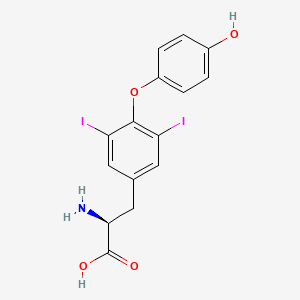
Diiodothyronine is what's left after an enzyme strips one iodine atom off T3. It's a thyroid hormone metabolite, studied mostly for how cells burn fuel.
 Compound
- Category
- Compound
What Diiodothyronine is, and what it does.
- Does it work
- This suits people reading a label closely, since it turns up inside dried thyroid glandular products. If you take thyroid medication, speak to your clinician before adding it.
- How much to take
- No daily amount is on record for diiodothyronine, and we won't invent one. It's a hormone metabolite, so the amount is a conversation to have with a clinician first.
- Time to feel it
- Nobody has established a reliable time to effect in people. Thyroid signalling reads on a blood panel over weeks rather than as something you notice on a given day.
- The first dose
- Day one gives most people nothing to notice. Any change from a thyroid metabolite shows up in lab values, not in how the afternoon feels.
- With regular use
- Weeks of daily use haven't been mapped in controlled human work. What is measurable is a thyroid panel, which is the reason to have one checked while using it.
- How well tolerated
- This is hormone related, so it deserves respect. Glandular sources carry unmeasured amounts, and anyone on thyroid medication, pregnant or breastfeeding should check with a clinician.
- How it feels
- Most people report no distinct sensation. Where thyroid signalling shifts anything, it tends to register as body temperature and steadiness over weeks, and on a blood panel.
- The overlooked benefit
- The enzymes that make it are selenoproteins, so the whole path from T4 to T3 to T2 leans on adequate selenium and iodine, not only on what's in the capsule.
The proof, claim by claim.
What these words mean
These words describe the research, not the molecule's worth. Research strength is how much work stands behind one claim, and it is never a product score.
- thyroid hormone signalling and its metabolitesNarrative review
- resting energy expenditure and fuel useAnimal study
2 more claims
- mitochondrial respirationIn vitro study
- lipid markers in early human observationCohort study
Why these belong in the same formula, 10 pairings
Why these belong in the same formula. Each row says what the basis is, from settled biochemistry through to a trial that measured the pair.
Type 1, 2 and 3 deiodinases all require selenocysteine to strip iodine atoms from the thyronine ring, and diiodothyronine is generated by exactly that sequence of reactions. Low selenium status impairs deiodinase activity, which is settled biochemistry rather than an inference. This describes how the body makes diiodothyronine and is not a claim that supplemental selenium raises it.
Iodide is trapped by the thyroid, oxidised, and attached to tyrosine residues on thyroglobulin to give monoiodotyrosine and diiodotyrosine, which couple to form T4 and T3. Diiodothyronine arises downstream when deiodinases remove further iodine atoms. Without adequate iodine none of it proceeds, though excess iodine has its own consequences and more is not better here.
Thyroid peroxidase needs its heme prosthetic group to catalyse iodide oxidation and coupling, so low iron status limits hormone synthesis upstream of any deiodination step. This is why iron status is examined alongside thyroid measures. Iron also interferes with the absorption of orally taken thyroid hormone when the two are swallowed together, which is a separate and opposite consideration.
Iodination occurs on tyrosine residues within the thyroglobulin protein rather than on free tyrosine, so supplemental free tyrosine does not straightforwardly feed the pathway. The structural relationship is real, the practical relationship is much weaker than supplement marketing suggests. Dietary protein supplies far more tyrosine than the thyroid pathway consumes.
Thyroid hormone receptors use zinc finger domains to bind DNA, so zinc status touches the response side of the axis rather than hormone synthesis. Deiodinase activity has also been reported to be lower in zinc-deficient states. This matters for people with genuinely low zinc status and says little for anyone already replete.
Calcium carbonate is a documented cause of reduced levothyroxine absorption when taken at the same time, and separating the doses by several hours is the standard handling. Any orally administered iodothyronine is subject to the same physical chemistry. This is an interaction to plan around rather than a reason to avoid either substance.
Ferrous sulfate taken alongside thyroid hormone measurably reduces its absorption, which is why prescribing guidance separates them in time. The same binding chemistry applies to iodothyronines generally. Note the direction is opposite to iron's supportive role in hormone synthesis, so both statements are true at once and the difference is timing.
Studies of levothyroxine absorption show a measurable reduction when the dose is taken with coffee rather than water, with the effect attributed to binding or to accelerated transit. Separating the two by roughly an hour restores absorption. The finding was established for levothyroxine, and applying it to other orally taken iodothyronines is an extension rather than a direct result.
Thyroid hormone receptors bind DNA as heterodimers with RXR, and 9-cis retinoic acid is the RXR ligand, so the two nuclear receptor systems are physically coupled at the level of gene transcription. This is textbook nuclear receptor biology. It describes signalling architecture and does not mean vitamin A supplements change thyroid hormone levels.
Trials of standardised ashwagandha root extract have reported increases in T3 and T4 and decreases in TSH in some participants. Adding it on top of an exogenous iodothyronine pushes the same axis in the same direction from two places. This one belongs in a caution box rather than a stack suggestion, and it is a conversation for a prescriber.
Nothing specific on file for Diiodothyronine. Match the label to the daily amount above, and tell your doctor what you take.
Not medical advice. Show the label to your pharmacist.What Diiodothyronine actually does.
This is a breakdown product of thyroid hormone, formed when enzymes strip one iodine atom off T3, and it comes in a couple of related forms.
2 more mechanisms
The enzymes that make this depend on selenium, so turning thyroid hormone T4 into T3 and then into this metabolite needs adequate selenium as well as adequate iodine.
This is a different molecule from diiodotyrosine, which is just a building block in thyroid hormone synthesis rather than something that circulates in the blood, but the similar names get mixed up on product labels.
Where Diiodothyronine comes from.
Your body makes this by stripping iodine off thyroid hormone, one atom at a time. What ends up in a bottle is either made in a lab or comes along inside dried animal thyroid tissue, and in that second case nobody has usually measured how much is there.
What this route gives you
The same molecule is reached more than one way. Which route a given product used is a manufacturing choice, and the finished compound is the same either way.
6 steps on record
In the body, T2 is formed from T4 and T3 by sequential deiodination in the liver, kidney and other tissues
Selenocysteine-containing deiodinase enzymes remove iodine atoms one at a time, giving T3 and then the T2 isomers
Commercially supplied 3,5-T2 is chemically synthesised from thyronine precursors rather than extracted
Bovine or porcine thyroid glands dried and powdered, carrying whatever hormone content the tissue held
Synthetic material is purified and assayed. Glandular material generally is not assayed for hormone content
Supplied either as a defined synthetic compound or as undefined glandular tissue
The forms it comes in.
3 more forms
FDA Disclaimer: These statements have not been evaluated by the Food and Drug Administration. This information is for educational purposes only and is not intended to diagnose, treat, cure, or prevent any disease. Consult your healthcare provider before starting any supplement regimen.