Echinacoside.
A plant polyphenol from Cistanche used in healthy ageing formulas. It quenches radicals in laboratory assays, and most of its 1,366 published records are preclinical.
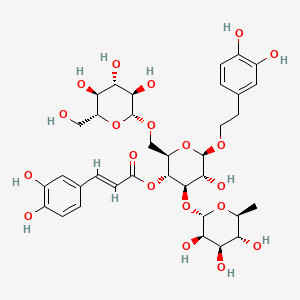 Compound
- Category
- Compound
What Echinacoside is, and what it does.
- Does it work
- Suits people building a healthy ageing routine who are comfortable with an ingredient grounded in chemistry and animal work rather than human trials.
- How much to take
- No daily amount is on record. Follow the extract's label, and read the percentage as marker content of that extract rather than a dose of isolated compound.
- Time to feel it
- Nobody has measured this in humans. Polyphenols of this type are taken daily across weeks as background support.
- The first dose
- Day one passes without sensation for most people. Whatever it does happens at the level of cell chemistry rather than perception.
- With regular use
- Daily use across weeks is the pattern in the animal work. Human outcomes over that span have not been measured.
- How well tolerated
- No specific safety signal is on record at ordinary extract amounts. Pregnant or breastfeeding people, and anyone on medication, should check first.
- How it feels
- There is no reported subjective effect. This one lives in laboratory measures rather than in how your day goes.
- The overlooked benefit
- Little of it reaches your blood intact. Gut bacteria clip it into caffeic acid and hydroxytyrosol, and those smaller phenolics are what actually get absorbed.
The proof, claim by claim.
What these words mean
These words describe the research, not the molecule's worth. Research strength is how much work stands behind one claim, and it is never a product score.
- Radical scavenging and antioxidant defenceIn vitro study
- Cellular stress defenceAnimal study
1 more claim
- Healthy inflammatory responseAnimal study
Why these belong in the same formula, 6 pairings
Why these belong in the same formula. Each row says what the basis is, from settled biochemistry through to a trial that measured the pair.
Intact echinacoside is poorly absorbed, so the microbiota performs the cleavage step that generates caffeic acid and hydroxytyrosol. People differ substantially in the bacterial enzymes they carry, which is one plausible reason responses to polyphenol-rich extracts vary. Whether supplementing specific strains raises that conversion has not been shown for this compound. The dependence on microbial conversion is established, the benefit of adding strains is not.
Inulin feeds bifidobacteria and other saccharolytic organisms whose glycosidases act on plant glycosides. The link to echinacoside conversion specifically is inferred from the compound class rather than measured. No human study has paired them. Read it as mechanistic reasoning about a conversion step.
A placebo-controlled trial tested the two extracts together, with echinacoside present as the marker constituent of the Cistanche side rather than as an isolated ingredient. Because both extracts were given as one combination, the design cannot separate what each contributed. The pairing is documented as a formulation, not as a demonstrated interaction between the isolated compounds. Anyone citing it should say the trial tested extracts.
Once a catechol donates a hydrogen atom it becomes a phenoxyl radical, and ascorbate can return it to the reduced state in vitro. Whether this recycling operates at physiological concentrations in people is not settled for any single polyphenol, let alone this one. The interaction is chemistry observed in model systems, not a measured human outcome. State it as mechanism only.
Both quercetin and the caffeic acid fragments released from echinacoside are handled by sulfotransferases and UDP-glucuronosyltransferases in the gut wall and liver. High simultaneous loads of dietary phenolics can compete for that conjugation capacity, which alters circulating metabolite profiles. This has been shown for phenolics as a class, not specifically for this pair. The practical effect at supplement doses is unknown.
Deglycosylation of plant glycosides by lactobacilli is well documented across several compound families. Applying that to echinacoside is a reasonable extension of enzyme class, not a measured conversion. No trial has tested strain supplementation alongside this compound. Keep the claim at the level of the enzyme, not the outcome.
Nothing specific on file for Echinacoside. Match the label to the daily amount above, and tell your doctor what you take.
Not medical advice. Show the label to your pharmacist.What Echinacoside actually does.
It is a big sugar-linked plant molecule with a caffeic acid piece and a hydroxytyrosol piece hung on it.
3 more mechanisms
The two-hydroxyl ring structure is what makes it mop up radicals in a test tube.
Your gut bacteria chop it up first. What circulates is mostly the fragments, not the original molecule.
On a Cistanche label the echinacoside percentage is a quality marker, not a dose of pure compound.
Where Echinacoside comes from.
It comes from a desert plant that grows on the roots of shrubs. The stems are dried, extracted with water or weak alcohol, and cleaned up until the marker compound hits a stated percentage. Researchers have also built the pathway into yeast.
What this route gives you
Made from a plant. What ends up in the capsule tracks the harvest, so batch testing and a stated marker matter more here than with a made molecule.
6 steps on record
A root-parasitic desert plant harvested in arid regions of China and Central Asia, increasingly from managed cultivation on host shrubs because of pressure on wild stands.
Stems are sliced and dried promptly, since the phenylethanoid glycosides degrade in moist warm material.
Hot water or dilute ethanol pulls the polar glycoside fraction from the dried stem.
The crude extract passes over adsorbent resin to remove sugars and salts and enrich the phenylethanoid fraction. Further chromatography yields the isolated compound.
Batches are released on a stated echinacoside percentage, frequently reported together with acteoside.
Spray-dried extract powder for capsules and tablets, or a high-purity isolate for reference and specialist use.
The forms it comes in.
4 more forms
The essence, in one line each.
- The authors report the full biosynthetic route to echinacoside in Cistanche deserticola and rebuild it in engineered yeast for de novo production.In vitro study. Ban et al., 2025 (Plant Communications). PMID 40566684 ↗
2 more findings
- A bile acid and FXR signalling study in which echinacoside is named among the compounds discussed, with the primary work centred on a Lactobacillus reuteri intervention in animals.Animal study. Yuan et al., 2026 (The ISME Journal). PMID 42301903 ↗
- A mechanistic animal study of mitophagy and carnitine metabolism in kidney tissue where echinacoside appears as a mentioned compound rather than the tested intervention.Animal study. Hu et al., 2026 (Autophagy). PMID 41139215 ↗
Chosen from the 4 we read for Echinacoside.
The studies, linked.
1 source behind our Echinacoside verdict, every one linked to PubMed, the journal or ClinicalTrials.gov.
- Clinical trialA Single-center, Randomized, Double-blind, Placebo-controlled, Dose Escalation Safety, Tolerability, and Pharmacokinetic Phase I Clinical Study of Naoqingzhiming Tablets in Chinese Healthy SubjectsClinicalTrials.gov ↗Phase 1, 76 participants, Unknown
From clinical trials and PubMed, ranked by study type and citation weight, not cherry-picked.
FDA Disclaimer: These statements have not been evaluated by the Food and Drug Administration. This information is for educational purposes only and is not intended to diagnose, treat, cure, or prevent any disease. Consult your healthcare provider before starting any supplement regimen.