Elenolic acid.
It's the fragment released when olive's oleuropein splits apart, and it's part of what makes fresh olive oil bitter and peppery at the back of the throat.
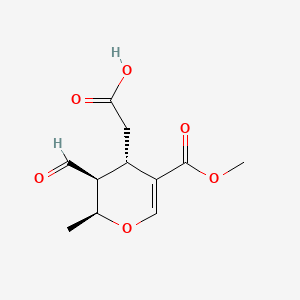 Compound
- Category
- Compound
What Elenolic acid is, and what it does.
- Does it work
- It suits people already interested in olive polyphenols who want to know what the oleuropein figure on a label becomes once it meets the gut.
- How much to take
- No daily amount is on record. Olive products are measured by oleuropein instead, because the free acid doesn't stay stable long enough to standardise.
- Time to feel it
- The throat pungency of a phenolic olive oil is immediate. Anything beyond taste has not been measured in people for this compound alone.
- The first dose
- Day one is a taste experience more than a sensation. Nobody has measured what a single day of the isolated acid does.
- With regular use
- Weeks of olive polyphenol intake have been studied as part of an olive oil pattern. The isolated acid has not been followed over time in people.
- How well tolerated
- Olive fruit and leaf are long-standing foods, and this fragment is eaten daily wherever olive oil is. Isolated preparations have no human tolerance record.
- How it feels
- Bitter, then a peppery catch at the back of the throat that can make you cough. That sting tells you phenolics are present.
- The overlooked benefit
- The throat sting doubles as a rough freshness check, because it tracks secoiridoid content. A bland oil is telling you something about the bottle.
The proof, claim by claim.
What these words mean
These words describe the research, not the molecule's worth. Research strength is how much work stands behind one claim, and it is never a product score.
- bitterness and throat pungency of fresh olive oilNarrative review
- release from oleuropein during milling and digestionNarrative review
2 more claims
- radical scavenging by olive secoiridoids in chemical assaysIn vitro study
- olive polyphenol intake and markers of blood lipid oxidationRandomised trial
Why these belong in the same formula, 9 pairings
Why these belong in the same formula. Each row says what the basis is, from settled biochemistry through to a trial that measured the pair.
Oleuropein hydrolysis yields hydroxytyrosol and the elenolic acid moiety in the same reaction, so their ratio in a product is decided by processing rather than by formulation. Hydroxytyrosol is the better absorbed and better characterised of the two. An extract standardised only to hydroxytyrosol says nothing directly about elenolic acid content. Read them as two halves of one parent compound.
Ligstroside is the mono-hydroxylated counterpart of oleuropein, and its cleavage produces tyrosol alongside the same secoiridoid backbone. That is why olive products contain both phenolic alcohols in fixed company with the secoiridoid fraction. Tyrosol lacks the catechol group, so its radical chemistry is weaker than hydroxytyrosol's. The relationship is compositional and enzymatic.
The derivatives are carried in the oil phase and reach the small intestine within a fat matrix that supports their dispersion and uptake. Refining strips most of the phenolic fraction, so refined oil and extra virgin oil are not equivalent here. The vehicle is part of what defines the exposure. Taking an isolated olive phenolic without fat is a different pharmacokinetic situation.
Medium chain triglycerides are rapidly emulsified and can carry lipophilic secoiridoid derivatives into mixed micelles. The principle is well established for fat soluble compounds in general. Direct measurement of this effect on olive secoiridoids specifically is limited. Formulators use it as a dispersion aid rather than as a documented absorption claim.
Lecithin lowers interfacial tension and helps form the mixed micelles that carry poorly soluble compounds to the enterocyte. This is standard formulation practice across lipophilic botanicals. Whether it changes measured exposure to olive secoiridoids in people has not been established. Count it as a formulation aid with mechanistic backing.
Tocopherols intercept lipid peroxyl radicals in the lipid phase while olive phenolics act at the lipid and water interface. In oil systems the two together slow oxidation more than either alone, which is why both matter to oil shelf life. Extending that to circulating lipid oxidation in people is not supported by measurement on this compound. The evidence is strongest in the food matrix.
Only part of ingested oleuropein is cleaved by host enzymes, and colonic bacteria handle the remainder. That microbial step shapes which metabolites appear in plasma and urine. Individual differences in gut flora are one reason phenolic metabolite profiles vary between people given the same dose. Whether adding specific strains changes that has not been shown for olive compounds.
The recycling chemistry applies to the catechol partner rather than to elenolic acid itself, which lacks that structure. Anyone claiming a direct ascorbate interaction with elenolic acid is describing the wrong half of the molecule. In a whole olive extract both halves are present, so the interaction is with the preparation, not the compound. State which one is meant.
Hydroxytyrosol and related catechols bind ferric iron, a well characterised property of catechol structures. In an olive extract that means simultaneous intake with a non-heme iron supplement can reduce the fraction absorbed. Elenolic acid itself lacks the catechol group and is not the chelating part. Separating an iron dose from a phenolic-rich olive extract by two hours is the usual practical response.
Nothing specific on file for Elenolic acid. Match the label to the daily amount above, and tell your doctor what you take.
Not medical advice. Show the label to your pharmacist.What Elenolic acid actually does.
Oleuropein splits into two useful pieces. Elenolic acid is one of them and hydroxytyrosol is the other.
3 more mechanisms
The moment you crush an olive, its own enzymes start converting oleuropein. How you crush it changes what you end up with.
On its own it does not sit still in water. In real products it exists mostly as related derivatives.
That peppery catch at the back of the throat from good olive oil is the secoiridoids talking.
Where Elenolic acid comes from.
It is one half of what olive's main bitter compound breaks into. You get it from olive leaves, olives or the water left after pressing oil, and labels almost always measure the parent compound instead because this half does not sit still long enough to measure easily.
What this route gives you
Made from a plant. What ends up in the capsule tracks the harvest, so batch testing and a stated marker matter more here than with a made molecule.
6 steps on record
Leaves pruned from olive groves, whole fruit, or the aqueous stream left after oil pressing. All three carry oleuropein and its cleavage products.
Native beta-glucosidase acts as soon as tissue is disrupted, splitting oleuropein into hydroxytyrosol and the elenolic acid moiety. Controlled acid or enzyme hydrolysis is used to push this deliberately.
Solvent extraction of dried leaf or fruit, or membrane and resin recovery from wastewater streams.
Adsorbent resin removes sugars and organic acids, with preparative chromatography needed to isolate the acid itself.
Commercial specifications almost always quote the parent glycoside or the phenolic alcohol rather than elenolic acid, because the acid is unstable and harder to assay.
Sold as standardised leaf or fruit extract powder, as phenolic-rich oil, or as a small-scale isolate for laboratory use.
Getting Elenolic acid from food.
The whole-food sources on file. A supplement closes the gap, it does not replace dinner.
A gram-for-gram figure (how much of each you would eat to match a dose) will appear here once it is sourced and reviewed. This page will not print a number it cannot cite.
The forms it comes in.
3 more forms
The essence, in one line each.
- An untargeted metabolomics analysis tracking how olive leaf phenolic compounds are metabolised and excreted in urine after intake, with elenolic acid derivatives appearing among the compounds discussed rather than as the tested substance.Open-label trial. Fernandez-Moreno et al., 2025 (Food Research International). PMID 41267315 ↗
Chosen from the 1 we read for Elenolic acid.
FDA Disclaimer: These statements have not been evaluated by the Food and Drug Administration. This information is for educational purposes only and is not intended to diagnose, treat, cure, or prevent any disease. Consult your healthcare provider before starting any supplement regimen.