Ethylcellulose.
A coating material that can control how quickly your supplement releases its contents. Creates a semi-permeable coating that controls how quickly active ingredients are released from a tablet.
Reviewed March 2026
- Category
- General
- Also filed under
- Enables sustained release formulationsProtects against moistureControls ingredient release timing
What Ethylcellulose is, and what it does.
- Does it work
- Functional excipient with real value for controlled-release formulations. Not therapeutic itself.
- How much to take
- No dose figure is on record, and there isn't one to take. The amount is set by the formulator as a film weight, chosen to meter how fast the active behind it diffuses out.
- Time to feel it
- It's a film, not an active. It doesn't dissolve, it meters how fast what's inside diffuses out, so any timing you notice belongs to the active behind the coating.
- The first dose
- If it's a sustained-release coating, you may notice a smoother, longer-lasting effect from the active ingredients.
- With regular use
- Over weeks the coating does the same job every dose: metering release so the active behind it arrives at a steadier rate. It passes through undigested rather than building up.
- How well tolerated
- Well tolerated. Not absorbed by the body.
- How it feels
- You don't feel the coating. You may notice a different release profile of the active ingredients.
- The overlooked benefit
- It gels edible oil on cooling into something that behaves like solid fat without hydrogenation. Very few polymers will structure an oil that way.
The proof, claim by claim.
These words describe the research, not the molecule's worth. Research strength is how much work stands behind one claim, and it is never a product score.
- Enables controlled-release delivery
- Not absorbed by the body
Questions people ask about Ethylcellulose.
- Why shouldn't I crush my coated tablet?
- Ethylcellulose coating controls release timing. Crushing it could release the full dose at once instead of slowly over hours.
- Is it vegan?
- Yes. Derived from plant cellulose.
- Does it slow down how fast my supplement works?
- That's often the point. Sustained-release means a smoother, longer-lasting effect instead of a quick spike and drop.
Why these belong in the same formula. Each row says what the basis is, from settled biochemistry through to a trial that measured the pair.
Ethylcellulose forms a water-insoluble film that meters how fast a core dissolves. Sustained-release beta-alanine is built this way so the amino acid enters the blood gradually rather than in one sharp peak, which is what drives the tingling skin sensation.
Iron salts taste metallic and react with other actives in a blend. An ethylcellulose shell around the iron particle keeps it physically separated until it reaches the gut, so taste and ingredient-to-ingredient contact are both reduced.
Potassium chloride is bitter and releases a concentrated salt load at one spot on the gut wall. An ethylcellulose matrix or coat spreads that release over time, lowering the local concentration at any single point of contact.
Free nicotinic acid produces a rapid rise in plasma concentration that causes the familiar warm flushing sensation. An ethylcellulose release-controlling layer flattens that peak by letting the niacin dissolve out over a longer window.
Ethylcellulose films are water-insoluble, so a water-soluble cellulose ether such as hypromellose is blended into the coat as a pore former. It dissolves out on contact with gut fluid and leaves the channels through which the active diffuses. Changing the ratio of the two is the standard way of tuning release rate.
Pectin is degraded by colonic bacterial enzymes but not by human digestive enzymes, so a pectin and ethylcellulose film can hold together until it reaches the colon. The ethylcellulose supplies mechanical integrity through the upper gut and the pectin supplies the microbial trigger. The evidence base is dissolution and fermentation modelling.
Melatonin clears quickly, so prolonged-release formats use a diffusion barrier to spread delivery across the night. An ethylcellulose matrix or coat is one of the polymers used for that. The polymer changes the release profile, not melatonin's activity.
Sustained-release caffeine relies on a diffusion barrier to flatten the peak that immediate-release powder produces. Ethylcellulose coats and matrices are used for this. What the polymer alters is the shape of the plasma curve, and nothing about the total dose absorbed unless transit outruns the release.
Timed-release ascorbic acid products use a water-insoluble polymer coat to spread delivery over hours rather than saturating the SVCT1 transporter with one large bolus. Ethylcellulose is among the polymers used for it. The transporter saturation argument is established. Whether the release profile changes any measured outcome is a separate question.
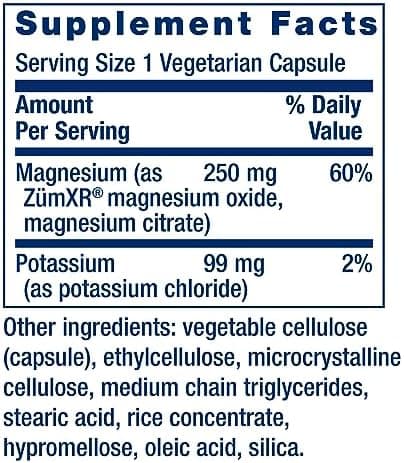
Magnesium salts in a single large dose draw water into the gut and loosen stools. A matrix or coat that spreads release lowers the luminal concentration at any moment, which is the rationale behind sustained-release magnesium tablets. Ethylcellulose is one of the matrix polymers used.
Live organisms have to survive gastric acid to reach the intestine, so microencapsulation in a water-insoluble polymer shell is one protection strategy. Ethylcellulose is used in this role, often blended with a material that releases the core further down. The polymer protects delivery and contributes nothing itself.
Ethylcellulose is used to microencapsulate liquid oils, putting a physical barrier between a polyunsaturated oil and atmospheric oxygen and masking its taste in a powder. It also forms oleogels, structuring liquid oil into a solid without hydrogenation. Both uses are about handling the oil, not about changing what it does in the body.
In ethylcellulose oleogels, surfactants such as lecithin change the polymer network and the firmness of the resulting gel. The pairing appears in oil-structuring work rather than in supplement dosing. The interaction is physical, between polymer and surfactant.
Curcumin is poorly water-soluble and unstable at intestinal pH, so it is frequently loaded into polymer particles including ethylcellulose ones. Encapsulation in a hydrophobic polymer is a delivery strategy tested largely in vitro. Any resulting change in absorption belongs to the specific particle system and does not transfer between formulations.
Talk to a doctor before taking Ethylcellulose if any of these apply to you: No therapeutic benefit on its own. These are flags to check first, not effects Ethylcellulose is known to cause.
Not medical advice. Show the label to your pharmacist.What Ethylcellulose actually does.
Ethylcellulose is a modified plant fiber compound, and that modification is what makes it stay insoluble in water no matter the pH level in the body.
Our digestive enzymes can't break the chemical bonds in this compound, and its modification makes it even harder to access, so it passes through the gut undigested and unabsorbed.
When a supplement or medicine is coated with ethylcellulose, the ingredient slowly diffuses out through the coating and small pores rather than the coating itself dissolving away.
Because this compound has no charge-carrying groups, how permeable it is doesn't change with pH, which is the key functional difference from coatings designed to release based on pH.
Getting Ethylcellulose from food.
The whole-food sources on file. A supplement closes the gap, it does not replace dinner.
A gram-for-gram figure (how much of each you would eat to match a dose) will appear here once it is sourced and reviewed. This page will not print a number it cannot cite.
The forms it comes in.
The essence, in one line each.
- Cellulose-based biodegradable coatings slowed nutrient release from coated granules in laboratory release testing. The same diffusion-through-a-film principle used in oral controlled release, demonstrated in an agricultural rather than a nutritional setting.In vitro study. Boberski P et al., 2025 (Journal of Agricultural and Food Chemistry). PMID 40391942 ↗
These are the studies our verdict leans on, chosen from the 1 we read for Ethylcellulose. The full linked list is below.
The studies, linked.
1 source behind our Ethylcellulose verdict: peer-reviewed studies and registered clinical trials. Every one links straight to PubMed, the journal, or ClinicalTrials.gov. Read them yourself.
- Clinical trialInfluence of 2% HPMC Used During Cataract Surgery for Intraoperative Corneal Optical Clarity and Post-operation Xerophthalmia.ClinicalTrials.gov ↗100 participants, Unknown
Evidence surfaced via Semantic Scholar (Allen Institute for AI) and ClinicalTrials.gov. Ranked by study type and citation weight, not cherry-picked.
FDA Disclaimer: These statements have not been evaluated by the Food and Drug Administration. This information is for educational purposes only and is not intended to diagnose, treat, cure, or prevent any disease. Consult your healthcare provider before starting any supplement regimen.