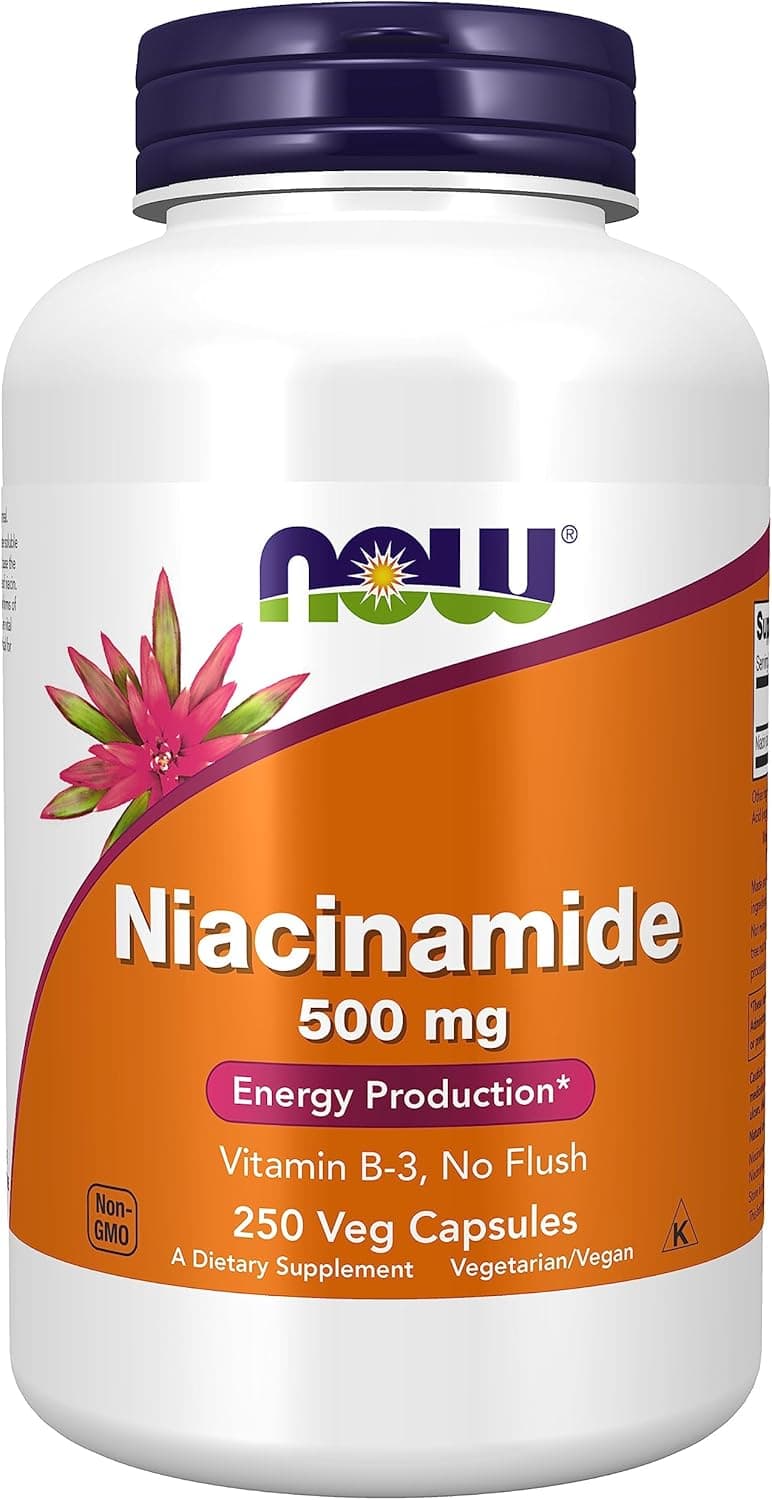
Niacin.
Research-backed compound with potential health benefits. Niacin becomes NAD, the electron carrier your cells use to turn food into usable energy. Enough of it keeps normal energy metabolism, skin and nerve signalling ticking along.
Reviewed March 2026
- Category
- Compound
What Niacin is, and what it does.
- Does it work
- Worth it if you eat little meat, fish, peanuts or fortified grain, or if your protein intake is low. Steady eaters of those foods usually cover the requirement already.
- How much to take
- Start with 16 to 50mg a day, the daily maintenance band that keeps normal NAD production supplied. Trials used 500mg, which is a research condition rather than a daily target.
- Time to feel it
- Nothing to wait for at everyday amounts. Niacin status shows up on blood work rather than as a sensation. The flush from the nicotinic acid form arrives within 30 minutes.
- The first dose
- At 16 to 50mg, day one is quiet and the vitamin goes straight into NAD production. Larger nicotinic acid amounts can bring warm, pink skin inside half an hour.
- With regular use
- Weeks of steady intake keep the NAD pool topped up for normal energy metabolism, skin and nerve signalling. Status reads on blood work rather than as something you sense.
- How well tolerated
- Well tolerated across the maintenance band. Gram amounts of nicotinic acid can flush the skin and raise liver enzymes, so speak to your doctor before going near that.
- How it feels
- At everyday amounts, nothing you would sense, which is normal for a B vitamin. The nicotinic acid form at high amounts feels like a prickly sunburn for half an hour.
- The overlooked benefit
- Your body makes niacin from tryptophan at roughly 60mg of tryptophan per 1mg of niacin, so a decent protein intake quietly covers part of your daily requirement.
20 to 100mg a day is where Niacin works.
Source: NIH ODS + AIM-HIGH trial + HPS2-THRIVE
The proof, claim by claim.
These words describe the research, not the molecule's worth. Research strength is how much work stands behind one claim, and it is never a product score.
Niacin is documented in the library. The clinical read is in the queue. Nothing about the strength of the research prints until the read is done.
- Normal energy-yielding metabolismNarrative review
- NAD and NADP statusNarrative review
- Blood lipids already in the normal range at gram amounts of nicotinic acidMeta-analysis
- Normal skin and nervous system functionNarrative review
- Tryptophan to niacin conversionNarrative review
Questions people ask about Niacin.
- When should I take it?
- With food, ideally a meal containing some fat for better absorption. Morning or evening, pick one and stick with it.
- How long until I notice something?
- If you're deficient, you might notice within 1-2 weeks. For general maintenance, give it 4-8 weeks.
- Can I get enough from food?
- Sometimes. If your diet is solid and varied, you might not need to supplement. But deficiency is more common than most people think. A blood test is the only way to know for sure.
- Can I take too much?
- Water-soluble vitamins (B, C) are harder to overdose on since you pee out the extra. Fat-soluble ones (A, D, E, K) can build up. Stick to recommended doses unless a doctor says otherwise.
- Can I take it with other supplements?
- Usually fine. The main thing to watch is not doubling up on the same ingredient from different products. If you're on prescription meds, check with your pharmacist first.
- Who benefits most from this?
- People with a specific, evidence-backed need. Niacin has strong research. If your situation matches the studied use case, it's one of the more reliable supplements you can take.
Why these belong in the same formula. Each row says what the basis is, from settled biochemistry through to a trial that measured the pair.
The body makes part of its own NAD from tryptophan through the kynurenine pathway, so dietary tryptophan and niacin feed the same pool. Dietary equivalents count roughly 60 mg of tryptophan as 1 mg of niacin.
Kynureninase, the step that lets tryptophan continue toward NAD, is a PLP enzyme and depends on vitamin B6. When B6 is short the pathway diverts and less NAD is generated from tryptophan, so more of the demand falls on niacin itself.
Kynurenine monooxygenase, another step on the route from tryptophan to NAD, uses riboflavin-derived FAD. Riboflavin status therefore influences how much NAD the body can build without preformed niacin.
The first committed step of the tryptophan to NAD route is run by heme enzymes that hold iron at the active site. Iron availability shapes how readily tryptophan enters the pathway that supplements the niacin supply.
Nicotinic acid is converted through the Preiss-Handler route to nicotinic acid mononucleotide, then to NAD. Nearly every named use of niacin runs through this conversion.
Both forms converge on NAD, but nicotinic acid activates the HCAR2 receptor on skin and fat cells while the amide does not, which is why only the acid form causes the flush. Formulators pick between them, or blend, on that basis.
NMN enters the NAD pool through the salvage route while nicotinic acid enters through Preiss-Handler. The two routes are separate for most of their length and meet only at NAD.
NR is phosphorylated to NMN then adenylylated to NAD, bypassing the enzymes nicotinic acid uses. Combining them covers both entry points into the same pool.
Nicotinamide generated downstream of niacin is cleared by methylation using S-adenosylmethionine, and TMG restores that donor by remethylating homocysteine. Higher B3 intake raises the methyl draw.
Methylfolate feeds homocysteine remethylation and so helps regenerate the S-adenosylmethionine spent on nicotinamide methylation. This is the folate arm of the same support TMG provides.
The niacin flush is driven by prostaglandin D2 released from skin cells, and salicylates from willow bark blunt that release by inhibiting cyclooxygenase. This is the established reason a salicylate is taken ahead of nicotinic acid.
The body makes a share of its own niacin from tryptophan, and one of the committed steps in that route runs on pyridoxal 5-phosphate. When B6 coenzyme status is low, more tryptophan leaves through side branches and less arrives as nicotinic acid. Pairing the active B6 form with niacin covers both the dietary source and the endogenous route. This is settled biochemistry rather than a combination trial result.
Nicotinic acid reaches NAD through the Preiss-Handler route, and the final step swaps an acid group for an amide using nitrogen donated by glutamine. Glutamine is abundant in most diets, so this is a dependency rather than a shortfall people usually run into. It is worth stating because it explains why NAD synthesis is not a single-nutrient process. No human combination trial is being described here.
Every phosphotransfer in the NAD assembly line uses ATP complexed with magnesium, including the adenylylation step that joins nicotinic acid mononucleotide to AMP. Magnesium is the counter-ion that makes those transfers possible. The pairing is mechanistic support for the pathway, not a claim that adding magnesium raises NAD.
Reduced glutathione is restored from its oxidised form by glutathione reductase, and the electrons come from NADPH. NADPH is phosphorylated NAD, so niacin status sits upstream of the whole recycling loop. The relationship is directional: the dinucleotide pool supports glutathione turnover rather than the other way around.
N-acetylcysteine feeds the cysteine that glutathione is built from, while niacin-derived NADPH is what keeps recycling the glutathione already made. Two different limits on the same system, which is why they are often formulated together. The rationale is mechanistic. Head-to-head human data on the pair is not what is being cited.
Complex I oxidises NADH and passes the electrons to ubiquinone, so the niacin-derived carrier and the quinone carrier are consecutive links in the same chain. A shortfall at either point slows the same flux. This describes normal energy metabolism and does not imply a measured combination effect.
Nicotinamide that is not used is cleared by methylation to N1-methylnicotinamide, and each methyl group comes from S-adenosylmethionine. Larger intakes therefore draw on the methyl pool that choline and betaine also feed. Formulators often pair methyl donors with higher-dose niacin for this reason. The interaction is directional and dose-dependent rather than a fixed ratio.
S-adenosylmethionine is the methyl donor spent when surplus nicotinamide is methylated for excretion, and the product N1-methylnicotinamide appears in the co-study record alongside niacin. The relationship is a draw on a shared pool, so it matters most at higher intakes. It is a metabolic accounting point, not a measured clinical outcome.
Methionine is converted to S-adenosylmethionine, which supplies the methyl group for nicotinamide clearance. Intake of the vitamin and intake of methyl donors therefore sit on the same ledger. Stating this is what keeps a high-dose formulation honest about what else it is drawing on.
Thiamine pyrophosphate runs the pyruvate and alpha-ketoglutarate decarboxylation steps, and each of those steps hands electrons to NAD. Neither coenzyme can carry the flux without the other. B-complex formulation reflects this rather than any single-nutrient finding.
Pantothenic acid becomes coenzyme A, which accepts the acetyl group at the same reaction where NAD accepts the electrons. The two vitamins are joint inputs to one enzyme complex. This is textbook cofactor pairing and needs no trial to state.
Lipoic acid is reduced during the decarboxylation cycle and then reoxidised by an enzyme that hands the electrons to NAD. Supplemental lipoate also participates in broader redox cycling that draws on the same dinucleotide pool. The mechanistic tie is clear. How much a supplemental pairing changes anything measurable in people has not been shown here.
One commercial niacin form is literally inositol esterified with six nicotinate groups, which slows the release of free nicotinic acid and blunts the flush. The inositol is the carrier, not an added active. Release from the ester in people is incomplete and variable, which is the trade-off that comes with it.
Chromium and niacin appear together in the co-study record and were given as a combined supplement to transition dairy cows, with metabolic and production measures reported. That is livestock production data, not human evidence, and the outcomes measured were animal performance markers. The pairing is a research question rather than an established human combination.
Nicotinic acid at gram-level intakes reduces free fatty acid release from fat cells, while long-chain omega-3s act mainly on hepatic triglyceride assembly. Because the routes differ, the two are often formulated alongside each other in lipid-support products. This is a structure-function statement about normal lipid handling and belongs with a clinician when intakes get large.
Berberine acts largely through hepatic LDL receptor expression and AMPK signalling, which does not overlap with the adipocyte receptor route that nicotinic acid uses. Stacking them is common in lipid-support formulas. Neither the size nor the direction of a combined effect is settled, so read the pairing as mechanistic.
Red yeast rice supplies monacolin K, an HMG-CoA reductase inhibitor, and gram-level nicotinic acid has long been combined with that drug class in lipid research. Combined use raises the practical questions of muscle symptoms and liver enzyme monitoring that apply to the drug class itself. This pairing is a clinician-supervised decision, not a self-directed stack.
Nicotinic acid becomes a mononucleotide only when it is joined to phosphoribosyl pyrophosphate, a phosphorylated sugar. Phosphate also appears alongside niacin in the co-study record. Dietary phosphorus is rarely the limiting factor, so this is background pathway detail rather than a reason to co-supplement.
Nothing specific on file for Niacin. Match the label to the daily amount above, and tell your doctor what you take.
Not medical advice. Show the label to your pharmacist.What Niacin actually does.
Nicotinic acid gets built into NAD along a three-step assembly line. Each step bolts on another piece until the finished coenzyme is ready to use.
NAD and its partner NADP ferry electrons for several hundred reactions. So niacin status sits underneath how you burn carbs, fat and amino acids rather than off to one side.
NADPH from that same pool supplies the power for building fats and cholesterol, and it recharges glutathione. That's how niacin connects to your normal antioxidant recycling.
Your body can make niacin from the amino acid tryptophan, roughly 60 mg of tryptophan for 1 mg of niacin. That conversion leans on vitamin B6, riboflavin and iron-dependent enzymes.
Where Niacin comes from.
The niacin in a capsule is made in a chemical plant, not pressed out of a plant or a yeast. Chemists build a small ring molecule, convert it in two steps, and crystallise it until it matches an official standard. The niacinamide and inositol hexanicotinate versions branch off the same production line at different points.
Chemically synthesised. The molecule is identical to the one a plant or an animal makes, and building it deliberately means a known purity, a fixed dose and no crop contaminants. For several nutrients this is the only route that reaches a usable amount.
The pyridine ring is built industrially from ammonia with acetaldehyde and formaldehyde, giving beta-picoline, or from acetaldehyde and ammonia routes that give the ethyl-methyl pyridine. The starting material is petrochemical, not agricultural.
Beta-picoline is passed over a vanadium-based catalyst with ammonia and air to give 3-cyanopyridine. The older nitric acid oxidation route to nicotinic acid is still used in some plants and produces more waste acid.
3-cyanopyridine is hydrolysed to nicotinic acid, either chemically with base or enzymatically with a bacterial nitrile hydratase or nitrilase, which runs in water at mild temperature and avoids salt-heavy waste streams.
Crude nicotinic acid is decolourised and recrystallised from water to pharmacopoeial specification, then dried.
The finished acid is assayed by titration or chromatography against a monograph specification. Niacinamide is made separately by amidating the nitrile or the acid, so the two forms are distinct products from a shared intermediate.
Milled powder is used directly, granulated with a matrix for slower release, or esterified with inositol to give inositol hexanicotinate.
Getting Niacin from food.
The whole-food sources on file. A supplement closes the gap, it does not replace dinner.
A gram-for-gram figure (how much of each you would eat to match a dose) will appear here once it is sourced and reviewed. This page will not print a number it cannot cite.
The forms it comes in.
The essence, in one line each.
- Pooling 30 randomized trials of 4,749 people, niacin raised HDL cholesterol by about 16 percent, lowered triglycerides by about 20 percent, and lowered LDL cholesterol by about 14 percent.Meta-analysis. Birjmohun et al., 2005 (Journal of the American College of Cardiology). PMID 15653014 ↗
- Across 14 placebo-controlled trials totaling about 9,000 people, extended-release niacin lowered blood lipoprotein(a) by about 23 percent.Systematic review and meta-analysis. Sahebkar et al., 2016 (Metabolism). PMID 27733255 ↗
- Across 7 randomized trials of 441 people, niacin improved flow-mediated dilation, a measure of blood-vessel function, by about 2 percentage points.Systematic review and meta-analysis. Sahebkar, 2014 (Vascular Medicine). PMID 24391126 ↗
- Across eight randomised trials in 2,110 adults with elevated blood sugar, niacin lowered total cholesterol by about 0.28 mmol/L, triglycerides by 0.37 and LDL cholesterol by 0.42 and raised HDL cholesterol by 0.33, with no detected change in plasma glucose or HbA1c.Meta-analysis. Xiang et al., 2020 (Medicine). PMID 32702899 ↗
- The authors review the mechanistic case for NAD+ precursor and niacin supplementation in support of normal retinal and optic nerve energy metabolism, and describe the clinical evidence as preliminary.Narrative review. Gemae MR et al., 2024 (Nutrients). PMID 39203931 ↗
- A published protocol setting out the design of a randomised controlled trial of niacin supplementation. It reports the planned methods and outcome measures and contains no results.Randomised trial. Yan X et al., 2021 (Medicine). PMID 33761625 ↗
- A systematic review of published cases of severe niacin deficiency reported between 2000 and 2023, describing the settings in which inadequate niacin status is still identified, including poor dietary intake, heavy alcohol use and malabsorption.Systematic review. Litaiem N et al., 2026 (International Journal of Dermatology). PMID 41876960 ↗
- In rodents exposed to an organophosphate flame retardant, niacin supplementation reduced airway inflammatory markers and NF-kB pathway signalling. A mechanistic animal finding with no human counterpart offered.Animal study. Zhou M et al., 2026 (Antioxidants). PMID 41596143 ↗
- Pooling animal feeding trials, the authors report effects of supplemental niacin on metabolic and production measures across the transition and lactation periods. Livestock production data only.Meta-analysis, in animals. Arshad U et al., 2025 (Journal of Dairy Science). PMID 40054690 ↗
- Dietary niacin supplementation altered performance, egg quality and yolk antioxidant measures in laying quails. A production and marker study in birds.Animal study. Gul ET et al., 2025 (Tropical Animal Health and Production). PMID 41364256 ↗
- Niacin supplementation attenuated the loss of three-dimensional capillary architecture in unloaded rat muscle. A structural marker measured in animals under a disuse model.Animal study. Lin H et al., 2024 (Physiological Reports). PMID 38627220 ↗
- Dietary niacin was associated with changes in meat quality, muscle fibre type distribution and mitochondrial function measures in heat-stressed animals.Animal study. Mei W et al., 2024 (Frontiers in Veterinary Science). PMID 39469586 ↗
- Adding niacin during in vitro oocyte maturation changed fertilisation rate and mitochondrial competence measures. Laboratory culture work in animal cells.In vitro study. Azari M et al., 2026 (Veterinary Medicine International). PMID 42257056 ↗
These are the studies our verdict leans on, chosen from the 719 we read for Niacin. The full linked list is below.
The studies, linked.
4 sources behind our Niacin verdict: peer-reviewed studies and registered clinical trials. Every one links straight to PubMed, the journal, or ClinicalTrials.gov. Read them yourself.
- Clinical trialMulticenter, Randomized, Double-Blind Study to Evaluate the Efficacy and Safety of Ezetimibe/Simvastatin and Niacin (Extended Release Tablet) Co-Administered in Patients With Type IIa or Type IIb HyperlipidemiaClinicalTrials.gov ↗Phase 3, 1,220 participants, Completed
- Clinical trialA Multicenter, Randomized, Double-Blind, Placebo-Controlled Study to Demonstrate the Lipid-Altering Efficacy and Safety and Tolerability of MK0524A in Patients With Primary Hypercholesterolemia or Mixed HyperlipidemiaClinicalTrials.gov ↗Phase 3, 646 participants, Completed
- Clinical trialComparative Efficacy Evaluation of Lipid Levels When Treated With Niaspan and Statin or Other Lipid-Modifying TherapiesClinicalTrials.gov ↗Phase 4, 300 participants, Completed
- Clinical trialA Randomized, Double-Blind, Placebo Controlled Study Evaluating the Effects Of Niacin On Reverse Cholesterol Transport As Measured Using [1,2-3H]-Cholesterol (3H-cholesterol) in Healthy Volunteers.ClinicalTrials.gov ↗22 participants, Completed
Evidence surfaced via Semantic Scholar (Allen Institute for AI) and ClinicalTrials.gov. Ranked by study type and citation weight, not cherry-picked.
Problems people have reported.
Read this carefully. These are 118,322 voluntary, unverified reactions reported to the FDA (openFDA). The number mostly reflects how popular Niacin is, not how risky it is. A report is not proof Niacin caused anything. It is a signal of what to watch for, nothing more.
Source: openFDA adverse-event reports. Voluntary reporting, not an incidence rate.
FDA Disclaimer: These statements have not been evaluated by the Food and Drug Administration. This information is for educational purposes only and is not intended to diagnose, treat, cure, or prevent any disease. Consult your healthcare provider before starting any supplement regimen.