Inosinic acid.
This is the savoury booster in aged meat, dried fish and seasoning blends. On its own it barely tastes of anything. Its job is amplifying the umami of glutamate.
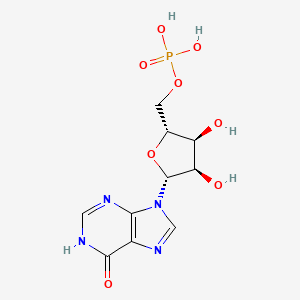 Compound
- Category
- Compound
What Inosinic acid is, and what it does.
- Does it work
- It suits food formulators wanting savoury depth at lower sodium. As a supplement for a body process there is no established role, since your body builds its own purines.
- How much to take
- No supplemental daily amount is on record. In food it is used in fractions of a percent, which is enough because the effect works alongside glutamate rather than alone.
- Time to feel it
- Instantly, on the tongue. Savoury depth arrives with the mouthful, and there is no delayed effect to wait on.
- The first dose
- Food tastes rounder and more savoury. Nothing else about day one is noticeable, and no body-level change has been measured at food amounts.
- With regular use
- Weeks of regular intake mainly mean a steady small purine load, which ends as urate because humans lack uricase. That shows on a blood panel, not in how you feel.
- How well tolerated
- Well tolerated as a food additive. Because it adds to the purine pool, people keeping an eye on their urate levels usually keep purine-rich seasonings modest.
- How it feels
- A mouth-filling savoury roundness, the quality people call brothy. It shows up in taste rather than anywhere in the body.
- The overlooked benefit
- It is the branch point of purine synthesis: every adenine and guanine nucleotide in your cells is built from inosinate, so it sits upstream of both DNA and ATP.
The proof, claim by claim.
What these words mean
These words describe the research, not the molecule's worth. Research strength is how much work stands behind one claim, and it is never a product score.
- umami potentiation alongside glutamate at the T1R1 and T1R3 receptorNarrative review
- hydrolysis of ingested nucleotides before absorptionNarrative review
3 more claims
- contribution of dietary purine intake to the urate poolCohort study
- accumulation in muscle after slaughter as ATP breaks downNarrative review
- savoury seasoning and food appeal when appetite is lowRandomised trial
Why these belong in the same formula, 5 pairings
Why these belong in the same formula. Each row says what the basis is, from settled biochemistry through to a trial that measured the pair.
Adding inosinate lets a formulator hold perceived savouriness while cutting added salt, because umami intensity partly substitutes for the sensation salt provides. The compound itself is supplied as a sodium salt, so it contributes a small amount of sodium back. Net sodium usually still falls because the substitution ratio is favourable. This is a formulation lever, not a physiological effect.
Inosinate is a purine nucleotide, and its breakdown runs through hypoxanthine and xanthine to urate. Xanthine oxidoreductase, the enzyme that catalyses both of those steps, carries a molybdenum cofactor. Without adequate molybdenum the enzyme cannot function, which is textbook biochemistry rather than a supplement interaction. Dietary molybdenum deficiency is rare in people eating ordinary food.
Ascorbate competes with urate at the URAT1 transporter in the kidney tubule, which increases urate excretion and modestly lowers serum urate. Since inosinate is a dietary purine that ends in urate, the two act in opposite directions on the same pool. The size of the vitamin C effect is small. It is a directional point about shared handling, not a strategy.
Inosinate is the first complete purine nucleotide the body builds, and it is assembled on a ribose-5-phosphate backbone supplied as PRPP from the pentose phosphate pathway. Ribose feeds that pool. Every adenine and guanine nucleotide in the body is made downstream of inosine monophosphate, which is why this molecule sits at the branch point of purine synthesis.
During hard contraction, when ATP resynthesis falls behind, adenylate kinase and AMP deaminase push AMP toward inosine monophosphate, and muscle inosinate rises. Phosphocreatine buffers ATP during exactly those first seconds, so a well-loaded creatine pool blunts the drop that drives that reaction. The relationship is about intramuscular nucleotide handling and does not imply that swallowing inosinate does anything for exercise.
Nothing specific on file for Inosinic acid. Match the label to the daily amount above, and tell your doctor what you take.
Not medical advice. Show the label to your pharmacist.What Inosinic acid actually does.
It is the shared parent molecule the body builds both of its purine building blocks from.
3 more mechanisms
You do not absorb it whole. It gets taken apart in the gut like any other nucleotide.
Purines in food end up as uric acid. Humans cannot break it down further.
The savoury punch in aged meat and dried bonito flakes is largely this compound, formed after the fact.
Where Inosinic acid comes from.
It is the savoury compound that builds up in aged meat and dried fish. Industry makes it by fermenting sugar or by breaking down yeast RNA.
What this route gives you
The same molecule is reached more than one way. Which route a given product used is a manufacturing choice, and the finished compound is the same either way.
6 steps on record
Three separate industrial routes exist. The dominant one starts from a sugar feedstock. The others start from yeast RNA or from naturally nucleotide-rich animal tissue.
Engineered Corynebacterium or Bacillus strains accumulate inosine or inosinate directly from sugar. The alternative route uses 5'-phosphodiesterase to cut yeast RNA into its four constituent nucleotides, from which inosinate is separated.
Cells and solids are filtered off and the nucleotide-bearing liquor is concentrated.
Ion exchange chromatography separates inosinate from guanylate and other nucleotides, followed by crystallisation of the salt.
Purity assayed by HPLC and the counter-ion set as sodium, potassium or calcium.
Dried, milled and either sold as the single salt or blended with disodium guanylate.
Getting Inosinic acid from food.
The whole-food sources on file. A supplement closes the gap, it does not replace dinner.
A gram-for-gram figure (how much of each you would eat to match a dose) will appear here once it is sourced and reviewed. This page will not print a number it cannot cite.
The forms it comes in.
3 more forms
The essence, in one line each.
- Dietary polyphenol supplementation changed muscle flavour nucleotide and amino acid profiles, inosinic acid among them, in the treated animals.Animal study. Xu X et al., 2019 (Food and Function). PMID 31660546 ↗
1 more finding
- Coated sodium butyrate in feed was followed by changes in meat quality indices including muscle inosinic acid content.Animal study. Gu Z et al., 2025 (Genes). PMID 40282393 ↗
Chosen from the 2 we read for Inosinic acid.
Problems people have reported.
Read this carefully. These are 28 voluntary, unverified reactions reported to the FDA (openFDA). The number mostly reflects how popular Inosinic acid is, not how risky it is. A report is not proof Inosinic acid caused anything. It is a signal of what to watch for, nothing more.
3 more reported effects
Source: openFDA adverse-event reports. Voluntary reporting, not an incidence rate.
FDA Disclaimer: These statements have not been evaluated by the Food and Drug Administration. This information is for educational purposes only and is not intended to diagnose, treat, cure, or prevent any disease. Consult your healthcare provider before starting any supplement regimen.