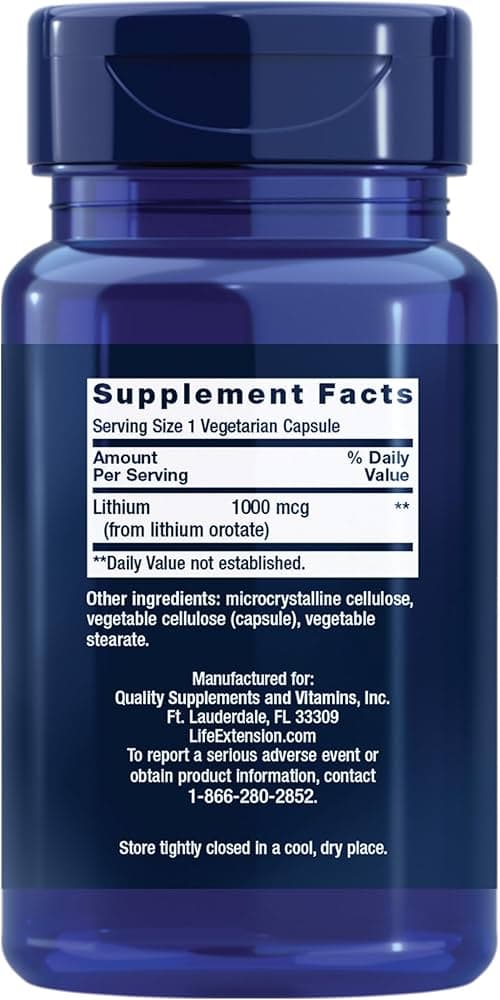
Lithium Aspartate Low Dose.
Lithium Aspartate Low Dose supplementation for targeted health support. Provides lithium at nutritional levels. May support mood stability, neuroprotection, and cellular health.
Reviewed March 2026
- Category
- Mineral
What Lithium Aspartate Low Dose is, and what it does.
- Does it work
- Interesting emerging research area. Epidemiological data is intriguing. Clinical trials at nutritional doses are limited. Worth considering for brain health support with appropriate monitoring.
- How much to take
- 5-20mg lithium aspartate daily (providing 0.7-3mg elemental lithium). Much lower than psychiatric doses of 600-1800mg lithium carbonate.
- Time to feel it
- Nobody has measured an onset at these nutritional amounts. What people describe builds across several weeks of daily use rather than within a day.
- The first dose
- Day one is quiet. The ion spreads through body water within hours and the kidney starts clearing it, which is something a blood test picks up rather than a feeling.
- With regular use
- Potential mood and cognitive benefits with consistent use. Epidemiological data suggests brain-protective effects.
- How well tolerated
- Well tolerated at trace levels but still requires kidney and thyroid monitoring. Much safer than pharmaceutical lithium doses.
- How it feels
- Subtle. Some notice improved emotional resilience. Not a dramatic mood change like psychiatric lithium.
- The overlooked benefit
- The kidney reabsorbs lithium alongside sodium, so how much you retain moves with your salt and fluid intake, which matters if you sweat heavily or cut salt hard.
1 to 5mg a day is where Lithium Aspartate Low Dose works.
Source: Schrauzer 2002 J Am Coll Nutr (epidemiological); Marshall 2015 Int J Bipolar Disord.
The proof, claim by claim.
These words describe the research, not the molecule's worth. Research strength is how much work stands behind one claim, and it is never a product score.
- Epidemiological link to lower suicideMultiple population studies
- May support mood stabilitySome clinical studies, mechanistic plausibility
- Neuroprotective potentialAnimal studies, epidemiological data
- Well tolerated at nutritional dosesLong natural exposure, low-dose studies
Questions people ask about Lithium Aspartate Low Dose.
- Is this the same as psychiatric lithium?
- Same element, dramatically lower doses. Psychiatric lithium is 600-1800mg lithium carbonate. Nutritional is 1-20mg lithium aspartate. Huge difference.
- Why aspartate form?
- Better absorption than some forms. Provides lithium bound to aspartic acid. Orotate is another common nutritional form.
- Do I need kidney/thyroid monitoring?
- At nutritional doses, risk is low but prudent monitoring makes sense for regular users. More important than with other minerals.
- Can I take this if I'm on psychiatric medications?
- Don't combine with psychiatric lithium. For other psych meds, consult your doctor. Generally okay at nutritional doses but professional guidance is wise.
- Is this 'natural' lithium?
- Lithium is a natural element. It's in water and food in trace amounts. This provides controlled low doses of that natural element.
Why these belong in the same formula. Each row says what the basis is, from settled biochemistry through to a trial that measured the pair.
Lithium inhibits inositol monophosphatase and lowers free inositol available for phosphoinositide signalling. Added inositol restocks exactly the pool lithium restricts, so the pair works against each other at one enzyme step.
The lithium ion substitutes for magnesium at several enzyme active sites, including glycogen synthase kinase 3. Magnesium intake changes how strongly a given lithium dose registers at those sites.
Lithium is reabsorbed by the proximal tubule alongside sodium, so a high sodium intake speeds its clearance and a low one raises its blood level. Sodium intake is the single largest swing factor on lithium exposure.
Regular caffeine increases urinary lithium loss and lowers the level reached from a fixed dose. The direction flips when caffeine is withdrawn, so habitual intake is what matters.
Lithium accumulates in the thyroid and slows release of stored hormone, and iodine supplies the substrate for hormone synthesis. Both act on the same gland, from opposite ends of one pathway.
Lithium is a monovalent cation reabsorbed in the proximal tubule alongside sodium, so any shift in sodium and potassium handling changes lithium retention. Products combining electrolytes with a lithium salt therefore change the exposure of the lithium as well as the electrolyte load. This is settled renal pharmacology and applies at any dose, though the consequences scale with the dose taken.
A sodium load reduces proximal tubular reabsorption of both sodium and lithium, so lithium clearance rises and blood concentration falls. Sodium bicarbonate delivers exactly that load. Anyone using a lithium salt should regard sodium intake as a variable that moves the exposure, not as an unrelated ingredient.
Multi-electrolyte products vary widely in sodium content, and it is the sodium that matters for lithium handling. Sodium depletion through sweat loss or restriction raises lithium retention, and sodium repletion lowers it. Formulating the two together makes the lithium exposure a moving target unless the sodium is fixed.
Inhibiting renal prostaglandin synthesis reduces lithium excretion and raises its blood concentration, which is one of the most consistently documented lithium interactions in clinical pharmacology. White willow bark supplies salicin, which is converted to salicylate. Combining a salicylate botanical with a lithium salt pushes lithium exposure upward by a mechanism nobody in a supplement setting is measuring.
Dandelion root has traditional diuretic use and preclinical support for increased urine output. Any agent that changes sodium and volume status changes lithium handling with it, and the direction depends on which tubular segment is affected. The mechanism is well established for pharmaceutical diuretics. The magnitude for a botanical at supplement doses is not characterised.
Lithium shifts the set point of the parathyroid calcium-sensing receptor, so parathyroid hormone and serum calcium tend upward with sustained exposure. That is documented at therapeutic concentrations and is a marker relationship, not established at nutritional intakes. Pairing calcium with a lithium salt means two inputs into the same regulatory loop.
Because lithium acts on the calcium-sensing receptor's set point, and vitamin D status governs calcium absorption and parathyroid hormone, the two inputs meet in the same axis. Combining them makes any change in calcium or parathyroid hormone harder to attribute. Both effects here are marker relationships in an endocrine loop, not demonstrated outcomes.
Taurine acts as an intracellular osmolyte and influences ion and volume handling in several tissues, which is the same broad territory a monovalent cation load touches. This is a plausible interaction from cell physiology, not something measured for the pair. It is offered as context for formulators rather than as a reason to combine them.
Lithium is a monovalent cation reabsorbed alongside sodium in the proximal tubule, so sodium intake and lithium retention move in opposite directions. Low sodium intake or sodium loss through sweat or vomiting raises lithium retention, and a high sodium load increases its clearance. This is settled renal pharmacology and it applies regardless of dose size.
Viscous soluble fibre taken at the same time can trap a cation in its gel and slow its contact with the absorptive surface, and reduced lithium levels alongside psyllium have been described in case-level reports rather than controlled trials. The practical answer is separating the doses by a couple of hours. Case-level means low confidence about magnitude.
Nothing specific on file for Lithium Aspartate Low Dose. Match the label to the daily amount above, and tell your doctor what you take.
Not medical advice. Show the label to your pharmacist.What Lithium Aspartate Low Dose actually does.
Lithium is a simple metal ion with no established human requirement, no recommended intake and no recognised deficiency state. What people get comes mostly from drinking water and plant foods, and it varies widely with local geology.
Whatever salt it arrives in, lithium splits off in the stomach and the ion your body sees is the same. What differs between salts is how much elemental lithium sits in each milligram and how readily the salt dissolves.
Lithium spreads through body water, does not stick to proteins and is not broken down. The kidney handles nearly all of it, and reabsorption shares a route with sodium, so running low on sodium keeps more lithium in while a sodium load moves more out.
Lithium blocks two enzymes: one that recycles inositol and one called glycogen synthase kinase 3 beta. Both actions were worked out at drug-level concentrations, and nobody has established whether either happens meaningfully at microgram to low-milligram intakes.
Where Lithium Aspartate Low Dose comes from.
The lithium comes out of the ground, either from salty lake water left to evaporate or from crushed rock, and is refined to a plain white salt. That salt is then combined with aspartic acid, an amino acid usually made by fermentation, and dried into the powder used in capsules. There is so little of it per capsule that most of what you swallow is carrier, and the number to read on the label is whether the milligrams mean the whole salt or just the lithium in it.
From a mineral source, then refined and usually bound to a carrier so the body can take it up.
Commercial lithium comes either from continental brines pumped from salars in South America and concentrated by solar evaporation, or from spodumene ore mined and concentrated in Australia and elsewhere. Both routes end at the same lithium ion.
Brine concentrate is treated to remove magnesium and calcium then precipitated with soda ash as lithium carbonate. Spodumene is roasted to convert it to a leachable phase, acid leached, purified and crystallised. These are the two industry-standard routes and neither is a purity claim over the other.
Purified lithium carbonate or hydroxide is reacted in aqueous solution with L-aspartic acid, with carbon dioxide released in the carbonate route, giving lithium aspartate in solution. The aspartic acid itself is usually made by microbial fermentation or enzymatic conversion of fumarate.
The salt is crystallised or spray dried, then washed to remove unreacted starting material and residual counter-ions. Sodium and potassium carry over from brine-derived lithium and are the residuals a specification watches.
Lithium content is measured by atomic absorption or ICP, then the salt is blended with a diluent because the active weight per capsule is very small. Whether a label states salt weight or elemental lithium weight is decided at this step and is the single most consequential number on the product.
Blended with carriers and encapsulated, or dissolved for a drop format. Uniformity of blend matters more than usual because the active is a tiny fraction of the fill weight.
Getting Lithium Aspartate Low Dose from food.
The whole-food sources on file. A supplement closes the gap, it does not replace dinner.
A gram-for-gram figure (how much of each you would eat to match a dose) will appear here once it is sourced and reviewed. This page will not print a number it cannot cite.
The forms it comes in.
FDA Disclaimer: These statements have not been evaluated by the Food and Drug Administration. This information is for educational purposes only and is not intended to diagnose, treat, cure, or prevent any disease. Consult your healthcare provider before starting any supplement regimen.