Lupulone.
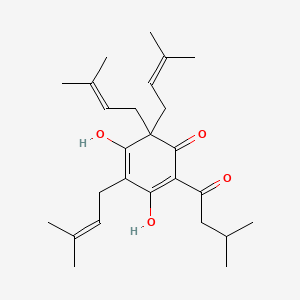
Lupulone is one of the bitter beta-acids in hops. In culture it collapses the pH gradient Gram-positive bacteria depend on, which is why it shows up in gut-focused formulas.
 Compound
- Category
- Compound
What Lupulone is, and what it does.
- Does it work
- Of interest if you want a hop-derived ingredient with defined chemistry. Anyone drawn to the calming reputation of hops should know that comes from a different compound.
- How much to take
- No daily amount is on record for lupulone. Start with what the product states, and note it needs a fat or emulsified carrier to dissolve at all.
- Time to feel it
- No time course has been measured in people. Its described action is on bacteria in the gut, which would show up in stool testing rather than in how you feel.
- The first dose
- Very bitter on the tongue. Day one otherwise passes quietly, because the described activity is on microbes in the gut rather than on anything you register.
- With regular use
- Nobody has measured weeks of daily lupulone in people. What is documented over time is its use in food and beverage preservation, not a human daily-use record.
- How well tolerated
- Hops have a long food history in beer and beta-acids are used in food production. Isolated lupulone has little human data, so check with a prescriber before daily use.
- How it feels
- Sharply bitter, resinous and lingering. Nothing else is reliably reported, which fits an ingredient acting on gut bacteria rather than on your nervous system.
- The overlooked benefit
- It binds magnesium, calcium and zinc tightly, which is how stable hop salts are made. That same binding is a reason to space it away from a mineral serving.
The proof, claim by claim.
What these words mean
These words describe the research, not the molecule's worth. Research strength is how much work stands behind one claim, and it is never a product score.
- antibacterial activity against Gram-positive organismsIn vitro study
- gut microbial balance in animalsAnimal study
2 more claims
- food and beverage preservationNarrative review
- binding of divalent mineralsIn vitro study
Why these belong in the same formula, 9 pairings
Why these belong in the same formula. Each row says what the basis is, from settled biochemistry through to a trial that measured the pair.
Beta-acids degrade through oxidation of the acylphloroglucinol core, which is why aged hops lose their beta-acid content and why hop products are stored cold and dark. A tocopherol antioxidant in an oil-based or softgel format slows that loss. This is a stability relationship in the container, not a biological interaction in the body. Without it, label content and delivered content diverge over shelf life.
Beta-acids partition into fat rather than dissolving in water, so a dry powder in a hard capsule presents a dissolution-limited absorption problem. A medium-chain triglyceride carrier keeps the compound in solution through the gut and recruits normal lipid absorption. This is formulation chemistry that applies to the whole acylphloroglucinol family, not a lupulone-specific finding.
Lecithin emulsifies poorly soluble actives into mixed micelles, increasing the surface area available at the intestinal wall. The technique is well established across lipophilic botanicals. Whether it produces a meaningful blood-level change for lupulone specifically has not been measured in people.
Hops has a traditional association with calm and sleep, and hop-plus-melatonin blends are common. The sedative-associated hop fraction is generally attributed to degradation products such as 2-methyl-3-buten-2-ol rather than to lupulone itself, so attributing this to the beta-acid overstates what is known. Anyone combining sedating agents should count the total. Read this as an additive-effect flag rather than a benefit claim.
The two herbs are combined so consistently that single-herb hop data in people is scarce. As with melatonin, the calming fraction of hops is not clearly the beta-acids, so a lupulone-specific contribution is unproven. The practical point is additive: stacking two sedating botanicals produces more sedation than either, which matters for driving and for anyone already on a sedating medication.
Beta-acids act as ionophores across the Gram-positive cell membrane, dissipating the transmembrane pH gradient. That is why hops preserve beer against lactic acid bacteria specifically. Lactobacillus and Bifidobacterium species fall in the same susceptibility class. Taking a concentrated beta-acid preparation in the same swallow as a live culture puts the two in direct contact, so spacing them is the sensible default.
Hop acids are routinely isolated and stabilised as magnesium, calcium or zinc salts precisely because they bind divalent cations well. In the gut the same chemistry can tie up a portion of a mineral dose. The industrial use of these salts is the clearest evidence that the binding is real. Separating a hop beta-acid product from mineral supplements by a couple of hours removes the overlap.
Magnesium beta-acid salts exist as products in their own right, which demonstrates the affinity directly. Where the compound is delivered as a free acid rather than a pre-formed salt, it retains the capacity to bind magnesium presented at the same time. In a pre-formed magnesium salt the interaction is already accounted for and no spacing is needed.
Prenylated hop phenolics are cleared largely by glucuronidation, and silymarin components inhibit several UGT isoforms in vitro. Whether that shifts lupulone exposure in a person has not been measured. Read this as mechanistic rather than clinical, and worth noting only where both are taken at concentrated doses.
Nothing specific on file for Lupulone. Match the label to the daily amount above, and tell your doctor what you take.
Not medical advice. Show the label to your pharmacist.What Lupulone actually does.
Lupulone is one of hops' beta-acids, structurally distinct from the alpha-acids, and the two behave differently when brewed, with alpha-acids changing form during boiling while beta-acids largely stay as they are.
3 more mechanisms
Hop beta-acids kill certain bacteria by shuttling ions across their membranes and collapsing the internal pH balance the cell needs to bring in nutrients. This works against gram-positive bacteria but not gram-negative ones, whose outer membrane blocks access.
These beta-acids barely dissolve in water at gut pH, so taking them orally depends on a fat-based or emulsified delivery form. Plain dry powder won't dissolve well on its own.
Lupulone breaks down with exposure to oxygen, light and heat, so its levels drop noticeably during warm storage, which is why commercial forms are often refrigerated, kept under inert gas or made into more stable mineral salts.
The forms it comes in.
4 more forms
The essence, in one line each.
- An ex vivo pharmacokinetic and pharmacodynamic model of hexahydrocolupulone, a hydrogenated hop beta-acid derivative, against Clostridium perfringens in broilers, characterising the exposure needed for antibacterial activity in that system.Animal study. Zhang W et al., 2024 (Frontiers in Veterinary Science). PMID 38756506 ↗
1 more finding
- A review of the Humulus lupulus phytochemical profile and bioactive properties in animal nutrition, describing beta-acids including lupulone among the characteristic constituents of the plant.Narrative review. Zepeda C et al., 2026 (Plants). PMID 42280732 ↗
Chosen from the 2 we read for Lupulone.
FDA Disclaimer: These statements have not been evaluated by the Food and Drug Administration. This information is for educational purposes only and is not intended to diagnose, treat, cure, or prevent any disease. Consult your healthcare provider before starting any supplement regimen.