Miliacin.
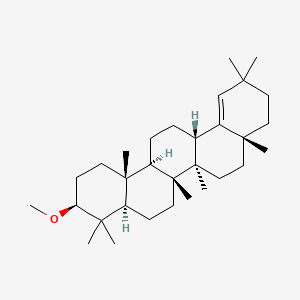
It's a triterpene from millet seed oil used in hair, scalp and nail formulas. It has no water-friendly group at all, so it only travels in a fat or a lipid shell.
 Compound
- Category
- Compound
What Miliacin is, and what it does.
- Does it work
- It suits people building a hair and nail routine who don't mind an oil-based capsule. With 53 published records, expect chemistry to be further along than human trials.
- How much to take
- No daily amount is on record, so there's no band to give. It's used as a daily oil capsule, and the carrier it sits in matters as much as the milligrams.
- Time to feel it
- Hair and nail routines are read at the speed the tissue grows, so around three months of daily use is the usual window before anything is visible.
- The first dose
- Day one is an oil capsule with a meal. Nothing registers, because keratin tissue changes at the rate it grows rather than overnight.
- With regular use
- Across a few months, what changes is what grows out: new nail plate and new hair shaft. Human data on the isolated triterpene is limited, so it reads as an early ingredient.
- How well tolerated
- Well tolerated as a fraction of a food oil, and millet oil has a long food history. Anyone with a millet or grain sensitivity should read the label, and a meal helps it along.
- How it feels
- There's nothing to sense from a fat-soluble triterpene in a capsule. What it contributes shows up in what grows out over months.
- The overlooked benefit
- It survives the alkali step that turns oil into soap, and that is exactly how it gets concentrated. The unsaponifiable fraction is where the millet oil interest sits.
The proof, claim by claim.
What these words mean
These words describe the research, not the molecule's worth. Research strength is how much work stands behind one claim, and it is never a product score.
- Hair, scalp and nail supportNarrative review
- Presence in the unsaponifiable fraction of millet seed oilNarrative review
2 more claims
- Fat-phase behaviour and dependence on a lipid carrierIn vitro study
- Cellular activity of pentacyclic triterpenesIn vitro study
Why these belong in the same formula, 5 pairings
Why these belong in the same formula. Each row says what the basis is, from settled biochemistry through to a trial that measured the pair.
Miliacin has essentially no water solubility. Taken with a medium-chain triglyceride carrier it stays dissolved through the stomach and enters the same micellar route used by other fat-soluble compounds. Without any lipid present, a dry powder of it is likely to pass through largely undispersed. This is carrier chemistry rather than a measured absorption comparison.
Phosphatidylcholine is the component of lecithin that does most of the lamellar structuring. Pairing it with a lipophilic triterpene is standard delivery practice across the supplement industry. The reasoning is physical chemistry, not a demonstrated increase in blood levels of miliacin, which has not been measured in any published pharmacokinetic study.
The carrier oil, not the triterpene, is the part that goes rancid. Adding a tocopherol protects the fatty acid fraction and the sensory quality of the finished product. This is shelf-life chemistry and says nothing about what miliacin does in the body.
Miliacin reaches consumers almost entirely inside multi-ingredient hair products, and biotin is the near-universal co-ingredient in that category. There is no published work combining the two, and no shared mechanism has been described. Read the pairing as market convention, and note that any effect seen in such a product cannot be assigned to either ingredient.
Zinc is a cofactor for a large set of enzymes involved in protein synthesis and cell division, including in rapidly dividing follicular tissue. That is textbook biochemistry and it holds independently of miliacin. No study has tested the two together, so the pairing is rational rather than demonstrated.
Nothing specific on file for Miliacin. Match the label to the daily amount above, and tell your doctor what you take.
Not medical advice. Show the label to your pharmacist.What Miliacin actually does.
Chemically it is a fat-like ring compound with nothing on it that water can grip. It travels with oils, not with water.
1 more mechanism
When millet oil is treated with alkali, the fatty acids convert and this compound does not. Collecting the leftover fraction is how it gets concentrated.
Where Miliacin comes from.
It comes from millet seed oil. Millers press the oil, then strip out the fatty part with alkali, and what is left behind includes this compound. Because it will not mix with water, it is usually packed inside a fat-based carrier before it goes into a product.
What this route gives you
Made from a plant. What ends up in the capsule tracks the harvest, so batch testing and a stated marker matter more here than with a made molecule.
5 steps on record
A drought-tolerant cereal grown across China, India, Russia and parts of central Europe. The seed oil, a minor co-product of milling, is the commercial source.
Cold pressing or solvent extraction of the seed to give a crude oil in which miliacin is a minor unsaponifiable constituent.
Alkaline hydrolysis converts the triglycerides to soaps. Miliacin has no ester bond and is untouched, which separates it from the bulk of the oil.
The non-saponified material is extracted into solvent and further purified to raise triterpene content.
Sold either as concentrated miliacin or dispersed into a shea-derived polar lipid system, which is the form used in the published clinical work.
Getting Miliacin from food.
The whole-food sources on file. A supplement closes the gap, it does not replace dinner.
A gram-for-gram figure (how much of each you would eat to match a dose) will appear here once it is sourced and reviewed. This page will not print a number it cannot cite.
The forms it comes in.
3 more forms
The essence, in one line each.
- In a 12-week study in women with a diagnosed hair shedding condition, miliacin encapsulated by polar lipids significantly reduced the density of hairs in the shedding phase compared to a placebo, an effect the authors link to its ability to stimulate cell proliferation in the hair bulb more than miliacin alone.Randomised trial, in nonmenopausal women affected by telogen effluvium. Keophiphath M et al., 2020 (Journal of Cosmetic Dermatology). PMID 31135099 ↗
Chosen from the 1 we read for Miliacin.
FDA Disclaimer: These statements have not been evaluated by the Food and Drug Administration. This information is for educational purposes only and is not intended to diagnose, treat, cure, or prevent any disease. Consult your healthcare provider before starting any supplement regimen.