MK-7.
It's the long-lasting form of vitamin K that switches on the proteins which bind calcium, so calcium gets built into bone and stays out of soft tissue.
Reviewed July 2026
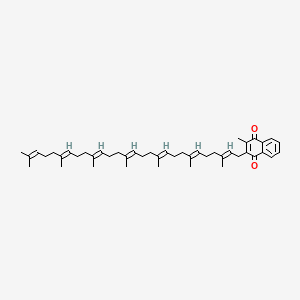 Vitamin
- Category
- Vitamin
What MK-7 is, and what it does.
- Does it work
- Suits people already taking vitamin D or calcium, and anyone whose diet holds little natto or fermented food. Anyone on anticoagulant medication should speak to their prescriber first.
- How much to take
- No daily amount is on record here. Because the seven-unit side chain keeps blood levels steady, one serving a day with a meal containing fat is how it's usually taken.
- Time to feel it
- About four weeks of daily use.
- The first dose
- Nothing you'd sense. Uptake starts with your first meal containing fat, and circulating levels begin climbing that same day.
- With regular use
- Weeks of daily use lower undercarboxylated osteocalcin, meaning more calcium-binding proteins are switched on. That's a readout of vitamin K status, not a measure of bone strength.
- How well tolerated
- Well tolerated at supplement intakes. Anyone taking vitamin K antagonist anticoagulant medication needs medical supervision, because that medication works on this same pathway.
- How it feels
- Subjectively nothing shifts. This one lives in the biochemistry, so a blood panel is where you'd read it rather than in sensation.
- The overlooked benefit
- The long side chain means far more of it reaches tissue outside the liver than vitamin K1 does, which is why bone and vessel-wall proteins get a real share of it.
How long it takes.
The dosing trials for MK-7 do not yet agree on a number we would put a line through.
What the trial measured, in its words
A double-blind randomised dose-finding trial gave 60 postmenopausal women aged 50 to 69 either 0, 50, 100 or 200 micrograms of menaquinone-7 daily for four weeks on a controlled diet. The ratio of carboxylated to undercarboxylated osteocalcin rose dose dependently, with significant differences from the 0 microgram group at 100 and 200 micrograms. A companion 12-week trial in 120 people aged 20 to 69 confirmed the change at 100 micrograms daily. Both studies were run by authors affiliated with the R and D division of J-Oil Mills. An independent 8-week double-blind trial in 55 healthy prepubertal children found the same direction at 45 micrograms daily. What was measured is a blood marker of vitamin K status, not bone density and not a sensation.
The proof, claim by claim.
What these words mean
These words describe the research, not the molecule's worth. Research strength is how much work stands behind one claim, and it is never a product score.
- vitamin K status markers in bloodMeta-analysis
- carboxylation of osteocalcinRandomised trial
3 more claims
- bone mineral density maintenanceMeta-analysis
- arterial elasticity markersRandomised trial
- cofactor role for gamma-glutamyl carboxylaseNarrative review
What the trials show about these together.
Outcomes the engine found studied for these actives as a combination, not one at a time. Each is a finding a named trial measured, cited and dated, never written by the brand.
- PromisingMK-7 + Vitamin DBone
In a meta-analysis of eight randomized trials, vitamin K2 taken together with vitamin D raised total bone mineral density and lowered undercarboxylated osteocalcin, a marker of vitamin K status.
Kuang et al., 2020 (Food & Function)PMID 32219282
How these rows are read
Research strength. Research strength says how much work stands behind the combination. It is never a product score.
Fail closed. Where actives were studied on their own rather than together, each shows on its own evidence, never a combined effect no trial measured.
Independent record. Every finding is cited to a named trial, dated, and never written by the brand.
Findings from trials that studied these actives as a combination. Context for how the actives were tested together, not a statement about any individual and not a claim about this product.
Why these belong in the same formula, 9 pairings
Why these belong in the same formula. Each row says what the basis is, from settled biochemistry through to a trial that measured the pair.
Vitamin D drives transcription of osteocalcin in osteoblasts, and vitamin K is the cofactor for the gamma-carboxylation step that lets that protein bind calcium. Supplying one without the other leaves the pathway half finished, which shows up as a higher share of undercarboxylated osteocalcin in circulation. This is why the two are routinely formulated together. The carboxylation ratio is a biochemical marker, not a bone outcome in itself.
Carboxylated osteocalcin and matrix Gla protein are the proteins that bind calcium in bone matrix and in vessel wall tissue respectively. Menaquinone-7 does not add calcium, it changes how the calcium already present is handled. The pairing is common in bone formulas for that reason.
Magnesium sits in the mineral phase of bone and is involved in the enzymes that handle vitamin D activation. It is a standard third component in bone stacks alongside vitamin D and menaquinone-7. The combination is formulation convention supported by nutrient biology rather than by head-to-head trials of the full stack.
Menaquinone-7 is a lipid, so it needs dietary fat and bile to form the micelles that carry it across the intestinal wall. Oil suspensions and softgels exist for exactly this reason. Taking a dry powder form on an empty stomach gives a lower and more variable absorption than taking it with a fat-containing meal.
An omega-3 softgel provides the lipid phase that a fat-soluble vitamin needs, which is why menaquinone-7 is often dissolved directly into one. The pairing is about delivery rather than any shared biological target. Oxidation of the oil is the practical thing to watch, since a rancid carrier is a problem for the vitamin sitting in it.
Phylloquinone and menaquinone-7 both feed the same gamma-carboxylation reaction, but they behave differently in the body: phylloquinone clears quickly and is taken up strongly by the liver, while menaquinone-7 has a longer circulating half-life and reaches extrahepatic tissue in greater proportion. Neither is the correct choice in general. Phylloquinone tracks the green-vegetable end of dietary intake, menaquinone-7 the fermented-food end.
Several gut bacteria synthesise menaquinones of varying chain length, and Bacillus subtilis natto is the organism behind commercial MK-7 production. How much of that bacterially made vitamin K a person actually absorbs from the colon is still contested. Read the pairing as plausible rather than quantified.
High doses of alpha-tocopherol have been reported to lower vitamin K dependent carboxylation, probably through effects on vitamin K metabolism and clearance. The effect is not seen at ordinary dietary intakes. Anyone stacking a high-dose vitamin E product with menaquinone-7 should know the two are not fully independent.
Bone is a collagen scaffold that is then mineralised, and osteocalcin is one of the non-collagen proteins that binds calcium into that scaffold. Combining a collagen supply with the cofactor for the mineral-binding step is a coherent formulation idea. There is no trial of the combination, so this is reasoning from structure, not from measured results.
Nothing specific on file for MK-7. Match the label to the daily amount above, and tell your doctor what you take.
Not medical advice. Show the label to your pharmacist.What MK-7 actually does.
It switches on certain proteins so they can grab hold of calcium.
3 more mechanisms
The same vitamin switch is used by bone proteins, blood clotting proteins and a protein that keeps calcium out of artery walls.
Its long tail keeps it in the blood much longer, so more of it reaches places other than the liver.
Warfarin-type medication works by blocking this exact vitamin. Do not change your intake without your doctor.
Where MK-7 comes from.
It comes from the same bacteria that make natto, the sticky fermented soybean dish. The bacteria make it, then it gets pulled out and cleaned up. Some is made synthetically instead, and the molecule is the same either way.
What this route gives you
Built by fermentation, the same way vitamin B12 and many amino acids are made at scale. Controlled conditions, consistent output.
6 steps on record
The classic substrate is steamed soybean, the base of Japanese natto. Chickpea and other legume substrates are used where a soy-free claim is wanted.
The bacterium synthesises menaquinone-7 as part of its own electron transport chain. Fermentation conditions determine the ratio of all-trans to cis isomers, and only the all-trans form is biologically active.
The lipid-soluble menaquinone is extracted from the biomass, since it cannot be separated by water-based methods.
Purification steps remove cis isomers and residual fermentation solids. Commercial specifications typically state all-trans content, which is the number that matters.
Batches are assayed by chromatography and diluted into an oil or a powder carrier to a declared microgram content.
Oil suspension suits softgels. Microencapsulated powder exists because raw MK-7 degrades on contact with alkaline minerals such as calcium carbonate in a tablet.
Getting MK-7 from food.
The whole-food sources on file. A supplement closes the gap, it does not replace dinner.
A gram-for-gram figure (how much of each you would eat to match a dose) will appear here once it is sourced and reviewed. This page will not print a number it cannot cite.
The essence, in one line each.
- In a meta-analysis of studies in Japanese adults, habitual natto intake was associated with higher serum MK-7, greater osteocalcin carboxylation, and modestly higher measured bone density.Meta-analysis. Wen Z et al., 2025 (Frontiers in Nutrition). PMID 41393956 ↗
5 more findings
- In a meta-analysis of trials in patients, MK-7 supplementation was found to have potentially beneficial effects on blood sugar control and total cholesterol, though the authors note more research is needed.Meta-analysis. Nikpayam O et al., 2025 (Prostaglandins Other Lipid Mediat). PMID 40054729 ↗
- In a one-year trial in adults with low vitamin K status, taking MK-7 daily was linked to more pronounced improvements in body composition in women than in men.Clinical trial (single-arm). Bittner R et al., 2026 (Nutrients). PMID 42280344 ↗
- No coagulation activation was detected after one year of MK-7 supplementation in a randomised trial of 123 adults receiving dialysis for a diagnosed kidney condition.Randomised trial, in patients on dialysis with functional vitamin K deficiency. Bladbjerg EM et al., 2024 (J Ren Nutr). PMID 38128853 ↗
- No difference was detected between low and high MK-7 doses on bone structure and remodelling measures in the model used.Animal study. Chiang HJ et al., 2026 (Nutrients). PMID 42197064 ↗
- In a study of healthy children aged 6-14, menaquinone-7 supplementation was not linked to height gain on its own but was associated with progressively greater height gain over time, an effect that was largest in pre-pubertal boys.Cohort study. Nguyen ND et al., 2026 (Nutrients). PMID 42356365 ↗
Chosen from the 7 we read for MK-7.
The studies, linked.
6 sources behind our MK-7 verdict, every one linked to PubMed, the journal or ClinicalTrials.gov.
- Clinical trialPilot Study of Vitamin K2 (MK-7) and Vitamin D3 Supplementation and the Effects on PASC Symptomatology and Inflammatory BiomarkersClinicalTrials.gov ↗151 participants, Completed
5 more linked trials
- Clinical trialComparative Study of Three Delivery Systems of Menaquinone-7ClinicalTrials.gov ↗107 participants, Completed
- Clinical trialIntervention Study on the Effect of Vitamin K2 (Menaquinone-7) Supplementation on the Vascular Stiffness in Subjects With Poor Vitamin K-statusClinicalTrials.gov ↗240 participants, Unknown
- Clinical trialInvestigations of the Effect of MK-7 on Bone and Glucose Metabolism and Arterial CalcificationClinicalTrials.gov ↗150 participants, Unknown
- Clinical trialOral Vitamin K2 (Menaquinone-7; MK-7) Supplementation and Effect on Vitamin K Status of Breastfed Term Infants in Early Infancy; a Four-cohort Prospective, Part-randomised, Part-blinded Study.ClinicalTrials.gov ↗134 participants, Not yet recruiting
- Clinical trialThe Role of Vitamin K on Knee Osteoarthritis OutcomesClinicalTrials.gov ↗Phase 1, 49 participants, Active not recruiting
From clinical trials and PubMed, ranked by study type and citation weight, not cherry-picked.
Problems people have reported.
Read this carefully. These are 267 voluntary, unverified reactions reported to the FDA (openFDA). The number mostly reflects how popular MK-7 is, not how risky it is. A report is not proof MK-7 caused anything. It is a signal of what to watch for, nothing more.
3 more reported effects
Source: openFDA adverse-event reports. Voluntary reporting, not an incidence rate.
FDA Disclaimer: These statements have not been evaluated by the Food and Drug Administration. This information is for educational purposes only and is not intended to diagnose, treat, cure, or prevent any disease. Consult your healthcare provider before starting any supplement regimen.