Propionic Acid.
A short-chain fatty acid your gut bacteria make from fibre. It feeds liver energy metabolism and signals the gut hormones involved in registering fullness after a meal.
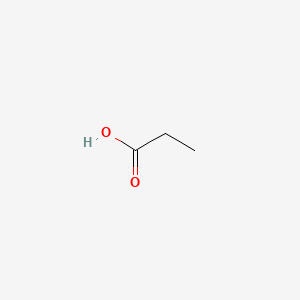 Compound
- Category
- Compound
What Propionic Acid is, and what it does.
- Does it work
- Suits people interested in what fibre fermentation actually produces, and in appetite signalling. Its salts also have a long record as bread and cheese preservatives.
- How much to take
- No daily amount is on record. Your own colon makes far more of it from fibre than any capsule provides, so fibre in the diet is where most of the supply comes from.
- Time to feel it
- Gut hormone signalling responds within hours of a dose reaching the colon. Appetite and metabolic markers are read over weeks rather than felt on the day.
- The first dose
- Day one is quiet. Some people notice a little more fullness after meals. Most of what is happening is portal blood chemistry you would need a lab to see.
- With regular use
- Weeks of steady supply, mostly from fibre, keep propionate flowing to the liver where it joins glucose and lipid pathways. That shows on markers, not in sensation.
- How well tolerated
- Propionate salts have a long record of food use at everyday intakes. The undiluted acid is corrosive and belongs in manufacturing, not in a kitchen or a scoop.
- How it feels
- Nothing distinct. The closest thing to a sensation is feeling less hungry between meals, and even that sits at the edge of what people reliably notice.
- The overlooked benefit
- Propionate is one of the few short-chain fatty acids the body turns into glucose, and that route needs both biotin and vitamin B12 to run.
The proof, claim by claim.
What these words mean
These words describe the research, not the molecule's worth. Research strength is how much work stands behind one claim, and it is never a product score.
- Release of the gut hormones GLP-1 and peptide YYRandomised trial
- Appetite regulation and fullness after mealsRandomised trial
4 more claims
- Healthy glucose metabolismRandomised trial
- Body composition during weight managementRandomised trial
- Gluconeogenesis in the liverNarrative review
- Histone deacetylase inhibition in epithelial and immune cellsIn vitro study
Why these belong in the same formula, 16 pairings
Why these belong in the same formula. Each row says what the basis is, from settled biochemistry through to a trial that measured the pair.
The first committed step of propionate disposal is carboxylation of propionyl-CoA, and that enzyme carries a covalently bound biotin. Biotin deficiency slows this step and raises propionate-derived organic acids in urine. This is textbook intermediary metabolism and needs no trial to support it.
Inulin reaches the colon intact and is fermented to acetate, propionate and butyrate, with the exact ratio set by which bacteria dominate. Feeding the substrate raises endogenous propionate production without swallowing propionate itself. The ratio between the three short-chain fatty acids is not something a supplement can dictate.
Resistant starch is among the most reliably fermented substrates but favours butyrate over propionate in most human fermentation work. If propionate specifically is the target, arabinoxylan and certain pectins are better substrate choices. Worth stating plainly, since prebiotics are often discussed as if they all produce the same output.
In in vitro and human fermentation work, pectins and other uronic acid rich polysaccharides shift the short-chain fatty acid profile toward propionate relative to starch-based substrates. The shift is in proportion, not in absolute output alone. It depends on the resident microbiota to carry it out.
PHGG ferments slowly and further along the colon than inulin, which spreads the fermentation load and reduces the gas and bloating that faster substrates cause. Total short-chain fatty acid output rises, propionate included. Tolerability is the practical reason it is chosen over inulin.
Propionibacterium species and members of the Bacteroidetes are the main propionate producers, working through the succinate and propanediol pathways. Adding a strain that does not use those pathways will not raise propionate no matter how well it colonises. Strain identity matters more than the word probiotic on the label.
Butyrate is the preferred fuel of colonocytes and stays largely local, while propionate passes to the liver and is used for gluconeogenesis. Both are histone deacetylase inhibitors, butyrate considerably more potent. Supplementing both covers the local and the systemic side of the same fermentation output.
When propionyl-CoA accumulates, carnitine conjugates it to propionylcarnitine for urinary excretion, which is why free carnitine falls in states of propionate overload. This is the biochemical basis for carnitine use in inherited disorders of propionate handling. At ordinary dietary propionate levels the drain on the carnitine pool is not meaningful.
Glycine N-acyltransferase conjugates propionyl-CoA to form propionylglycine, which is excreted in urine. It is the smaller of the two escape valves alongside carnitine conjugation. Both matter only when the primary carboxylase and mutase route is saturated or blocked.
Free propionic acid is a corrosive, pungent liquid and is not dosed as such. Neutralising it to the calcium or sodium salt gives a stable, handleable powder. The counter-ion has to be counted in the formula's mineral total, which is easy to miss.
Sodium propionate is more soluble than the calcium salt and is preferred in liquid formats. At the gram-scale doses used in short-chain fatty acid studies, the accompanying sodium adds up. That is a reason to check the sodium total rather than a reason to choose one salt over the other.
Acetate is the most abundant of the three main short-chain fatty acids and reaches the systemic circulation in the highest concentration. Propionate is largely cleared by the liver on first pass, so the two have very different exposure profiles despite being made side by side. Studies measuring total short-chain fatty acids blur that distinction.
GOS is fermented rapidly in the proximal colon, mainly to acetate and lactate, which cross-feeding organisms then convert onward to propionate and butyrate. The propionate arrives at the end of a chain of organisms, not directly. That chain is where between-person variation creeps in.
Oat beta-glucan is fermented in the colon and also acts physically upstream by raising the viscosity of gut contents. Both effects have been examined around post-meal glucose, and the propionate contribution is one proposed piece of that picture rather than the established mechanism. The viscosity effect is far better characterised than the fermentation one.
Bifidobacteria produce acetate and lactate rather than propionate directly. Cross-feeding species take those products onward through the acrylate and propanediol pathways. So this partner works one step removed, which makes the effect real but indirect and dependent on who else is present.
Psyllium is mostly a gel-forming, poorly fermented fibre, which is exactly why it is well tolerated. That same property means it produces less propionate than inulin or pectin per gram. Choosing psyllium for short-chain fatty acid production is picking the wrong tool for the job.
Nothing specific on file for Propionic Acid. Match the label to the daily amount above, and tell your doctor what you take.
Not medical advice. Show the label to your pharmacist.What Propionic Acid actually does.
Your gut bacteria make it all day from the fibre you eat. It is a normal part of how the body runs, not a foreign substance.
3 more mechanisms
The liver takes most of it before the rest of the body ever sees it. A blood test from your arm does not tell you what the gut produced.
It gets fed into the same engine as everything else, and unlike most fats, a little of it can be turned into glucose.
It docks onto sensors in the gut wall that release appetite and glucose signalling hormones.
Where Propionic Acid comes from.
Most of it is made in a chemical plant from ethylene, though it can also be brewed with the same bacteria that put the holes in Swiss cheese. Then it is neutralised into a stable powder. Your own gut also makes it every day from fibre, in larger amounts than any capsule provides.
What this route gives you
The same molecule is reached more than one way. Which route a given product used is a manufacturing choice, and the finished compound is the same either way.
5 steps on record
The dominant industrial route starts from petrochemical ethylene. A separate biotechnological route ferments glucose or glycerol with Propionibacterium species. The molecule is identical either way.
The chemical route hydroformylates ethylene to propionaldehyde and oxidises it to propionic acid. The fermentation route runs Propionibacterium freudenreichii or acidipropionici on sugar, giving propionate alongside acetate and carbon dioxide.
Chemical route product is purified by distillation. Fermentation broth needs extraction or electrodialysis to separate the acid from cells, salts and co-produced acetate, which is why the fermentation route costs more.
The free acid is neutralised with calcium hydroxide, sodium hydroxide or magnesium hydroxide, then crystallised and dried. This is what turns a corrosive liquid into a handleable powder.
Sold as the salt. Colon-targeted formats add a coating so the dose survives past the small intestine, which changes where the exposure happens.
Getting Propionic Acid from food.
The whole-food sources on file. A supplement closes the gap, it does not replace dinner.
A gram-for-gram figure (how much of each you would eat to match a dose) will appear here once it is sourced and reviewed. This page will not print a number it cannot cite.
The forms it comes in.
3 more forms
The essence, in one line each.
- In a study of adults with diagnosed kidney conditions, taking propionic acid for 30 days was followed by an expansion of regulatory T cells in those on dialysis, but not in those who had received a kidney transplant.Open-label trial, in dialysis patients and kidney transplant patients. Anft M et al., 2024 (Frontiers in Transplantation). PMID 39328339 ↗
6 more findings
- A meta-analysis of 8 human studies found that people with a diagnosed mood condition had significantly lower blood levels of propionic acid compared to healthy controls.Meta-analysis, in depressed patients. Do QL et al., 2026 (Biomedical Journal). PMID 41865792 ↗
- Reviews the reported association between short-chain fatty acid levels, propionate among them, and the incidence of food allergy.Systematic review. Szukalska I et al., 2025 (Nutrients). PMID 41097194 ↗
- In a 6-month randomised trial in 72 adults with a diagnosed neurodegenerative condition, supplementing with short-chain fatty acids (including propionic acid) and a prebiotic improved motor symptoms.Randomised trial, in people with Parkinson's disease. Hegelmaier T et al., 2025 (Scientific Reports). PMID 41350593 ↗
- Reviews metabolic approaches in propionic acidemia, an inherited defect of propionyl-CoA carboxylase, and describes how the propionate disposal pathway is managed when the enzyme is absent.Narrative review. Subramaniyan B et al., 2026 (Biochemical Pharmacology). PMID 42341992 ↗
- Reports that supplementing indole-3-propionic acid did not produce the protective metabolic effect the authors tested for in this model.Animal study. Lee DM et al., 2020 (American Journal of Physiology: Gastrointestinal and Liver Physiology). PMID 32421360 ↗
- Adding indole-3-propionic acid to an in vitro maturation medium was associated with improved embryo production measures in this system.Animal study. Nakayama Y et al., 2025 (BMC Veterinary Research). PMID 41184843 ↗
Chosen from the 8 we read for Propionic Acid.
The studies, linked.
6 sources behind our Propionic Acid verdict, every one linked to PubMed, the journal or ClinicalTrials.gov.
- Clinical trialA Phase 1, Randomized, Double-blind, Placebo-controlled, Multicenter, Single and Multiple Ascending Dose Study to Evaluate the Safety, Tolerability, Pharmacokinetics, and Pharmacodynamics of Oral VP 20629 in Adult Subjects With Friedreich's AtaxiaClinicalTrials.gov ↗Phase 1, 46 participants, Completed
5 more linked trials
- Clinical trialEinfluss Der Süßintensität Einer Saccharose-Lösung Auf Die Blutglukoseregulation Und Energieaufnahme in Gesunden MännernClinicalTrials.gov ↗Early phase 1, 30 participants, Completed
- Clinical trialCarbidopa in Familial Dysautonomia: Phase-II Study, Investigational New Drug (IND) 117435, Date: 01/07/13ClinicalTrials.gov ↗Phase 2, 22 participants, Completed
- Clinical trialPropionic Acid in Multiple Sclerosis: Safety, Tolerability and Clinical Outcomes From the Pro-MADAI StudyClinicalTrials.gov ↗22 participants, Completed
- Clinical trialAlpha-Amino-3-Hydroxy-5-Methyl-4- Isoxazole Propionic Acid Receptor Components of the Anti-Depressant Ketamine ResponseClinicalTrials.gov ↗Phase 1, 13 participants, Completed
- Clinical trialIndole-3-PROpionic Acid Clinical Trials - Multiple Sclerosis (iPROACT-MS)ClinicalTrials.gov ↗220 participants, Recruiting
From clinical trials and PubMed, ranked by study type and citation weight, not cherry-picked.
Problems people have reported.
Read this carefully. These are 286 voluntary, unverified reactions reported to the FDA (openFDA). The number mostly reflects how popular Propionic Acid is, not how risky it is. A report is not proof Propionic Acid caused anything. It is a signal of what to watch for, nothing more.
3 more reported effects
Source: openFDA adverse-event reports. Voluntary reporting, not an incidence rate.
FDA Disclaimer: These statements have not been evaluated by the Food and Drug Administration. This information is for educational purposes only and is not intended to diagnose, treat, cure, or prevent any disease. Consult your healthcare provider before starting any supplement regimen.