Saccharin.
Saccharin makes something taste sweet without adding energy. It is hundreds of times sweeter than sugar by weight, so a very small amount does the whole job.
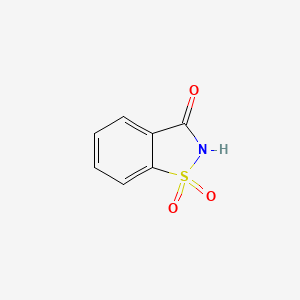 Compound
- Category
- Compound
What Saccharin is, and what it does.
- Does it work
- It suits anyone who wants sweetness in a powder or drink without sugar, and it holds up in heat and acid. Anyone with a documented sulfonamide sensitivity should check first.
- How much to take
- No dose is on record, because saccharin is a flavouring rather than an active. A few milligrams sweetens a serving, given how much sweeter than sugar it is.
- Time to feel it
- Instantly. Sweetness lands as soon as it dissolves, and at higher levels a metallic edge follows within seconds.
- The first dose
- Taste, and nothing past it. Saccharin is absorbed but not metabolised, so it leaves in urine essentially unchanged.
- With regular use
- It keeps a sugar-free product palatable month after month. Human research has not found a consistent metabolic effect at intakes used in food and supplements.
- How well tolerated
- Generally well tolerated. The aftertaste is the usual complaint. Anyone with a documented sulfonamide hypersensitivity is sometimes advised to avoid it, so ask a clinician.
- How it feels
- Clean sweetness up front with a faint metallic or bitter tail when the level is pushed. The whole experience happens on the tongue.
- The overlooked benefit
- It survives baking, effervescent tablets and long shelf life in acidic drinks, conditions where aspartame degrades. That is why it turns up in fizzing formats.
The proof, claim by claim.
What these words mean
These words describe the research, not the molecule's worth. Research strength is how much work stands behind one claim, and it is never a product score.
- Sweetness without contributing metabolisable energyNarrative review
- Activation of the sweet taste receptor pairIn vitro study
3 more claims
- Unchanged urinary excretion in humansNarrative review
- Glucose response after non-nutritive sweetener intakeRandomised trial
- Gut microbiota composition with sweetener intakeRandomised trial
Why these belong in the same formula, 5 pairings
Why these belong in the same formula. Each row says what the basis is, from settled biochemistry through to a trial that measured the pair.
Aspartame is clean but slow and unstable at low pH over time, while saccharin is fast, stable and leaves a metallic finish. Together they cover the full sweetness curve and each is used below the level where its own off-note registers. The blend is formulation economics and taste engineering, not a physiological interaction.
A small amount of sucrose alongside saccharin gives body and mouthfeel that a high-intensity sweetener cannot supply on its own, and the perceived sweetness exceeds what either concentration would give alone. Reduced-sugar products use this to cut sucrose without a hollow taste. The relationship is sensory.
Zinc salts, particularly in lozenges and liquids, carry a strong metallic astringency that stops people finishing a course. Saccharin is used as one of the masking agents in those preparations. Worth noting that saccharin has its own metallic tail, so it is usually combined with a second sweetener when masking a mineral.
Rodent and laboratory work has reported that saccharin inhibits growth of some bacterial species, while a human trial at high intake did not detect microbiota changes. Whether co-ingesting saccharin affects a live probiotic dose in people has not been established either way. Read this as a theoretical concern flagged by animal data rather than a demonstrated human interaction.
Effervescent bases taste salty and alkaline, and saccharin holds its sweetness across the pH swing during dissolution where some other sweeteners degrade. That heat and pH stability is why it persists in effervescent formats. The pairing is about surviving the dosage form.
Nothing specific on file for Saccharin. Match the label to the daily amount above, and tell your doctor what you take.
Not medical advice. Show the label to your pharmacist.What Saccharin actually does.
Saccharin attaches to the sweet-taste receptor on the tongue and tastes hundreds of times sweeter than sugar by weight, while providing essentially no calories.
3 more mechanisms
Saccharin is absorbed by the body but not broken down. It's passed unchanged in urine, which is why it has no calories and doesn't stay in the body long.
At higher amounts saccharin also triggers bitter-taste receptors, which is where that metallic aftertaste comes from and why there's a limit to how much can be used alone in a product.
Saccharin holds up to heat and works across a wide range of acidity, unlike aspartame, which is why it survives baking, fizzy drinks and long shelf life in acidic beverages.
The forms it comes in.
3 more forms
The essence, in one line each.
- At high supplemental intake the investigators did not detect changes in gut microbiota composition or in glucose tolerance, which is a failure to detect an effect rather than a demonstration that none exists.Randomised trial. Serrano J et al., 2021 (Microbiome). PMID 33431052 ↗
5 more findings
- The authors reported that saccharin supplementation worsened arterial plaque development in high-fat-fed mice, attributing it to disturbed lipid handling and inflammatory signalling.Animal study. Li Y et al., 2025 (Journal of Agricultural and Food Chemistry). PMID 40847258 ↗
- Saccharin inhibited bacterial growth and reduced experimentally induced gut inflammation in mice, a direction opposite to what several other rodent reports describe.Animal study. Sünderhauf A et al., 2020 (Nutrients). PMID 32316544 ↗
- Saccharin supplementation altered sweet receptor messenger RNA expression and appetite-related signalling alongside changes in body weight in the animals studied.Animal study. Zhao X et al., 2018 (Peptides). PMID 30055207 ↗
- A formulation case study in which saccharin appears among the excipients used to make an unpalatable active acceptable to paediatric patients.Narrative review. Tomlin S et al., 2026 (Pharmaceutical Medicine). PMID 42243603 ↗
- Artificial sweeteners including saccharin were tested with fruit juice extracts in a laboratory intestinal permeability model. The findings are cell-model observations, not human outcomes.In vitro study. Köpsel M et al., 2026 (ACS Omega). PMID 42004387 ↗
Chosen from the 7 we read for Saccharin.
The studies, linked.
5 sources behind our Saccharin verdict, every one linked to PubMed, the journal or ClinicalTrials.gov.
- Clinical trialTetronine (Sodium Liothyronine) for Infants & Children Undergoing Cardiopulmonary Bypass in a Middle Income Nation (OTICC Study)ClinicalTrials.gov ↗Phase 3, 224 participants, Completed
4 more linked trials
- Clinical trialOral Triiodothyronine for Children Undergoing Cardiopulmonary Bypass in IndonesiaClinicalTrials.gov ↗Phase 3, 177 participants, Completed
- Clinical trialInteractions of Human Gut Microbiota With Intestinal Sweet Taste ReceptorsClinicalTrials.gov ↗102 participants, Completed
- Clinical trialSensory and Gastrointestinal Impact of Taste Receptor Variants on Human Metabolism and NutritionClinicalTrials.gov ↗97 participants, Completed
- Clinical trialIntestinal Sweet Taste Receptor Function and Adaptation to Dietary Sugars and SweetenersClinicalTrials.gov ↗10 participants, Completed
From clinical trials and PubMed, ranked by study type and citation weight, not cherry-picked.
Problems people have reported.
Read this carefully. These are 9,932 voluntary, unverified reactions reported to the FDA (openFDA). The number mostly reflects how popular Saccharin is, not how risky it is. A report is not proof Saccharin caused anything. It is a signal of what to watch for, nothing more.
3 more reported effects
Source: openFDA adverse-event reports. Voluntary reporting, not an incidence rate.
FDA Disclaimer: These statements have not been evaluated by the Food and Drug Administration. This information is for educational purposes only and is not intended to diagnose, treat, cure, or prevent any disease. Consult your healthcare provider before starting any supplement regimen.