Aspartame.
It makes a powder, tablet or drink taste sweet at a few milligrams, with no sugar and no meaningful glucose load. It's a flavour tool rather than an active ingredient.
 Compound
- Category
- Compound
What Aspartame is, and what it does.
- Does it work
- Suits people who want a sweet-tasting formula without sugar in it. Anyone limiting phenylalanine will want to read the declaration on the label.
- How much to take
- There's no dose figure on record, because it isn't taken for an effect. Inclusion runs in milligrams: it's about two hundred times as sweet as sugar by weight.
- Time to feel it
- Sweetness arrives the moment it hits your tongue. There's nothing else to wait for.
- The first dose
- You taste sweetness. The molecule is split into two amino acids and a little methanol before absorption, the same building blocks ordinary protein food delivers.
- With regular use
- Daily use keeps doing one thing: sweetness with no carbohydrate load. Long-term intake at the amounts used in products has been examined repeatedly in the literature.
- How well tolerated
- Well tolerated at the amounts used in products. People who have to limit phenylalanine need to count it, which is why labels declare it as a phenylalanine source.
- How it feels
- Clean sweetness with a slight lingering edge some people notice. Taste is the whole experience, and there's no sugar rise behind it.
- The overlooked benefit
- It fades in acidic drinks over shelf life and breaks apart with heat, which is why it isn't used for baking and why an old bottle tastes flatter.
The proof, claim by claim.
What these words mean
These words describe the research, not the molecule's worth. Research strength is how much work stands behind one claim, and it is never a product score.
- post-meal glucose when it replaces sugarMeta-analysis
- body weight when it replaces sugar in the dietMeta-analysis
1 more claim
- acid production by mouth bacteriaIn vitro study
Why these belong in the same formula, 11 pairings
Why these belong in the same formula. Each row says what the basis is, from settled biochemistry through to a trial that measured the pair.
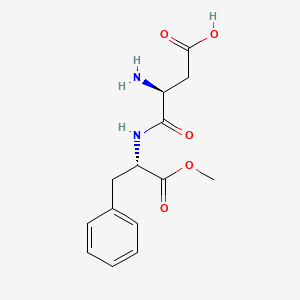
Aspartame is aspartyl-phenylalanine methyl ester, so digestion splits it into aspartic acid, phenylalanine and methanol before anything is absorbed. Phenylalanine is roughly half the molecule by weight. This is why products carrying aspartame must declare a phenylalanine source for people who have to restrict that amino acid in the diet. It is a labelling fact rooted in the chemistry, not a claim.
In people with normal phenylalanine hydroxylase activity, the phenylalanine liberated from aspartame is largely hydroxylated to tyrosine and enters the ordinary amino acid pool. Where that enzyme step is impaired the phenylalanine accumulates instead, which is the entire basis of the dietary restriction. The relationship is a metabolic step, not a supplement pairing anyone should design around. Worth stating because it explains the warning label.
Large neutral amino acids share a single saturable transporter into the brain, so raising the plasma level of one lowers the fraction of transporter available to the others. A phenylalanine load from aspartame is small next to a protein meal, but the competition is real and directional. This describes transport, which is a marker, and not a measured effect on mood or sleep. Anyone timing a tryptophan dose has more to gain from keeping it away from protein generally.
5-HTP crosses into the brain on the same large neutral amino acid transporter that phenylalanine uses, so a phenylalanine load competes for entry. The practical size of that competition from a diet drink is small compared with an ordinary meal. It is still the honest way to describe the interaction. Timing separation is the only handling this needs.
Aspartame is slow to onset with a lingering sweetness while acesulfame K hits fast and carries a bitter tail. Blending them gives a sugar-like curve that neither produces alone, and the sweetness is more than additive on a weight basis. This is one of the most widely used sweetener pairings in beverages. It is formulation convention, with no physiological claim attached.
Sucralose survives heat and long storage better than aspartame, which slowly hydrolyses in acidic liquids over shelf life. Blends use sucralose to hold sweetness late in shelf life while aspartame carries the cleaner early profile. The pairing is a stability and taste decision. Nothing about it implies a physiological interaction.
Caffeine has a bitter profile that intense sweeteners are used to cover, which is why the two travel together in beverages. There is no shared metabolic route between them. Any study of a diet cola is studying a mixture, which makes attributing a finding to the sweetener alone difficult. Read combination studies with that in mind.
Aspartame is hydrolysed and absorbed in the small intestine, so very little intact sweetener reaches the colon compared with non-absorbed sweeteners such as sucralose or the polyols. That makes a large microbiota effect less likely on chemical grounds, though studies report mixed findings. Any claim in either direction here is currently ahead of the evidence. Label it as unsettled.
Removing sugar removes both sweetness and physical bulk, so reduced-sugar formulas commonly pair an intense sweetener with a bulking fibre. Inulin supplies mouthfeel and body while aspartame supplies sweetness at a tiny inclusion rate. The two solve different halves of one problem. It is formulation convention.
Erythritol is around seventy percent as sweet as sugar and provides the bulk that an intense sweetener cannot, and it also blunts the lingering sweetness aspartame leaves behind. Powder and tabletop products lean on this pairing heavily. Erythritol brings its own tolerance ceiling at higher intakes. This is formulation practice, stated without preference between routes.
Saccharin and aspartame blends have been used since the early days of intense sweetener formulation because the combination gives higher perceived sweetness than the sum of the parts and mutually suppresses each one's aftertaste. The mechanism sits at the sweet taste receptor rather than anywhere downstream. It is a taste engineering choice.
Nothing specific on file for Aspartame. Match the label to the daily amount above, and tell your doctor what you take.
Not medical advice. Show the label to your pharmacist.What Aspartame actually does.
It gets taken apart in the gut into two amino acids and a small amount of methanol. The sweetener itself never reaches your blood.
3 more mechanisms
It hits the sweet receptor hard, so a pinch does the work of a spoonful of sugar.
There is no sugar in it to raise your blood sugar, and the amount used is far too small to count as calories.
Yes, it releases a little methanol. So does a glass of tomato juice, and usually more of it.
Where Aspartame comes from.
Bacteria are fed sugar and make two amino acids. Those two get stitched together and capped with a methyl group, and the result tastes intensely sweet. The building blocks are the same ones in ordinary protein food.
What this route gives you
The same molecule is reached more than one way. Which route a given product used is a manufacturing choice, and the finished compound is the same either way.
6 steps on record
L-phenylalanine and L-aspartic acid are produced industrially by bacterial fermentation of a carbohydrate feedstock, most often using engineered Escherichia coli or Corynebacterium glutamicum strains.
The two amino acids are joined into the aspartyl-phenylalanine dipeptide. Routes split between a chemical coupling with protected intermediates and an enzymatic coupling using thermolysin, which gives the correct isomer directly.
The phenylalanine carboxyl group is converted to its methyl ester, which is what gives the molecule its sweetness. The unesterified dipeptide is not sweet.
Repeated crystallisation removes the inactive beta isomer and residual reagents. Isomeric purity is a key specification because only the alpha-L,L isomer is sweet.
Batches are released against assay, isomer ratio and diketopiperazine limits, since that cyclisation product forms during storage.
Milled to a defined particle size, encapsulated, or co-crystallised with acesulfame K into a single salt.
Getting Aspartame from food.
The whole-food sources on file. A supplement closes the gap, it does not replace dinner.
A gram-for-gram figure (how much of each you would eat to match a dose) will appear here once it is sourced and reviewed. This page will not print a number it cannot cite.
The forms it comes in.
4 more forms
The essence, in one line each.
- In a systematic review and meta-analysis of human studies, aspartame had little to no effect on glucose or insulin responses, with the authors noting high heterogeneity between studies and very low certainty of the evidence.Systematic review. Boxall LR et al., 2025 (Advances in Nutrition). PMID 40381807 ↗
3 more findings
- Aspartame added to starter feed accelerated small intestinal epithelial cell turnover and altered gut secretion measures in young animals.Animal study. Sun D et al., 2019 (Journal of Animal Physiology and Animal Nutrition). PMID 31342562 ↗
- A computational network toxicology analysis with supporting cell-based work proposed candidate molecular pathways. The work is hypothesis-generating and was not conducted in people.In vitro study. Huang C et al., 2025 (International Journal of Molecular Sciences). PMID 41515956 ↗
- Artificial sweeteners tested with fruit juice extracts in an intestinal permeability model showed matrix-dependent effects on barrier measures.In vitro study. Köpsel M et al., 2026 (ACS Omega). PMID 42004387 ↗
Chosen from the 7 we read for Aspartame.
The studies, linked.
10 sources behind our Aspartame verdict, every one linked to PubMed, the journal or ClinicalTrials.gov.
- Clinical trialA Prospective, Randomized, Evaluator Blind, Active-Controlled, Parallel Study of the Efficacy and Safety of Quiklean® and Klean-Prep With Dulcolax® for the Bowel Preparation Prior to ColonoscopyClinicalTrials.gov ↗Phase 3, 472 participants, Completed
9 more linked trials
- Clinical trialEffect of a Dietary Supplement on Satiety and Acute Responses to Laboratory Alcohol ChallengeClinicalTrials.gov ↗64 participants, Completed
- Clinical trialEffect of Carbonated Soft Drinks on Body Weight, Fat Distribution and Metabolic Risk FactorsClinicalTrials.gov ↗60 participants, Completed
- Clinical trialEffects of the Sugar Sucrose on Bodyweight and Energy Intake Over 28 Days in Obese WomenClinicalTrials.gov ↗41 participants, Completed
- Clinical trialAdverse Metabolic Effects of Dietary Sugar: Ad Libitum vs Energy-balanced DietsClinicalTrials.gov ↗36 participants, Completed
- Clinical trialTrans-placental Transport and Foetal Accumulation of Artificial SweetenersClinicalTrials.gov ↗35 participants, Completed
- Clinical trialEffects of Stevia on Satiety and Eating Attitudes in Healthy, Overweight and Obese Adults: A Pilot StudyClinicalTrials.gov ↗30 participants, Completed
- Clinical trialEnteroendocrine, Pancreatic, and Adipocyte Hormonal Response After the Ingestion of Cola Beverages With Sucrose and Non-nutritive Sweeteners in Healthy Adults. Crossover Randomized Controlled TrialClinicalTrials.gov ↗20 participants, Completed
- Clinical trialInfluence of the Macronutrient Content of a Standardized Pre-Exercise Meal on the Glycemic Response Following Exercise in Type 2 DiabeticsClinicalTrials.gov ↗15 participants, Completed
- Clinical trialImmediate and Long-term Induction of Incretin Release by Artificial Sweeteners 1ClinicalTrials.gov ↗14 participants, Completed
From clinical trials and PubMed, ranked by study type and citation weight, not cherry-picked.
Problems people have reported.
Read this carefully. These are 550 voluntary, unverified reactions reported to the FDA (openFDA). The number mostly reflects how popular Aspartame is, not how risky it is. A report is not proof Aspartame caused anything. It is a signal of what to watch for, nothing more.
3 more reported effects
Source: openFDA adverse-event reports. Voluntary reporting, not an incidence rate.
FDA Disclaimer: These statements have not been evaluated by the Food and Drug Administration. This information is for educational purposes only and is not intended to diagnose, treat, cure, or prevent any disease. Consult your healthcare provider before starting any supplement regimen.