Sennoside.
It gets the colon moving. Taken in the evening, gut bacteria convert it overnight and a bowel movement usually follows the next morning.
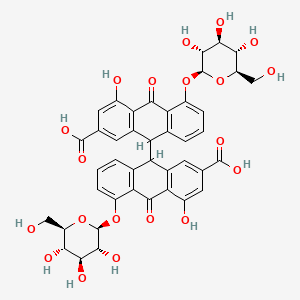 Compound
- Category
- Compound
What Sennoside is, and what it does.
- Does it work
- Suits someone who wants a short, defined course when things get sluggish. For everyday regularity, fibre and fluids do the steadier work.
- How much to take
- No dose figure is on record, so we won't invent one. Start with the amount printed on the product you have, once in the evening, over a short stretch rather than daily.
- Time to feel it
- Six to twelve hours, usually overnight. The wait is bacterial conversion in the colon, and a bigger amount doesn't shorten it.
- The first dose
- Quiet for most of the day. The effect lands the following morning, sometimes with cramping or gurgling in the hour or two before.
- With regular use
- This is designed for short stretches. Daily anthranoid use over months is linked with brown pigment in the colonic lining that recedes after stopping.
- How well tolerated
- Well tolerated over a few days. Cramping and loose stools are the common ones. Check with a clinician if you're pregnant, breastfeeding, or on a medicine affecting potassium.
- How it feels
- Some cramping and gurgling before it works, then clear relief. Replace fluids, because the water carried out can leave you a bit flat.
- The overlooked benefit
- It's a prodrug only your colonic bacteria can switch on, which is why two people taking the same amount can get quite different results.
The proof, claim by claim.
What these words mean
These words describe the research, not the molecule's worth. Research strength is how much work stands behind one claim, and it is never a product score.
- Bowel regularity over a short courseMeta-analysis
- Colonic transit time and stool water contentRandomised trial
2 more claims
- Bowel clearance before a scheduled endoscopyRandomised trial
- Colonic pigment deposition with prolonged daily useCohort study
Why these belong in the same formula, 7 pairings
Why these belong in the same formula. Each row says what the basis is, from settled biochemistry through to a trial that measured the pair.
Sennoside passes the small intestine largely unabsorbed because the sugar groups block uptake. Colonic bacteria with beta-glucosidase activity strip those sugars and reduce the aglycone to rhein anthrone, which is the active species. Someone whose colonic flora has been depleted converts less of the dose. This is why the same amount produces different effects in different people.
Faster colonic transit with more luminal fluid means less time and less surface for the colon to reclaim potassium. Repeated or high-dose use is where the loss becomes measurable rather than a single dose. Potassium status is a laboratory measure and not a symptom people notice early. Anyone using stimulant laxatives beyond short periods should have that measured rather than guessed.
The two arrive at the same endpoint by different routes, so combining them stacks the effect rather than balancing it. Magnesium citrate and magnesium oxide both do this at laxative doses, which are well above typical supplemental magnesium. People taking magnesium for other reasons often do not count it as part of their laxative load. The combination also compounds fluid and electrolyte shifts.
Psyllium holds water in the stool and increases mass, which is a mechanical effect that continues indefinitely without adaptation. Sennoside acts on the enteric nervous system and on fluid secretion, and is intended for short use. Using fibre as the base and the stimulant only intermittently is the standard structure. Taking both at the same moment can also make the stimulant effect harder to titrate.
Glycyrrhizin inhibits the enzyme that protects the mineralocorticoid receptor from cortisol, which increases renal potassium excretion. Anthranoid laxatives increase faecal potassium loss. The two additive routes are easy to miss because they sit in different product categories. Deglycyrrhizinated licorice does not carry this issue.
Non-heme iron absorption is slow and depends on residence time in the duodenum and upper jejunum. Anything that accelerates transit shortens that window. The interaction is directional and mechanistic. The size of it in ordinary use has not been quantified well. Separating an iron dose from laxative timing is the simple answer.
Stimulant laxatives commonly produce cramping, and the traditional response was to add a carminative such as ginger or fennel to the same formula. The rationale is smooth muscle relaxation and reduced gas retention. This is formulation tradition supported by mechanism rather than by trials of the specific combination. It does not change how much anthranoid gets converted.
Nothing specific on file for Sennoside. Match the label to the daily amount above, and tell your doctor what you take.
Not medical advice. Show the label to your pharmacist.What Sennoside actually does.
Sennoside carries sugar groups that make it too water-soluble to be absorbed, so the intact compound travels all the way to the colon instead of acting anywhere along the way.
3 more mechanisms
Bacteria in the colon remove the sugar units and convert what's left into rhein anthrone. That converted compound is what actually acts on the colon lining, so the effect depends on bacterial conversion rather than on the dose swallowed.
Rhein anthrone acts on nerve endings in the gut to speed up movement and shifts how the colon handles water and salts, both pushing more water into the stool.
The delay between taking it and feeling an effect, usually overnight, is just the time bacterial conversion takes. It's not a slow-release formulation effect and can't be sped up by taking more.
Where Sennoside comes from.
It comes from senna, a shrub used as a laxative for a very long time. Swallowed, it does nothing until gut bacteria in your colon chemically change it, which is why it works overnight rather than within an hour. Short-term use is the whole design of it.
What this route gives you
Made from a plant. What ends up in the capsule tracks the harvest, so batch testing and a stated marker matter more here than with a made molecule.
6 steps on record
Leaflets and pods of Cassia senna, also traded as Alexandrian or Tinnevelly senna depending on origin. Pods generally assay higher in sennosides than leaf.
Drying conditions matter because anthranoid glycosides oxidise and interconvert with heat and moisture. Poorly dried material assays lower and less predictably.
The glycosides are polar and come out in water or dilute alcohol. Non-polar plant material is left behind.
Sennosides are commonly recovered and stabilised as calcium salts, which improves handling and assay consistency.
Material is assayed by HPLC, usually against sennoside B, and blended to a target percentage.
Supplied as a defined-percentage powder for tabletting or as milled crude herb for teas.
The forms it comes in.
4 more forms
The essence, in one line each.
- The review sets out how gut bacteria convert inactive plant glycosides into their active aglycones, using anthranoid laxatives as a worked example.Narrative review. Ikarashi N et al., 2025 (Journal of Natural Medicines). PMID 41071238 ↗
1 more finding
- An ethanol extract of senna leaf changed inflammatory and oxidative stress markers in mice on untargeted metabolomic analysis.Animal study. Huang X et al., 2025 (Endocrine, Metabolic and Immune Disorders Drug Targets). PMID 39449343 ↗
Chosen from the 3 we read for Sennoside.
The studies, linked.
2 sources behind our Sennoside verdict, every one linked to PubMed, the journal or ClinicalTrials.gov.
- Clinical trialAdding Stewed Apricot Juice to Senna Improves the Right-Side and Overall Colon Cleansing Quality for Colonoscopy PreparationClinicalTrials.gov ↗Phase 4, 128 participants, Completed
1 more linked trial
- Clinical trialPolyethylene Glycol 3350 Compared With Senna After Urogynecologic Surgery A Randomized Controlled TrialClinicalTrials.gov ↗Phase 4, 254 participants, Recruiting
From clinical trials and PubMed, ranked by study type and citation weight, not cherry-picked.
FDA Disclaimer: These statements have not been evaluated by the Food and Drug Administration. This information is for educational purposes only and is not intended to diagnose, treat, cure, or prevent any disease. Consult your healthcare provider before starting any supplement regimen.