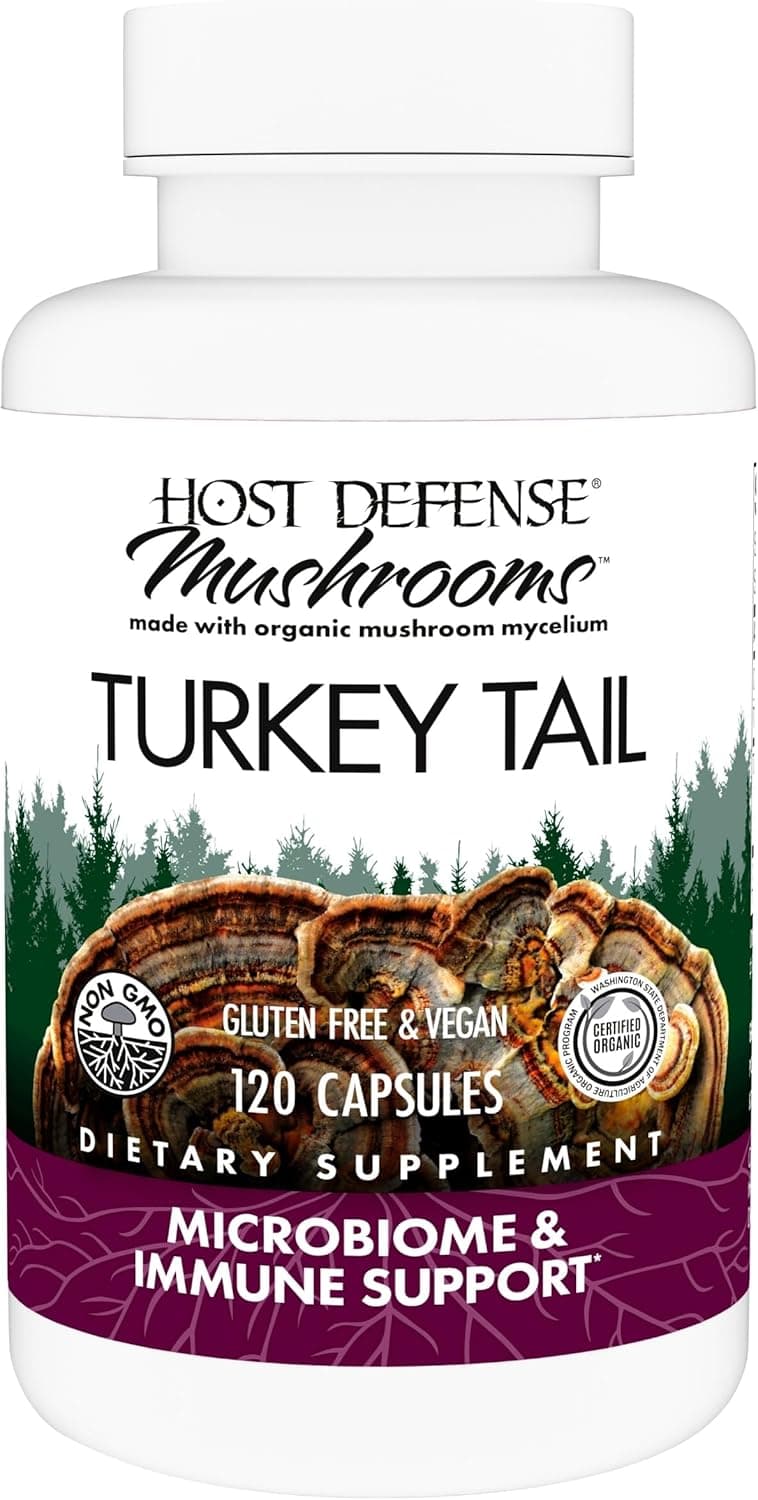
Split Gill Polypore Mycelium.
Split Gill mushroom mycelium containing schizophyllan, a beta-glucan with some interesting immune research. Provides schizophyllan (a beta-glucan) that may activate immune cells, based primarily on injectable research
Reviewed March 2026
- Category
- Herb
- Also filed under
- Contains schizophyllan (studied beta glucan)Immune modulation potentialOne of the more researched obscure mushrooms
What Split Gill Polypore Mycelium is, and what it does.
- Does it work
- The active compound schizophyllan has real clinical data, but it was given by injection. Oral mycelium supplements are a big extrapolation from that evidence. It's speculative at best.
- How much to take
- 500-1000mg of the biomass daily. No established oral dose because the clinical research used injectable forms at very different doses.
- Time to feel it
- Nobody has measured a timeline for the oral biomass. Beta-glucan work in general reads out on immune markers over weeks rather than as a sensation.
- The first dose
- Nothing detectable. Even if the beta-glucans are bioactive orally, immune modulation takes weeks to manifest.
- With regular use
- Theoretical immune support over months. No oral supplement studies to give you a real timeline.
- How well tolerated
- Well tolerated. Schizophyllum commune is edible (it's eaten in parts of Asia and Mexico). No reported adverse effects from supplement forms.
- How it feels
- There's no taste or lift to it. Beta-glucans act on immune cell receptors and on gut fermentation, so the read comes from markers rather than from sensation.
- The overlooked benefit
- Whatever isn't picked up by immune receptors carries on to the colon, where bacteria ferment it into short-chain fatty acids including butyrate. That part is settled biochemistry.
500 to 1,500mg a day is where Split Gill Polypore Mycelium works.
Source: Schizophyllan clinical studies (injectable form), Ooi & Liu 2000
The proof, claim by claim.
These words describe the research, not the molecule's worth. Research strength is how much work stands behind one claim, and it is never a product score.
- Schizophyllan activates immune cells
- Oral supplements provide immune benefits
- Anti-cancer properties
Questions people ask about Split Gill Polypore Mycelium.
- Is the injectable research relevant to oral supplements?
- Partially. The immune-activating mechanism is real, but injection bypasses digestion entirely. Oral beta-glucans interact with gut immune tissue differently, and the effects may be weaker.
- Why is this in my mushroom blend?
- Diversity. Multi-mushroom blends aim to provide different types of beta-glucans from different species. Split gill adds schizophyllan to the mix, which is structurally different from beta-glucans in reishi or turkey tail.
- Should I take this alone or in a blend?
- In a blend. As a standalone supplement, the evidence doesn't justify it. But as part of a multi-species mushroom stack, it adds a unique beta-glucan profile.
- How does it compare to turkey tail or reishi?
- Turkey tail (PSK/PSP) and reishi have much more oral supplement research. If you're choosing one mushroom for immune support, those are better bets. Split gill is a supporting player.
- Is the mycelium-on-rice format a problem?
- It's the same issue as other mycelium-on-grain products. A significant portion of what you're taking is rice starch, not mushroom actives. Look for beta-glucan content on the label.
- Can I eat split gill mushrooms?
- Yes, they're edible and eaten in many cultures. But they're tough and rubbery with a mild flavor. Not exactly a culinary highlight for Western palates.
Why these belong in the same formula. Each row says what the basis is, from settled biochemistry through to a trial that measured the pair.
Schizophyllan from Schizophyllum commune and yeast-derived beta-glucan share a beta-1,3-linked backbone with beta-1,6 branches. Dectin-1 and complement receptor 3 on innate immune cells bind that motif regardless of which fungus supplied it. Stacking the two raises total glucan load on one receptor system rather than opening a second one. Formulators pair them for breadth of source, not for a separate mechanism.
Generic beta-glucan preparations and schizophyllan are read by the body through the same carbohydrate-recognition machinery. Solubility and branching differ between sources, which changes how much reaches immune tissue, but the recognised motif is the same. Combined products deliver a higher glucan dose on one pathway. This is established carbohydrate immunology rather than a tested combination.
Reishi contributes its own beta-glucan fraction alongside triterpenes that schizophyllan preparations do not carry. Blends are built for a wider polysaccharide profile across species. The pairing is formulation convention with a shared structural rationale, not a measured combination effect.
Both fungi are cultivated for their cell-wall polysaccharide fractions. The immune-cell receptors involved read the glucan backbone common to each. A blend increases total recognised polysaccharide rather than introducing a distinct target. Read it as mechanistic overlap rather than tested synergy.
Maitake's glucan fraction differs in branching frequency from schizophyllan, which changes solubility and viscosity. Both are recognised by the same innate receptor set. Multi-mushroom formulas combine them for source diversity. No combination trial grounds this pairing.
Monocytes and macrophages express the vitamin D receptor, and receptor occupancy shifts how those cells respond after pattern-recognition receptors are engaged. Schizophyllan acts at the recognition step. Vitamin D acts on the cell's downstream readiness. The two touch normal immune signalling at different points. This is receptor biology, not a measured clinical pairing.
Zinc-dependent enzymes and zinc-finger transcription factors sit throughout normal immune cell function. A glucan that engages a receptor still needs the downstream machinery intact. Adequate zinc status supports that machinery. The relationship is nutritional dependence rather than a combination effect.
Human digestive enzymes do not cleave beta-1,3 glucosidic bonds, so a substantial fraction of ingested schizophyllan arrives intact in the large bowel. Several commensal genera ferment glucans there. Co-supplying live cultures gives the substrate an organism to reach. Extent of fermentation varies with the individual's existing microbial community.
Inulin is a fructan fermented rapidly in the proximal colon. Fungal beta-glucan ferments more slowly and further along. Combining them spreads fermentable substrate across the length of the bowel. Both raise short-chain fatty acid production by resident bacteria. Gas and bloating scale with total fermentable load, so the combination is dose-sensitive.
Bacterial fermentation of glucans yields short-chain fatty acids, butyrate among them, which colonocytes use as a fuel. Supplying butyrate directly and supplying its substrate are two routes to the same molecule in the lumen. The pairing is mechanistically coherent rather than trial-tested.
Resistant starch and fungal beta-glucan pass the small intestine largely intact and are fermented by different bacterial groups. Together they broaden which organisms are fed. Total fermentable load determines tolerability more than either ingredient alone.
Neutrophils concentrate ascorbate well above plasma levels and use it during normal oxidative activity. A beta-glucan that engages those cells depends on their baseline function being intact. This is nutrient adequacy supporting a pathway, not an ingredient interaction.
Glutathione peroxidases and thioredoxin reductases are selenoenzymes that manage reactive oxygen species produced by activated phagocytes. Adequate selenium keeps that handling intact. The link to schizophyllan is that both touch the same cell population from different sides.
Talk to a doctor before taking Split Gill Polypore Mycelium if any of these apply to you: Most research is on injectable schizophyllan, not oral, Mycelium on grain reduces potency, Oral bioavailability of schizophyllan is unclear. These are flags to check first, not effects Split Gill Polypore Mycelium is known to cause.
Not medical advice. Show the label to your pharmacist.What Split Gill Polypore Mycelium actually does.
Schizophyllan is a beta-1,3-glucan wearing single beta-1,6-linked glucose branches. That shape is exactly what innate immune receptors like dectin-1 and complement receptor 3 are built to recognise.
Our digestive enzymes can't cut beta-1,3 or beta-1,6 glucosidic bonds. So schizophyllan isn't absorbed as glucose, and most of what you swallow arrives in the colon still intact.
Grown on rice, the mycelium carries leftover grain starch and protein into the finished biomass. A whole-biomass powder is therefore fungal cell wall plus spent substrate, not an isolated polysaccharide.
Whatever glucan escapes digestion becomes food for the bacteria in your colon. They ferment it into short-chain fatty acids, mainly acetate, propionate and butyrate.
Where Split Gill Polypore Mycelium comes from.
A fungus is grown on cooked, sterilised rice until it has spread through the grain. The whole thing is then dried and ground. Some makers go a step further and simmer it in water to pull out the sugar-chain fraction, then dry that.
Produced by a cultured organism rather than harvested. The strain is selected and the conditions are controlled, so batches sit closer together than a field crop.
Whole or broken rice is hydrated and sterilised in sealed vessels to give a starch-rich growth bed with no competing organisms.
A Schizophyllum commune culture is inoculated onto the sterile grain and held under controlled temperature, humidity and gas exchange while mycelium threads through the substrate and lays down cell-wall glucan.
For extract material the dried biomass is held in hot water so water-soluble polysaccharide including schizophyllan moves into solution and insoluble substrate residue is separated off.
The aqueous fraction is concentrated and dried to a powder. Whole-biomass grades skip this and go straight from drying to milling.
Enzymatic or chemical assay sets a declared beta-glucan percentage, which is what distinguishes an extract specification from a plain biomass weight.
Material is milled to a defined particle size for capsule filling or blending.
The forms it comes in.
FDA Disclaimer: These statements have not been evaluated by the Food and Drug Administration. This information is for educational purposes only and is not intended to diagnose, treat, cure, or prevent any disease. Consult your healthcare provider before starting any supplement regimen.