Maitake (Grifola frondosa).
The dancing mushroom. Blood sugar and immune support. Maitake supplies fungal beta-glucans, the branched cell wall fibre that innate immune cells carry receptors for. It also feeds the gut bacteria that make butyrate.
Reviewed March 2026
- Category
- Mushroom
- Also filed under
- Blood sugarImmuneMetabolic
What Maitake (Grifola frondosa) is, and what it does.
- Does it work
- Suits people building an immune-focused routine and anyone eating little fungal fibre. If you cook mushrooms several times a week, dinner already contributes some.
- How much to take
- Start with 1 to 3 grams a day of dried mushroom or extract. A label stating beta-glucan rather than total polysaccharide tells you what you are actually getting.
- Time to feel it
- Not an acute ingredient. Colonic fermentation starts within a day, while immune and glucose markers are read across four to eight weeks of daily use.
- The first dose
- Mostly digestive. Some people notice a little extra gas as gut bacteria meet a new fermentable fibre. Nothing dramatic on day one.
- With regular use
- Across four to eight weeks of daily use, immune and glucose markers are what studies read, and the fermentable fibre keeps feeding the bacteria that make butyrate.
- How well tolerated
- Well tolerated as a food and as an extract. Mild gas or loose stools at the upper end. Check with your doctor if you take glucose-lowering or anticoagulant medicine.
- How it feels
- Quiet. Most people sense nothing directly, and the change shows up in how a season goes and in markers on a panel rather than in a same-day feeling.
- The overlooked benefit
- Mushrooms dried under sunlight or UV lamps carry vitamin D2. The same crop dried in the dark carries very little. Drying is a processing choice, so read the label.
1 to 3g a day is where Maitake (Grifola frondosa) works.
Source: Konno et al., J Nat Med 2013; Kodama et al., Altern Med Rev 2002
The proof, claim by claim.
These words describe the research, not the molecule's worth. Research strength is how much work stands behind one claim, and it is never a product score.
Based on 12 human trials with 60% consistency.
- Beta-glucan recognition by dectin-1 on innate immune cellsIn vitro study
- Immune cell activity markers in peopleRandomised trial
- Glucose metabolism markersAnimal study
- Colonic fermentation to short-chain fatty acidsNarrative review
- Vitamin D2 formation from ergosterol on UV exposureNarrative review
Questions people ask about Maitake (Grifola frondosa).
- When should I take it?
- Timing matters less than consistency. Pick a time that works for you and take it daily.
- Can I take it with other supplements?
- Usually fine. The main thing to watch is not doubling up on the same ingredient from different products. If you're on prescription meds, check with your pharmacist first.
- Any side effects to watch for?
- Most people tolerate it well at recommended doses. GI upset is the most common complaint with any supplement. Start with a lower dose and work up. If something feels off, stop and reassess.
Why these belong in the same formula. Each row says what the basis is, from settled biochemistry through to a trial that measured the pair.
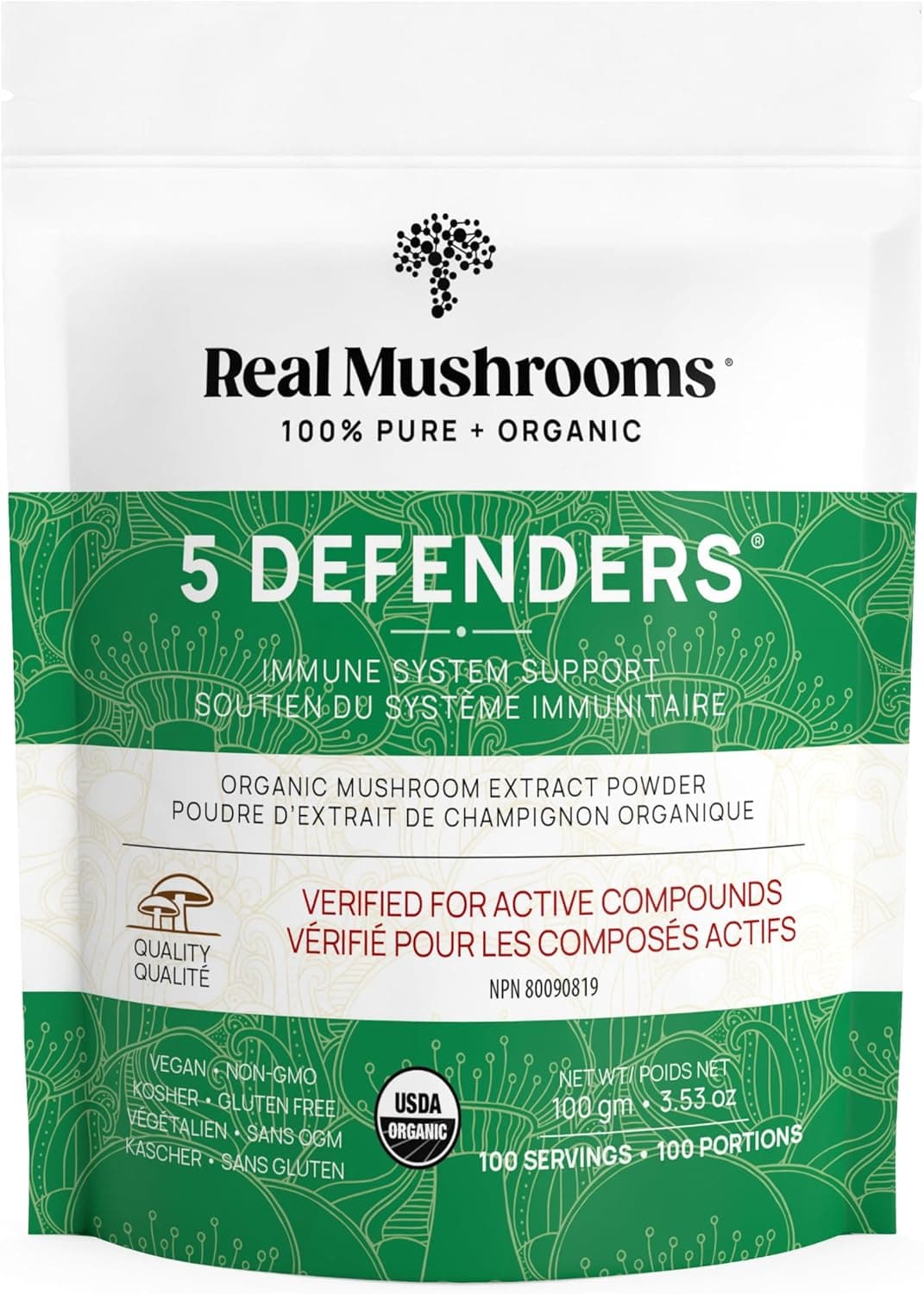
Both maitake and yeast-derived beta-glucans are (1,3)/(1,6)-beta-glucans recognized by the same innate immune pattern-recognition receptors such as dectin-1 on immune cells, so they engage the same normal immune-surveillance pathway. Pairing them presents similar glucan signals that support routine immune readiness.
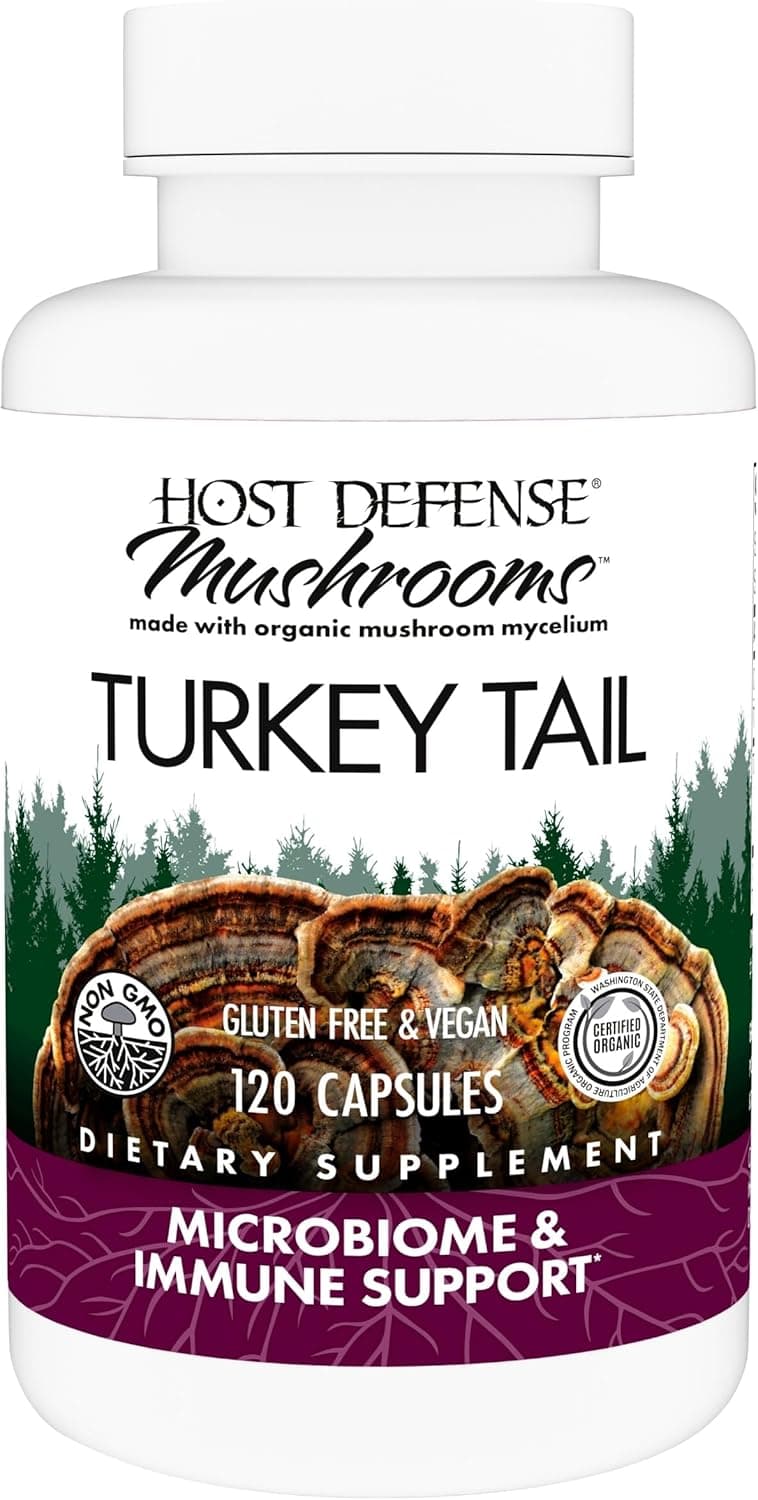
Turkey tail contributes protein-bound polysaccharides while maitake contributes its own branched beta-glucans, and both are sensed by innate immune receptors that support normal immune-cell activity. Combining two different fungal polysaccharide structures broadens the range of glucan signals the immune system can respond to.
Maitake's beta-1,6-branched-1,3-glucan and reishi's glucan fraction both engage dectin-1 and complement receptor 3 on innate immune cells, but with different branching and molecular weight. Blending them widens the receptor engagement rather than repeating one shape.
Chaga carries both glucans and a heavy melanin-polyphenol fraction, so it adds antioxidant chemistry that maitake does not have. The glucan portions still act on the same innate receptors.
Lion's mane contributes hericenones and erinacines alongside its glucans, which act on nerve growth factor signalling rather than innate immune receptors. Maitake supplies the glucan side, so a blend covers both.
Cordyceps adds cordycepin and adenosine-type nucleosides that act on energy metabolism, a route unrelated to glucan receptor binding. The two mushrooms are combined so one formula carries both fractions.
Tremella's main polysaccharide is an acidic glucuronoxylomannan rather than a beta-glucan, so it binds water and supports skin hydration instead of dectin-1. Pairing it with maitake puts two structurally distinct polysaccharides in one formula.
Oat beta-glucan is a linear 1,3/1,4 polymer that raises luminal viscosity and binds bile acids, while fungal beta-glucan is 1,3/1,6 branched and binds innate immune receptors. The same nutrient name covers two different mechanisms, and a formula can carry both.
Mushroom ergosterol converts to vitamin D2 on UV exposure, which is why mushroom powders can carry measurable D. Vitamin D receptor signalling also sits upstream of the innate responses beta-glucans engage.
Astragalus polysaccharides and saponins act on innate immune signalling from the plant side, with a structure unlike fungal glucan. The two classes engage overlapping pathways from different molecular starting points.
Mushroom beta-glucans and chicory fructans are both indigestible by human enzymes and both reach the colon intact, but they are fermented by different bacterial guilds with different enzyme sets. Combining substrate types broadens which organisms have something to eat. In vitro digestion work on this mushroom's polysaccharides supports the substrate half of that claim. The combination itself is untested.
Galactooligosaccharides are fermented preferentially by bifidobacteria, while beta-glucans favour other saccharolytic organisms. A formula using both is covering two substrate classes rather than doubling one. Mechanistic pairing, no combination trial.
Resistant starch is the most butyrogenic of the common fermentable substrates and beta-glucan fermentation yields a different short-chain fatty acid mix. Together they widen the fermentation profile along the length of the colon. This is substrate chemistry, not a measured clinical outcome.
Butyrate is one end product of colonic fermentation of beta-glucans and the primary fuel of the colonocyte. Supplying it directly alongside the substrate covers both the immediate and the fermentation-dependent supply. In vitro fermentation of this mushroom's polysaccharides is the mechanistic basis. The pairing is reasoning.
A live culture needs a substrate it can actually ferment to establish any foothold. Mushroom polysaccharides are fermentable, so pairing them with a culture is the standard synbiotic logic. Which strains benefit depends on their glycoside hydrolase repertoire, and that is strain-specific rather than general.
Mushroom extracts of this species raise measured antioxidant activity in food matrices, and ascorbate is the reference water-phase antioxidant. The two operate in the same aqueous compartment and ascorbate regenerates oxidised phenolics. Measured in food and in vitro systems, so this is a marker-level pairing rather than a human outcome.
In a pork sausage emulsion, extract of this mushroom acted as a natural antioxidant, which is the same functional slot tocopherols occupy in a lipid phase. A formula carrying both covers water-phase and lipid-phase oxidation. The evidence is food-technology oxidation chemistry, not a measurement in people.
Selenium is the catalytic centre of glutathione peroxidase, an enzymatic antioxidant defence, while mushroom phenolics act stoichiometrically as radical scavengers. Enzymatic and stoichiometric defences are complementary rather than redundant. Mechanism-level pairing.
Zinc is required for normal function of innate immune cells, the same cells whose surface receptors recognise fungal beta-glucans. A receptor ligand does little if the responding cell is short of a required mineral. Standard formulation logic with an established cofactor basis on the zinc side.
Peptide-calcium chelates prepared from this mushroom were reported to support bone measures in a mouse model of reduced bone density. That is an animal result and it concerns a manufactured peptide chelate, not the whole mushroom taken with a calcium tablet. The mechanistic point that peptides can chelate calcium and change its solubility is established. The benefit here is animal-level only.
Menaquinone-7 carboxylates osteocalcin, which is how deposited calcium is incorporated into bone matrix. Mushroom material contributes vitamin D2 when UV-exposed, and the D and K pathways in mineral handling are complementary. The bone side of this is established vitamin biochemistry. The mushroom's contribution is small and depends entirely on UV treatment.
Both are used in formulas aimed at supporting normal blood sugar handling, by unrelated mechanisms. Stacking two ingredients pointed at the same variable means the combined direction of effect can be larger than either alone. Anyone tracking glucose should expect to watch numbers more closely on a combination, not less.
These are two botanicals commonly formulated toward normal blood sugar handling. The interaction worth flagging is additive direction rather than a discovered mechanism. No trial has measured the pair together.
Berberine has a strong effect on glucose handling on its own. Adding a second ingredient aimed at the same variable is an additive-direction interaction to disclose, not a synergy to advertise. Monitor rather than assume the combination behaves like either component.
Cinnamon appears in the same formula slot for the same reason. The honest statement is that two additive-direction ingredients are present. Nothing about the pair has been measured together.
Quercetin and mushroom phenolics are both radical-scavenging plant polyphenols. Combining them raises total polyphenol load in the same compartment. Antioxidant capacity in a tube is a marker, not an outcome in a person. Labelled Early on that basis.
Glucomannan is a viscous soluble fibre and mushroom beta-glucan is a fermentable one, so a blend contributes both viscosity and fermentation substrate. Viscosity slows gastric emptying by simple physics. Additive fibre load also means additive gas and fullness, which is worth saying out loud.
N-acetylcysteine supplies cysteine, the rate-limiting substrate for glutathione synthesis, an endogenous antioxidant system. Mushroom phenolics scavenge directly. Two different tiers of the same defence, joined by reasoning rather than by a study of the pair.
Talk to a doctor before taking Maitake (Grifola frondosa) if any of these apply to you: diabetes meds. These are flags to check first, not effects Maitake (Grifola frondosa) is known to cause.
Not medical advice. Show the label to your pharmacist.What Maitake (Grifola frondosa) actually does.
The fruiting body carries beta-glucans with links your digestive enzymes can't cut. They arrive in your colon intact and are available to sugar-fermenting bacteria, which is what makes them a fermentable substrate.
Fungal beta-glucans bind pattern-recognition receptors on innate immune cells, dectin-1 and complement receptor 3 among them. That binding is settled immunology. What a given oral dose does downstream in a person is a separate question.
Mushroom tissue contains ergosterol, which ultraviolet light converts to vitamin D2. Material dried in sunlight or under UV lamps carries D2, material dried in the dark carries very little, so vitamin D content is a processing decision rather than a property of the species.
When your colon bacteria ferment beta-glucans they make short-chain fatty acids, including acetate, propionate and butyrate, and butyrate is the fuel colon cells prefer. That's established microbial biochemistry, independent of any clinical claim.
Where Maitake (Grifola frondosa) comes from.
It is a cultivated mushroom. Growers either raise the actual mushroom on sawdust and dry it, or stop earlier and harvest the root-like mycelium off grain. Extracts are made by simmering the mushroom in water and concentrating what dissolves. Whether the label's beta-glucan number means fungal fibre or leftover grain starch depends on which assay was used.
The same molecule is reached more than one way. Which route a given product used is a manufacturing choice, and the finished compound is the same either way.
Fruiting body production runs on sterilised hardwood sawdust blocks with a bran supplement. Mycelial production runs on sterilised grain or a liquid broth. The two routes diverge at this first step and never converge.
A pure culture of Grifola frondosa is introduced and colonises the substrate over weeks. For fruiting body material, colonised blocks are then moved to fruiting conditions and the visible clustered mushroom is harvested. For mycelial material the run stops at colonised biomass.
Harvested mushroom is dried, sometimes under ultraviolet light to convert ergosterol to vitamin D2. Extract streams instead go to hot-water decoction, with or without a following ethanol step.
The aqueous extract is concentrated, and a protein-bound polysaccharide fraction can be separated out. Insoluble cell wall residue is removed here.
Extract is assayed to a declared beta-glucan percentage. An enzymatic beta-glucan assay and a total polysaccharide assay give different numbers, since the latter can count substrate starch.
Dried extract or milled fruiting body is encapsulated or tabletted. The separated fraction is bottled as a liquid.
Fruiting body versus mycelium-on-grain is often unstated, as is which assay produced the polysaccharide figure and whether the material was UV-treated for vitamin D2.
Getting Maitake (Grifola frondosa) from food.
The whole-food sources on file. A supplement closes the gap, it does not replace dinner.
A gram-for-gram figure (how much of each you would eat to match a dose) will appear here once it is sourced and reviewed. This page will not print a number it cannot cite.
The forms it comes in.
The essence, in one line each.
- A systematic search of ten databases found the human research on maitake to be limited and clustered around glucose handling and immune stimulation, with the authors calling for randomised trials.Systematic review. Ulbricht et al., 2009 (Journal of the Society for Integrative Oncology). PMID 19476741 ↗
- Polysaccharides from this mushroom reduced markers of intestinal injury and shifted microbiota composition in a rodent model of chemotherapy-induced gut damage. The authors frame the finding as microbiota-mediated.Animal study. Wu et al., 2025 (Foods). PMID 41097543 ↗
- Under simulated gastrointestinal digestion the polysaccharides survived largely intact and then supported fermentation activity, which is the mechanistic basis for calling them a colonic substrate.In vitro study. Wang et al., 2025 (Nutrients). PMID 41228406 ↗
- Peptide-calcium chelates prepared from this mushroom improved bone measures in a mouse model of age-related reduced bone density. The result belongs to the manufactured chelate, not to whole mushroom powder.Animal study. Xiong et al., 2024 (Journal of Food Science). PMID 38685878 ↗
- Extract of this mushroom slowed lipid oxidation in emulsion-type pork sausages during storage, performing as a natural antioxidant in a food matrix.In vitro study. Jang et al., 2025 (Food Chemistry X). PMID 40599596 ↗
- Adding this mushroom to gluten-free bread raised the antioxidant activity and the nutritional profile of the finished loaf. The measurements are food-composition and capacity assays.In vitro study. Kobus et al., 2026 (Scientific Reports). PMID 41735479 ↗
- A review of medicinal mushrooms and their bioactive compounds names this species among the beta-glucan-bearing fungi carried from traditional use into current research. The review summarises the literature and measures nothing itself.Narrative review. Sadowska et al., 2026 (Molecules). PMID 42197308 ↗
- A review of mushrooms in the diet in relation to bone density names this species among sources of vitamin D2 and fungal polysaccharides. Associations reported in the underlying dietary literature are not causal.Narrative review. Cicha-Jelen et al., 2026 (Pharmaceuticals). PMID 41901328 ↗
These are the studies our verdict leans on, chosen from the 609 we read for Maitake (Grifola frondosa). The full linked list is below.
FDA Disclaimer: These statements have not been evaluated by the Food and Drug Administration. This information is for educational purposes only and is not intended to diagnose, treat, cure, or prevent any disease. Consult your healthcare provider before starting any supplement regimen.