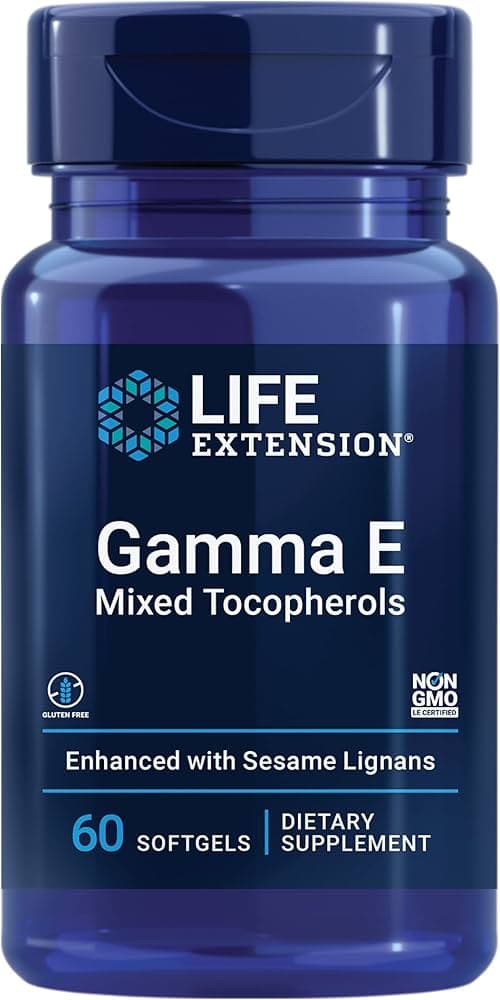
Mixed Tocopherols.
All four tocopherols together. Better than alpha alone. Supplies alpha, beta, gamma and delta tocopherol together. They sit inside cell membranes and break the chain reaction that oxidises membrane fats.
Reviewed March 2026
- Category
- Vitamin
- Also filed under
- Full spectrum EAntioxidantCardiovascular
What Mixed Tocopherols is, and what it does.
- Does it work
- Suits anyone who wants the whole tocopherol family rather than alpha alone, and anyone whose diet is light on nuts, seeds and plant oils.
- How much to take
- Start with 100 to 400 IU a day of the concentrate, alongside a meal containing fat. That band keeps all four forms circulating day to day.
- Time to feel it
- Weeks. Plasma tocopherols shift within days of daily intake, and any change in skin condition arrives slowly over a couple of months.
- The first dose
- Day one is quiet. The tocopheryl ester is hydrolysed, absorbed with your meal's fat and into circulation within hours, which reads on a blood measure.
- With regular use
- Weeks to months of daily use keeps gamma and delta present alongside alpha, so the distinct chemistry of each form stays available to your tissues.
- How well tolerated
- Well tolerated at usual amounts. Higher intakes can affect clotting, so anyone on anticoagulant or antiplatelet medication should clear it with their prescriber.
- How it feels
- Not a sensation. It works in membrane lipids, so what changes is a plasma tocopherol measure rather than how your day feels.
- The overlooked benefit
- Gamma-tocopherol has an open position on its ring that lets it trap reactive nitrogen species. Alpha-tocopherol cannot do that chemistry at all.
15 to 200 IU a day is where Mixed Tocopherols works.
Source: NIH ODS + Miller 2005 meta-analysis
The proof, claim by claim.
These words describe the research, not the molecule's worth. Research strength is how much work stands behind one claim, and it is never a product score.
- antioxidant defence in membrane lipidsNarrative review
- circulating gamma-tocopherol statusRandomised trial
- markers of lipid peroxidationRandomised trial
- reactive nitrogen species trappingIn vitro study
Questions people ask about Mixed Tocopherols.
- When should I take it?
- With food, ideally a meal containing some fat for better absorption. Morning or evening, pick one and stick with it.
- How long until I notice something?
- If you're deficient, you might notice within 1-2 weeks. For general maintenance, give it 4-8 weeks.
- Can I get enough from food?
- Sometimes. If your diet is solid and varied, you might not need to supplement. But deficiency is more common than most people think. A blood test is the only way to know for sure.
- Can I take too much?
- Water-soluble vitamins (B, C) are harder to overdose on since you pee out the extra. Fat-soluble ones (A, D, E, K) can build up. Stick to recommended doses unless a doctor says otherwise.
- Can I take it with other supplements?
- Usually fine. The main thing to watch is not doubling up on the same ingredient from different products. If you're on prescription meds, check with your pharmacist first.
- Who benefits most from this?
- People with a specific, evidence-backed need. Vitamin E Mixed Tocopherols has strong research. If your situation matches the studied use case, it's one of the more reliable supplements you can take.
Why these belong in the same formula. Each row says what the basis is, from settled biochemistry through to a trial that measured the pair.
High dose alpha-tocopherol interferes with vitamin K dependent gamma-carboxylation of clotting factors, so large amounts work against vitamin K in normal clotting. It is an honest anti-synergy rather than a benefit.
Alpha-tocopherol is strongly preferred by the hepatic alpha-tocopherol transfer protein and competes for the same intestinal uptake, so it lowers tocotrienol levels in circulation. Formulas keep the two apart or skew the ratio deliberately.
After tocopherol quenches a lipid peroxyl radical it becomes a tocopheroxyl radical, and ascorbate at the membrane surface reduces it back to the active form. The pair is the textbook example of antioxidant recycling across phases.
Tocopherol breaks lipid radical chains while selenium dependent glutathione peroxidase reduces the lipid hydroperoxides that form. Each spares the other, which is why low status in one raises the requirement for the other.
EPA and DHA have many double bonds and oxidise readily, so tocopherol is added to fish oil both in the bottle and to protect those fatty acids once incorporated into membranes. Higher PUFA intake raises the tocopherol requirement.
Ubiquinol can regenerate the tocopheroxyl radical within the same membrane, so the two extend each other. Both need dietary lipid for absorption and are commonly co-formulated.
Tocopherols are absorbed from bile salt micelles and packaged into chylomicrons, so uptake is much higher with lipid present. This is why they ship in oil filled softgels.
Dihydrolipoic acid restores ascorbate and glutathione, which in turn regenerate oxidised tocopherol. The sequence links the water soluble and lipid soluble arms of the network.
Glutathione keeps ascorbate reduced, and ascorbate is what returns tocopheroxyl radical to active tocopherol. A stocked glutathione pool makes each tocopherol molecule usable more than once.
Alpha-tocopherol transfer protein discriminates strongly in favour of the alpha form, and the other tocopherols are preferentially metabolised and excreted. Adding isolated alpha-tocopherol to a mixed tocopherol product therefore reduces the very gamma and delta fractions the mixed product exists to supply. This is the single most consequential interaction in this ingredient's pharmacology and it needs no combination trial.
Riboflavin status determines glutathione reductase activity, which determines the supply of reduced glutathione. Vitamin E recycling depends on that chain rather than on riboflavin directly. The connection is two steps long and every step in it is textbook.
Cysteine availability governs how much glutathione a cell can make. Glutathione sits downstream of ascorbate in the antioxidant network that returns the tocopheroxyl radical to tocopherol. The pairing supports the recycling side rather than adding more vitamin E.
Both classes depend on the same micellar route and compete for space in it when given together at high doses. That competition is documented in absorption pharmacology. It is a dosing and timing consideration rather than a reason to avoid the combination.
High-dose tocopherol given alongside lutein competes for the same micellar and lipoprotein capacity. The two are still routinely formulated together because both need dietary fat present. Split high doses if the target is maximal exposure to each.
The competition sits at micelle incorporation, not at any tissue target. Both are conventional in eye-support formulas. The practical answer is taking the formula with a fat-containing meal.
Shared transport means shared competition at high doses. Lycopene is also readily oxidised, which is why tocopherols appear alongside it as formulation antioxidants. Both facts are worth stating together.
Absorption competition and formulation compatibility point in opposite directions here. In practice they are combined and taken with food. State the shared route rather than implying either blocks the other.
All four fat-soluble vitamins compete for the same lipid-dependent uptake route. This is textbook and applies whatever the formula. The design answer is a lipid vehicle and a fed dosing instruction.
Both need dietary fat and bile for uptake, which is why they appear together in oil-based softgels. Competition matters mainly at high simultaneous doses. Tocopherols also serve as the oxidation protection for the oil carrier they share.
Flavonoid regeneration of the tocopheroxyl radical is demonstrated in chemical and cell model systems. Whether it operates at nutritional exposures in people is not established. This is mechanistic chemistry, labelled as such.
The chemistry is documented in vitro and the overlap is at the lipid interface. Human data on the pair is not cited here. Read the row as mechanistic.
Tocopherol-sparing by polyphenols is a documented behaviour in lipid oxidation chemistry. It sits in the same network as the ascorbate recycling step. It is measured in model systems and not established as a human outcome.
The chemistry mirrors that of other proanthocyanidin sources. It supports the recycling arm rather than adding vitamin E activity. Label it mechanistic.
Emulsification raises the surface area available for lipase action and micelle formation, which is the physical step tocopherol absorption depends on. This is settled formulation practice used across fat-soluble actives. It is a delivery effect and not a nutritional interaction.
Its emulsifying role in mixed micelle formation is established colloid chemistry. Tocopherols in turn protect the polyunsaturated acyl chains of the phospholipid from oxidation. The relationship runs in both directions and is a formulation one.
Tocopherol donates a hydrogen atom to the lipid peroxyl radical and terminates the propagation chain, which is what keeps a polyunsaturated oil from going rancid. Every marine oil softgel carries tocopherol for this reason. The protection is of the oil in the capsule and in the body's lipid pools alike.
The more double bonds a fatty acid carries, the faster it oxidises, and the tocopherol terminates that chain reaction. This is why flax oil is sold with tocopherol and in dark bottles. It is settled lipid chemistry.
Chain-breaking antioxidants terminate lipid peroxidation propagation, which is what protects a highly unsaturated fatty acid in the capsule and after absorption. The requirement scales with the degree of unsaturation. This is why higher-concentration marine oils carry more added tocopherol.
Rosemary extract and tocopherol are used together in oil stabilisation because they act at different points, with the phenolic diterpenes regenerating tocopherol in some systems. This is food technology rather than nutrition. The pairing on a label usually indicates oil protection.
Iron initiates the peroxidation chain and vitamin E breaks it, so the two are on opposite sides of the same reaction. In a formulation this means an iron salt and an unprotected polyunsaturated oil should not sit in the same matrix. In the body the relationship is a consumption of vitamin E rather than a blocking of it.
A gelling fibre taken at the same time as a fat-soluble vitamin lowers the fraction absorbed by holding lipid in the gel matrix. The effect is general to fat-soluble nutrients rather than specific to tocopherols. Separating the doses by a couple of hours is the standard handling.
Without adequate bile salt, dietary lipid does not emulsify into absorbable micelles and fat-soluble vitamin uptake falls. The dependence is a textbook step in lipid digestion. Supplemental bile components are used where that step is limiting.
Micelle formation depends on lipolysis products, and fat-soluble vitamin absorption depends on micelles. The chain is settled digestive physiology. It explains why fat-soluble vitamins are dosed with a meal rather than fasted.
Nothing specific on file for Mixed Tocopherols. Match the label to the daily amount above, and tell your doctor what you take.
Not medical advice. Show the label to your pharmacist.What Mixed Tocopherols actually does.
Vitamin E is not one molecule. It is a family of eight: four tocopherols and four tocotrienols, each labelled alpha, beta, gamma or delta, told apart by how the ring is methylated and whether the tail is saturated.
Tocopherols stop a chain reaction. The hydroxyl on the ring hands a hydrogen atom to a fat radical, which ends the spreading step of lipid peroxidation and leaves behind a comparatively calm tocopheroxyl radical.
Vitamin C hands that spent radical back its hydrogen at the boundary between fat and water, recycling it into working tocopherol. Glutathione and its NADPH-driven reductase back up the chain further along.
A liver transfer protein picks out the RRR form of alpha-tocopherol to send back out in VLDL. That is why alpha dominates plasma and the other tocopherols circulate lower no matter how much of them you eat.
Where Mixed Tocopherols comes from.
When vegetable oil is refined, the vitamin E is stripped out into a side stream. That stream is distilled under vacuum to concentrate the tocopherols, cleaned up to remove waxes and plant sterols, measured for how much of each of the four types is present, and then either bottled as an oil or dried onto a carrier for tablets.
The same molecule is reached more than one way. Which route a given product used is a manufacturing choice, and the finished compound is the same either way.
The side stream from refining soybean, sunflower, rapeseed or palm oil, which concentrates the tocopherols removed during deodorisation.
Short-path or molecular distillation under high vacuum separates the tocopherol fraction from free fatty acids, sterols and glycerides at temperatures low enough to avoid degrading it.
Sterols are crystallised out and the tocopherol fraction is further purified, with ion exchange or adsorption chromatography used where a specific isomer ratio is required.
Free tocopherol is reacted with acetic anhydride or succinic anhydride to give the acetate or succinate ester, which blocks the chromanol hydroxyl and stabilises the molecule.
The concentrate is assayed by chromatography for alpha, beta, gamma and delta content and blended to a declared ratio and a declared total or alpha-equivalent figure.
Supplied as an oil for softgels, or spray dried and starch coated into a beadlet for tablets and powders.
Labels commonly state an alpha-tocopherol equivalent or an international unit figure without declaring the gamma and delta content, and the source oil is often not named, so the isomer ratio of a given mixed tocopherol product is usually only visible on a certificate of analysis.
Getting Mixed Tocopherols from food.
The whole-food sources on file. A supplement closes the gap, it does not replace dinner.
A gram-for-gram figure (how much of each you would eat to match a dose) will appear here once it is sourced and reviewed. This page will not print a number it cannot cite.
The forms it comes in.
The essence, in one line each.
- A scoping review of rodent-model work on vitamin E, reporting that outcomes varied by tocopherol form, dose and model rather than converging on a single direction.Systematic review. Mohd Murshid et al., 2026 (Nutrients). PMID 41599900 ↗
- Reviews the nutritional composition of sea buckthorn oil and its by-products, describing tocopherol and tocotrienol content among the lipid-soluble antioxidants present.Narrative review. Jiang et al., 2026 (Foods). PMID 42279660 ↗
- Reports that added antioxidative substances affected micronutrient retention and antioxidative capacity in a rapeseed matrix, which is a food-stability measurement.In vitro study. Liu et al., 2025 (Foods). PMID 41300065 ↗
These are the studies our verdict leans on, chosen from the 3 we read for Mixed Tocopherols. The full linked list is below.
Problems people have reported.
Read this carefully. These are 112 voluntary, unverified reactions reported to the FDA (openFDA). The number mostly reflects how popular Mixed Tocopherols is, not how risky it is. A report is not proof Mixed Tocopherols caused anything. It is a signal of what to watch for, nothing more.
Source: openFDA adverse-event reports. Voluntary reporting, not an incidence rate.
FDA Disclaimer: These statements have not been evaluated by the Food and Drug Administration. This information is for educational purposes only and is not intended to diagnose, treat, cure, or prevent any disease. Consult your healthcare provider before starting any supplement regimen.