AdultsNHANES 2005 to 2016
About 84% of US adults
take in less vitamin E than the estimated average requirement.
Reider et al., Nutrients 2020, immune-nutrient intakes in US adults, NHANES 2005 to 2016. ↗The real vitamin E. Synthetic is half as good. Antioxidant. Protects cell membranes. Skin health. The real vitamin E.
Reviewed March 2026
Public health figures for this ingredient, reported by the agencies that publish them, cited and dated.
About 84% of US adults
take in less vitamin E than the estimated average requirement.
Reider et al., Nutrients 2020, immune-nutrient intakes in US adults, NHANES 2005 to 2016. ↗About 85% of US women aged 19 and over
take in less vitamin E from food and drink than the estimated average requirement.
USDA ARS, Usual Nutrient Intake from Food and Beverages, by Gender and Age, WWEIA NHANES 2013-2016, Table A 32 (vitamin E as alpha-tocopherol), females 19+: 85% below EAR (SE 1.7). ↗About 72% of US men aged 19 and over
take in less vitamin E from food and drink than the estimated average requirement.
USDA ARS, Usual Nutrient Intake from Food and Beverages, by Gender and Age, WWEIA NHANES 2013-2016, Table A 32 (vitamin E as alpha-tocopherol), males 19+: 72% below EAR (SE 1.3). ↗About 90% of US women aged 71 and over
take in less vitamin E from food and drink than the estimated average requirement.
USDA ARS, Usual Nutrient Intake from Food and Beverages, by Gender and Age, WWEIA NHANES 2013-2016, Table A 32 (vitamin E as alpha-tocopherol), females 71+: 90% below EAR (SE 1.2). ↗About 95% of US girls aged 14 to 18
take in less vitamin E from food and drink than the estimated average requirement.
USDA ARS, Usual Nutrient Intake from Food and Beverages, by Gender and Age, WWEIA NHANES 2013-2016, Table A 32 (vitamin E as alpha-tocopherol), females 14-18: 95% below EAR (SE 1.5). ↗Population figures from public health data. Context for the category, not a statement about any individual and not a claim about this product.
Source: NIH ODS Vitamin E Fact Sheet. UL 1000mg (1500 IU natural).
These words describe the research, not the molecule's worth. Research strength is how much work stands behind one claim, and it is never a product score.
Based on 40 human trials with 65% consistency.
Why these belong in the same formula. Each row says what the basis is, from settled biochemistry through to a trial that measured the pair.
When alpha-tocopherol quenches a lipid radical it becomes a tocopheroxyl radical at the membrane surface, and ascorbate in the adjacent water phase hands over an electron to return it to active form. Vitamin C status therefore sets how many times one tocopherol molecule can act.
Ascorbate reduces the tocopheroxyl radical back to alpha-tocopherol at the lipid and water interface, recycling it rather than consuming it. This is the classic vitamin E sparing effect of vitamin C.
Alpha-tocopherol stops radical chain reactions inside the membrane while selenium-dependent glutathione peroxidase clears the peroxides that form in the water phase. Each covers what the other cannot reach, which is why low status in one raises the requirement for the other.
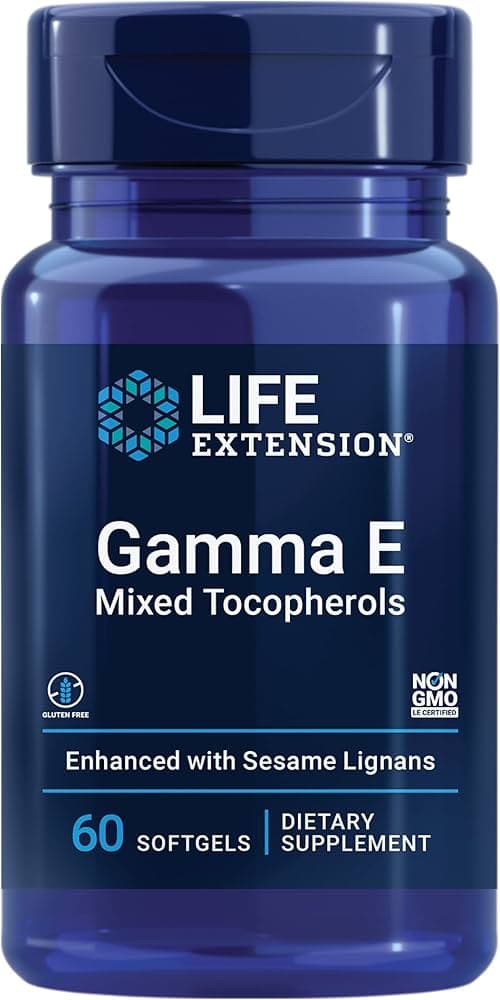
Glutathione supplies the reducing power that regenerates ascorbate, which in turn regenerates tocopherol. The three sit in one chain, so tocopherol turnover depends on glutathione supply further back.
NAC supplies the cysteine that limits glutathione synthesis, and glutathione is what keeps the ascorbate and tocopherol recycling loop running. Supporting the upstream step extends how long tocopherol stays in its active form.
Dihydrolipoic acid, the reduced form of lipoic acid, regenerates ascorbate and can act on the tocopheroxyl radical, feeding the same recycling network. It works in both the lipid and water phases, which is unusual among the recyclers.
Ubiquinol sits inside the same lipid bilayer as alpha-tocopherol and can reduce the tocopheroxyl radical without needing a water-phase partner. The pair covers membrane lipid oxidation between them.
Hepatic alpha-tocopherol transfer protein strongly prefers alpha-tocopherol, so a high alpha dose lowers the amount of tocotrienol that reaches circulation. Splitting the doses in time is the usual formulation answer.
High-dose alpha-tocopherol interferes with vitamin K dependent carboxylation of clotting factors and with platelet aggregation. The effects add to anything else acting on normal clotting, which is why the pair is watched rather than avoided.
Long-chain polyunsaturated fats are the most oxidation-prone lipids in the body, so a higher intake raises the alpha-tocopherol requirement. Tocopherol is added to the oil itself for the same reason it is needed after absorption.
Alpha-tocopherol is fat soluble and needs dietary fat to trigger bile release and form the mixed micelles that carry it across the gut wall. Taking it with a fat source rather than water is the difference between partial and full uptake.
Tocopherol and carotenoids compete for space in the same mixed micelles and for the same intestinal uptake route, so a large dose of one lowers the appearance of the other. Once absorbed, tocopherol protects carotene from oxidation, so the relationship runs both ways.
Alpha-tocopherol limits oxidation of retinol in the gut and in tissue stores, which raises how much usable vitamin A survives. The two also share the fat-dependent absorption route, so a very large tocopherol dose can crowd retinol uptake.
Low zinc status lowers circulating alpha-tocopherol, which is attributed to zinc's role in the lipoprotein machinery that carries it. Zinc adequacy is part of what makes a tocopherol dose show up in plasma.
Glutathione reductase is an FAD enzyme built from riboflavin, and it is what regenerates reduced glutathione. Glutathione in turn supports the ascorbate recycling that returns the tocopheroxyl radical to active tocopherol. Riboflavin sits three steps back in the same recycling chain that keeps vitamin E working.
Fat-soluble vitamins have to be packed into mixed micelles before they cross the enterocyte membrane, and bile salts are what forms those micelles. Where bile flow is reduced, tocopherol uptake falls with it. Supplemental bile acids are used in formulation for exactly this step.
Pancreatic lipase releases fatty acids from dietary triglyceride, and those fatty acids are part of the micelle that carries tocopherol. Esterified tocopherol additionally needs an esterase step before the free vitamin is available. Both are enzymatic preconditions for absorption rather than additive effects.
Phospholipid carriers form a lipid phase that keeps tocopherol dispersed and contributes to micelle formation in the gut. This is why phospholipid-based softgel fills are used for fat-soluble vitamins. The effect is on delivery, not on the vitamin's own activity.
Lecithin acts as an emulsifier that keeps tocopherol dispersed in an aqueous format and supports micellar uptake. Sunflower-derived lecithin is used where a soy-free label is needed. Its role is vehicle and stability rather than any activity of its own.
Tocopherol and cholecalciferol share micellar packaging and the same enterocyte uptake proteins including NPC1L1 and SR-BI. At high single doses they compete for that limited transit. Splitting them across meals removes the overlap without reducing either dose.
Carotenoids and tocopherol compete for space in the same mixed micelle, so large doses of one can reduce the uptake of the other from the same meal. Lycopene is among the most lipophilic of them and competes strongly. In the tissue phase the two are complementary antioxidants, so the competition is at the gut, not at the target.
Lutein shares micellar incorporation and enterocyte uptake with tocopherol, and high-dose combinations reduce the uptake of each from a single meal. Once absorbed the two occupy different membrane environments. The practical answer is dose separation rather than avoidance.
Zeaxanthin follows lutein's absorption route and competes with tocopherol for the same micellar capacity. The interaction is an uptake ceiling at a single meal rather than an antagonism in tissue. Formulas carrying all three at high dose should expect less than additive absorption.
Astaxanthin spans the lipid bilayer with polar groups at both faces, so it quenches radicals at the membrane surface as well as in the core where tocopherol works. The two therefore cover different depths of the same membrane. They also compete for micellar transit at the absorption step, which is the trade-off.
Quercetin can reduce the tocopheroxyl radical back to tocopherol in model membrane systems, sparing the vitamin during oxidative load. Quercetin sits nearer the aqueous interface and tocopherol in the lipid core. The recycling relationship is well characterised chemically and less well quantified in people.
Proanthocyanidins act at the lipid to water interface and can regenerate oxidised tocopherol, in the same way ascorbate does. Combining them extends how long a given amount of tocopherol keeps working under oxidative load. The relationship is chemical and has been shown mostly in model systems.
Pine bark procyanidins behave like other polyphenols toward the tocopheroxyl radical, reducing it back to the active form at the membrane interface. Tocopherol remains the chain-breaking agent inside the lipid phase. The pairing is about how long the vitamin lasts, not about a new effect.
Resveratrol is a stilbene phenol that can donate a hydrogen atom to lipid radicals in the same membranes tocopherol protects. The two are commonly formulated together for that reason. The combined behaviour is characterised in model systems rather than in people.
Catechins are aqueous-phase radical scavengers that also protect tocopherol from consumption in emulsions, which is why the two appear together in oil stabilisation. In the body the compartments differ, tocopherol in the membrane and catechins largely outside it. The pairing is complementary by compartment.
Free non-heme iron catalyses the Fenton reaction and initiates lipid peroxidation, the exact chain tocopherol terminates. Placing a high-dose iron salt and an oil-phase tocopherol in the same capsule fill accelerates oxidation of the fill itself. Physiologically the two work against each other at the initiation step, so dosing them apart is standard practice.
Copper is a redox-active transition metal that catalyses lipid and lipoprotein oxidation in vitro, the classic assay in which tocopherol shows its protective role. In a formulation the two should not share an oil phase. In the body copper is protein-bound in normal status, so the interaction matters far more in the bottle than in the bloodstream.
High-dose alpha-tocopherol interferes with vitamin K-dependent carboxylation and reduces platelet aggregation, while nattokinase has fibrinolytic activity of its own. The two push clotting in the same direction. Anyone on anticoagulant therapy or approaching surgery should raise the combination with a clinician before taking it.
Krill oil supplies phospholipid-bound long-chain polyunsaturated fatty acids, which both carry tocopherol into micelles and are themselves the most peroxidation-prone lipids in the diet. Tocopherol protects that cargo during storage and after absorption. The relationship is mutual: the oil delivers the vitamin and the vitamin protects the oil.
Talk to a doctor before taking D-Alpha Tocopherol (Natural Vitamin E) if any of these apply to you: high dose caution. These are flags to check first, not effects D-Alpha Tocopherol (Natural Vitamin E) is known to cause.
Not medical advice. Show the label to your pharmacist.Vitamin E stops a chain reaction of fat damage inside cell membranes by donating a hydrogen atom to a reactive molecule, ending the chain.
After it does that, vitamin C can regenerate the used-up vitamin E, so the two work together as part of a recycling system rather than vitamin E acting alone.
A liver protein selectively picks out one specific form of vitamin E to keep in circulation, which is why different chemical versions stay in the body for different lengths of time.
Tocopheryl esters like the acetate and succinate forms have their active hydroxyl group blocked and carry no antioxidant activity until gut enzymes release the free tocopherol. That blocking is exactly what makes the ester forms shelf-stable.
It comes from a by-product of vegetable oil refining. That side-stream is rich in vitamin E, which is separated out under vacuum at low heat. If the starting oil carries mostly the gamma type, a chemical step converts it to the alpha type, but the natural three-dimensional shape the plant made stays intact, and that shape is the difference between the natural and the synthetic material. A final step can cap the molecule so it survives longer on a shelf.
Made from a plant. What ends up in the capsule tracks the harvest, so batch testing and a stated marker matter more here than with a made molecule.
The side-stream from refining soybean, sunflower, rapeseed or corn oil, where tocopherols concentrate along with sterols and free fatty acids. Sunflower distillate is naturally alpha-rich. Soybean distillate is gamma-rich.
Sterols are crystallised out and the tocopherol fraction is separated under high vacuum at low temperature, which avoids the thermal damage that ordinary distillation would cause.
Gamma- and delta-tocopherol from a soy-based feedstock are chemically methylated to alpha-tocopherol. Material sold as mixed tocopherols skips this step and keeps the native ratio. Stereochemistry is preserved either way, so the product remains RRR.
The free tocopherol is reacted with acetic anhydride or succinic anhydride to block the chromanol hydroxyl and give a shelf-stable ester.
Residual solvent, odour and colour bodies are stripped, and the concentrate is filtered.
Assayed by HPLC for tocopherol content and by optical rotation or chiral chromatography to confirm the RRR configuration rather than the synthetic isomer mixture.
Supplied as a viscous oil, diluted into a carrier oil for softgels, or spray-dried onto maltodextrin or modified starch with an antioxidant system for dry blends.
The whole-food sources on file. A supplement closes the gap, it does not replace dinner.
A gram-for-gram figure (how much of each you would eat to match a dose) will appear here once it is sourced and reviewed. This page will not print a number it cannot cite.
These are the studies our verdict leans on, chosen from the 5 we read for D-Alpha Tocopherol (Natural Vitamin E). The full linked list is below.
FDA Disclaimer: These statements have not been evaluated by the Food and Drug Administration. This information is for educational purposes only and is not intended to diagnose, treat, cure, or prevent any disease. Consult your healthcare provider before starting any supplement regimen.