Xanthophyll.
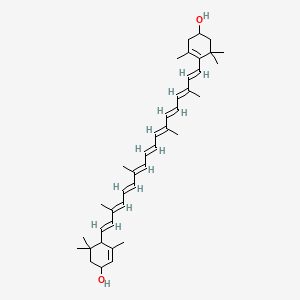
The oxygen-carrying branch of the carotenoid pigments. Two of them, lutein and zeaxanthin, are the only dietary carotenoids the eye concentrates in the macula.
 Compound
- Category
- Compound
What Xanthophyll is, and what it does.
- Does it work
- Useful if you spend the day on screens or want dietary support for the pigment layer in the eye. Which xanthophyll you get matters, because they are not interchangeable.
- How much to take
- No dose figure is on record for the group as a whole. Since each one behaves differently, the working amount belongs to the named xanthophyll on the label, not the class.
- Time to feel it
- Macular pigment density climbs over weeks to months of daily intake, and it is read with an instrument rather than felt.
- The first dose
- Day one puts a fat-soluble pigment into circulation and no more than that. The change shows up later, in macular pigment measurement.
- With regular use
- Months of daily intake raise macular pigment optical density, and some people report better glare recovery and contrast handling under bright light.
- How well tolerated
- Well tolerated at dietary amounts. Very high long-term intake of some carotenoids can tint the skin yellow-orange, which fades. Absorption needs fat, so take them with a meal.
- How it feels
- There is no immediate sensation to it. What people report after a few months is less strain at a screen and quicker recovery from oncoming headlights.
- The overlooked benefit
- Beta-cryptoxanthin is one of the few xanthophylls the body converts to vitamin A, because it keeps the ring that lutein and zeaxanthin do not have.
The proof, claim by claim.
What these words mean
These words describe the research, not the molecule's worth. Research strength is how much work stands behind one claim, and it is never a product score.
- Macular pigment optical densityMeta-analysis
- Visual performance under glare and low contrastRandomised trial
5 more claims
- Eye comfort during long screen useRandomised trial
- Skin resilience through sun exposureRandomised trial
- Processing speed in older adultsRandomised trial
- Singlet oxygen quenching by the polyene backboneIn vitro study
- Provitamin A conversion of beta-cryptoxanthinNarrative review
Why these belong in the same formula, 14 pairings
Why these belong in the same formula. Each row says what the basis is, from settled biochemistry through to a trial that measured the pair.
Xanthophylls are fat-soluble and must be incorporated into mixed micelles before an enterocyte can take them up. Without dietary fat in the same meal, a large share passes through unabsorbed. Even a modest amount of fat changes the outcome substantially, which is why carotenoid products are so often oil-based.
Micelle formation is a bile-dependent step, so anyone with reduced bile output absorbs less of any fat-soluble pigment. Supplemental bile salts are used in formulas aimed at that situation. This addresses a shortfall in the delivery step and does not raise absorption above the normal ceiling in someone with ordinary bile flow.
Dietary fat has to be broken down before it can form micelles, and pancreatic lipase does that work. Xanthophyll esters additionally need cleaving by carboxyl ester lipase before the free pigment is taken up. Both steps sit upstream of absorption, so enzyme capacity is a real determinant of how much gets in.
Beta-carotene and the xanthophylls share SR-B1 mediated uptake and limited room in mixed micelles. Large doses of one lower the absorbed fraction of the other when taken in the same meal. This is why high-dose single-carotenoid products can quietly reduce the status of the others.
Plant sterols work by crowding cholesterol out of micelles, and carotenoids get crowded out along with it. Regular sterol intake lowers circulating carotenoid concentrations. Spacing the two apart, or taking the pigment with a separate fat-containing meal, is the usual workaround.
Both partition into membranes and lipoproteins, where tocopherol handles chain-breaking and carotenoids quench singlet oxygen. They also share the lipid absorption route, so very high tocopherol doses can compete for micellar space. The functional pairing is well grounded, the competition at high dose is the trade-off.
Ascorbate sits in the water phase and hands electrons back to radicals formed in the lipid phase, which is the classic tocopherol recycling step. Carotenoid radicals can be reduced by the same route in model systems. Most of this work is in vitro, so read it as network chemistry rather than as a measured effect in people.
Lutein and zeaxanthin are selectively concentrated in the macula by specific binding proteins, StARD3 and GSTP1, which no other carotenoid uses. A mixed xanthophyll intake supplies both. Within the group they still compete for absorption, so the ratio in a product matters as much as the total.
The two pigments distribute differently across the macula, with zeaxanthin centred and lutein more peripheral. Supplying both covers the spatial distribution that a single pigment cannot. Meso-zeaxanthin is formed in the retina from lutein, which links the two directly.
The keto groups on astaxanthin let it sit across the whole membrane rather than within one leaflet, giving it a different physical position from lutein or zeaxanthin. Combining differently positioned pigments covers more of the membrane. They still compete for the same absorption route, which caps how much the combination adds.
DHA makes up an unusually large share of photoreceptor outer segment phospholipid, and that highly unsaturated environment is exactly what the xanthophylls are positioned to protect. Long-chain omega-3 fat in the same meal also improves carotenoid micellar uptake. The pairing has both a structural and a delivery rationale.
Phospholipid-based delivery keeps crystalline xanthophyll dispersed rather than aggregated, which is the state it must be in to enter a micelle. Formulators use lecithin systems for exactly this reason. The effect is on the delivery step, not on tissue uptake once absorbed.
Pectin raises the viscosity of intestinal contents and binds bile acids, both of which slow micelle diffusion to the brush border. Studies of soluble fibres have shown reduced carotenoid absorption when taken in the same meal. Separating the fibre dose from the pigment dose avoids most of it.
Psyllium forms a gel that binds bile acids and slows the movement of micelles toward the absorptive surface. Anything fat-soluble taken in that same window is likely to be absorbed less completely. This is a timing problem rather than a reason to avoid either.
Nothing specific on file for Xanthophyll. Match the label to the daily amount above, and tell your doctor what you take.
Not medical advice. Show the label to your pharmacist.What Xanthophyll actually does.
Xanthophylls are carotenoids that carry oxygen in their structure, unlike plain carotenes such as beta-carotene, and that oxygen changes their polarity and where they sit in cell membranes.
3 more mechanisms
This group includes lutein, zeaxanthin, beta-cryptoxanthin, astaxanthin and others, and they aren't interchangeable since their chemistry determines where in the body they end up and how stable they are.
Lutein and zeaxanthin's polar ends anchor them across cell membranes in a fixed orientation that non-polar carotenes don't have.
Their chemical backbone absorbs blue light and neutralizes reactive oxygen, which explains both their color and their behavior in oxidative reactions.
Getting Xanthophyll from food.
The whole-food sources on file. A supplement closes the gap, it does not replace dinner.
A gram-for-gram figure (how much of each you would eat to match a dose) will appear here once it is sourced and reviewed. This page will not print a number it cannot cite.
The forms it comes in.
4 more forms
The essence, in one line each.
- In young, healthy adults, supplementation with macular xanthophylls for 6 months was followed by higher serum brain-derived neurotrophic factor and lower levels of the inflammatory marker IL-1β compared with a placebo.Randomised trial. Stringham NT et al., 2019 (Physiology and Behavior). PMID 31425700 ↗
6 more findings
- In a pilot study in middle-aged and older adults, paprika xanthophyll supplementation appeared to enhance the improvements in cognitive function seen after a multitasking exercise.Open-label trial. Shirai A et al., 2022 (Healthcare). PMID 35052245 ↗
- Uptake and transport of xanthophylls were characterised in the Caco-2 intestinal cell model, mapping the routes by which these pigments cross the intestinal barrier.In vitro study. Wu F et al., 2026 (Nutrients). PMID 42123990 ↗
- Dietary xanthophyll supplementation lowered several inflammatory mediators and reduced apoptotic markers in laying hens and their chicks.Animal study. Gao YY et al., 2016 (Journal of Animal Science). PMID 27285699 ↗
- Xanthophyll supplementation shifted both carotenoid and retinoid metabolism in hens and their chicks, indicating cross-talk between the two pigment systems.Animal study. Gao YY et al., 2016 (Poultry Science). PMID 26574032 ↗
- Lutein intake was associated with coordinated changes in liver gene expression and caecal microbial composition, linking the pigment to antioxidant and metabolic gene programmes.Animal study. Li G et al., 2026 (Antioxidants). PMID 42351967 ↗
- Fucoxanthin extended lifespan and reduced neuronal decline markers in a nematode model, with effects depending on DAF-16 signalling and autophagy.Animal study. Kim S et al., 2026 (Rejuvenation Research). PMID 42304897 ↗
Chosen from the 8 we read for Xanthophyll.
Problems people have reported.
Read this carefully. These are 263 voluntary, unverified reactions reported to the FDA (openFDA). The number mostly reflects how popular Xanthophyll is, not how risky it is. A report is not proof Xanthophyll caused anything. It is a signal of what to watch for, nothing more.
3 more reported effects
Source: openFDA adverse-event reports. Voluntary reporting, not an incidence rate.
FDA Disclaimer: These statements have not been evaluated by the Food and Drug Administration. This information is for educational purposes only and is not intended to diagnose, treat, cure, or prevent any disease. Consult your healthcare provider before starting any supplement regimen.