
CalciumWWEIA NHANES 2009 to 2010
About 42% of Americans
take in less calcium than the estimated average requirement.
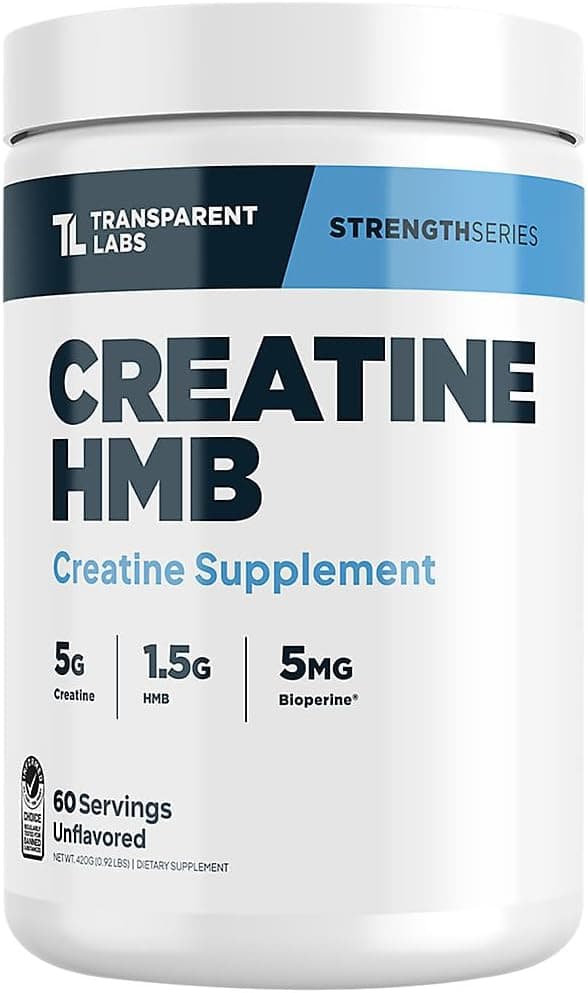
NHANESCreatine Monohydrate is the lead active here, studied most for strength. 22 human studies on Creatine Monohydrate back this formula, each one cited. Each serving carries 5,000 mg of Creatine Monohydrate, inside the range the published research used. Who it fits: for everyone, adults.
 Verified by IngredientMD
The panel on the left is the one we evaluated, line by line.
All 5 actives checked against the clinical evidence: dose, form, and what the research actually shows.
Doses, ratios, and how the ingredients work together. That assessment is the verdict above: "Strong evidence, strong dose".
The verdict is public and identical whether or not a brand pays. A formula that does not clear the bar gets nothing.
Read by the engine against 2.1 million data points from clinical trials, PubMed and more than a hundred vetted sources. No individual reviewer is named or implied.
Cross-checked against 1,284 documented interactions for these actives.
Public health figures the engine matched to this formula's ingredients. Reported by their source, cited and dated, never written by the brand.
About 42% of Americans
take in less calcium than the estimated average requirement.
NHANESAbout 41% of US adults
have blood vitamin D below the level considered sufficient.
Peer-reviewed analysis24.2% of US adults
aged 18 and over met both the aerobic and muscle strengthening activity guidelines in 2020, in the National Health Interview Survey.
CDC National Center for Health Statistics, 202231% of US adults
said they were taking protein supplements such as powders, drinks, or bars, in a Pew Research Center survey fielded in July 2026.
Pew Research Center, 202621.1% of the US population
aged 15 and over took part in sports, exercise, or recreation on an average day in 2023, in the American Time Use Survey.
US Bureau of Labor Statistics, 202457.6%
During 2017 to 2018, 57.6% of US adults aged 20 and over reported using a dietary supplement in the past 30 days.
CDC National Center for Health Statistics41.3% of US men aged 18 to 34
met both the aerobic and muscle strengthening activity guidelines in 2020, the highest rate of any age and sex group, in the National Health Interview Survey.
CDC National Center for Health Statistics, 202237% of US adults aged 18 to 29
said they were taking protein supplements such as powders, drinks, or bars, roughly double the rate among adults aged 65 and over, in a Pew Research Center survey fielded in July 2026.
Pew Research Center, 202659 to 66 days
was the median time it took adults to make a new daily health habit automatic across the studies a 2024 review pooled, with individuals ranging from 4 to 335 days.
Systematic review and meta-analysis, 202461% to 74%
About 61 to 74 percent of adults refilling a long-term medicine on their own stopped within a year, versus 33 to 44 percent on one set pickup day.
Cohort study, 2015Meta-analysis, 2017
In older adults doing resistance training, adding creatine increased lean tissue mass by about 1.37 kg and produced greater chest and leg press strength than training alone across 22 trials.
Open Access Journal of Sports MedicineMeta-analysis, 2024
Across 10 trials in 318 athletes, vitamin D3 raised blood vitamin D by about 14.8 nmol/L and hinted at better muscle strength, though few trials leave that uncertain.
Frontiers in NutritionSystematic review and meta-analysis, 2023
Across 8 randomized trials, creatine improved memory performance in healthy people, with the largest effect in adults aged 66 to 76.
Nutrition ReviewsMeta-analysis, 2014
Pooling 30 trials of 5,615 adults, vitamin D gave a small rise in overall muscle strength, with no measurable effect on muscle mass or power.
Journal of Clinical Endocrinology and MetabolismMeta-analysis, 2003
Combining about 100 controlled studies, creatine gave a small but real improvement in short, intense exercise under 30 seconds, with no improvement seen in running or swimming.
International Journal of Sport Nutrition and Exercise MetabolismSystematic review, 2026
A comparison of protein, creatine and omega-3 found each supported muscle strength and endurance outcomes to a different degree alongside training.
NutrientsRandomised trial, 2025
In 40 healthy men and women, 33 days of creatine before a muscle-damaging workout sped up strength recovery, with less stiffness and fatigue, and less swelling in the women.
NutrientsRandomised trial, 2026
Adding calcium HMB to a whey drink raised the muscle-building response to feeding in older women and slowed muscle breakdown later on.
NutrientsMeta-analysis, 2015
HMB was linked to more muscle mass gain than control across seven trials in adults 65 and older, with no change in fat mass.
Archives of Gerontology and GeriatricsRandomised trial, 2022
In 8 healthy adults taking 5 grams of creatine monohydrate daily for 14 days, muscle creatine content rose, while creatyl-L-leucine at the same dose produced no change.
International journal of sport nutritionMeta-analysis, 2025
Across 15 controlled trials in 712 adults, HMB raised testosterone (SMD 0.82) with no measurable change in cortisol, IGF-1 or growth hormone.
Frontiers in NutritionRandomised trial, 2025
Vitamin D3 supplementation changed the inflammatory protein CHI3L1 and oxidative stress markers in adults with a chronic demyelinating condition. These are markers, not clinical outcomes.
Neuropsychopharmacology ReportsSystematic review and meta-analysis, 2020
In young adults doing resistance training, HMB across 11 trials produced a small increase in total body mass but no detectable change in fat-free mass or strength.
NutrientsSystematic review and meta-analysis, 2018
Across ten trials in healthy adults, HMB lowered post-exercise creatine kinase by about 61 U/L and lactate dehydrogenase by about 15 U/L, markers that rise with muscle damage after strenuous exercise.
Journal of the American College of NutritionMeta-analysis, 2024
Across 20 studies, daily vitamin D3 raised blood vitamin D levels by about 10.4 nmol/L more than the same dose of vitamin D2, roughly 40 percent more.
Advances in NutritionMeta-analysis, 2012
In trials directly comparing the two forms, vitamin D3 raised blood 25-hydroxyvitamin D more than vitamin D2 did (P = 0.001).
American Journal of Clinical NutritionRandomised trial, 2022
Curcumin taken together with piperine raised blood vitamin D levels compared with placebo in the women studied.
BMC complementary medicine and therapiesMeta-analysis, 2026
Pooling 13 randomised trials and 561 adults aged 50 and over, HMB added to resistance training did not measurably change muscle mass (SMD 0.05), muscle strength (SMD 0.04) or fat mass.
Age and AgeingMeta-analysis, 2014
Across 23 trials of 4,082 adults, vitamin D raised bone mineral density at the femoral neck by about 0.8%, with no measurable change at the spine, hip, or other sites.
LancetPopulation figures from public health data. Context for the category, not a statement about any individual and not a claim about this product.
Each line below was derived from this formula's own record at the time of verification. Nothing here was written by the brand, and nothing can be added that the evidence does not carry.
Time-to-effect windows the engine read from the trial record. Each is a window a named study measured, cited and dated, never written by the brand.
A randomised cross-over trial in ten women of mean age 69 gave a single 500 mg dose of calcium as citrate fasting, citrate with a meal, fortified juice or a dairy product meal, with blood drawn before and at 1, 2, 4 and 6 hours. Serum ionised and total calcium increased significantly from baseline over six hours, with the rise similar after fortified juice, delayed when citrate was taken with a meal and smaller after the dairy meal. A separate double-blind cross-over trial in 25 postmenopausal women measured parathyroid hormone and a bone resorption marker 12 hours after a single calcium dose. Ten participants is a small sample, and what moved was blood chemistry, not a sensation.
In the trial record, blood vitamin D rises for about 3 months of daily vitamin D3 and then holds at a plateau, near 69 nmol/L at 1,000 IU a day, from a starting level near 41 nmol/L.
In the trial record, muscle creatine stores rise to a loaded level over about 4 weeks at 3 g daily, or about 1 week with a higher loading dose, and return toward baseline about 4 weeks after stopping.
Windows measured in the cited trials. Context for how the active behaves over time, not a statement about any individual and not a claim about this product.
Five ingredients, from each one's own page.
No acute sensation. Parathyroid hormone responds within hours, while bone density shifts over a year or more of steady intake, so this reads on a panel and a scan.
25-hydroxyvitamin D climbs over roughly six to twelve weeks of daily dosing before it plateaus. It's a blood level you watch rather than a feeling.
Give it two to four weeks of daily use for muscle stores to fill. A higher first week reaches the same place in about five to seven days.
Plasma levels rise faster than with the calcium salt, inside about half an hour, while the muscle-preservation effect itself still builds over two to four weeks.
There is nothing to time on its own. Piperine changes how much of its partner compound reaches your blood, so the timeline you watch is that partner's.
How each ingredient usually behaves over time, from its own page on IngredientMD. General timing for the ingredient, not a measurement of this product.
What each form is, and where it fits in a formula. Measured findings carry the study that reported them.
The animal-sourced form of vitamin D, made in skin under UVB light and produced commercially from lanolin. Fat-soluble, so it travels with dietary fat and is stored in body fat.
In a 12-week double-blind randomised controlled trial in 108 young women in urban Bangalore, most of whom began vitamin D-deficient, daily vitamin D3 at 400, 600 or 800 IU in a fortified wafer raised serum 25-hydroxyvitamin D, parathyroid hormone fell over time, and effects on bone-turnover markers were modest and not dose specific. The 800 IU dose brought 65 percent of participants to sufficiency.
Creatine crystallised with one water molecule per creatine molecule, roughly 88 percent creatine by mass, weakly soluble in cold water.
Descriptions of the form itself, read from the cited studies. Not a comparison between products and not a statement about any individual.
It is a powder, so the serving scales to the amount you want and mixes into something you already drink.
Where two of this brand's products carry actives the literature has read together, the pairing and its basis are below. The evidence word is the corpus row's own confidence, never a score.
Active vitamin D switches on the calcium-binding proteins and channels in the gut lining that carry calcium across the intestinal wall, so the body absorbs far more of the calcium it takes in. With too little vitamin D, much of a calcium dose passes straight through unabsorbed.
Established biochemistry. No combination trial has tested this exact pairing.
Creatine keeps the phosphocreatine pool topped up so muscles can rapidly regenerate ATP in the first seconds of a maximal effort, while beta-alanine raises muscle carnosine, the buffer that soaks up the acidity that builds as high-intensity work continues. They support different, consecutive stages of the same energy demand, which is the long-standing reason the two are stacked together.
Complementary energy systems. No combination trial has tested this exact pairing.
Because the effect builds and holds only with continued daily use, a steady recurring supply is the practical way to keep it going.
Put an earned verification on your own product page.
These statements have not been evaluated by the Food and Drug Administration. This product is not intended to diagnose, treat, cure, or prevent any disease. This record is not medical advice. Always consult your healthcare provider before starting any supplement regimen.