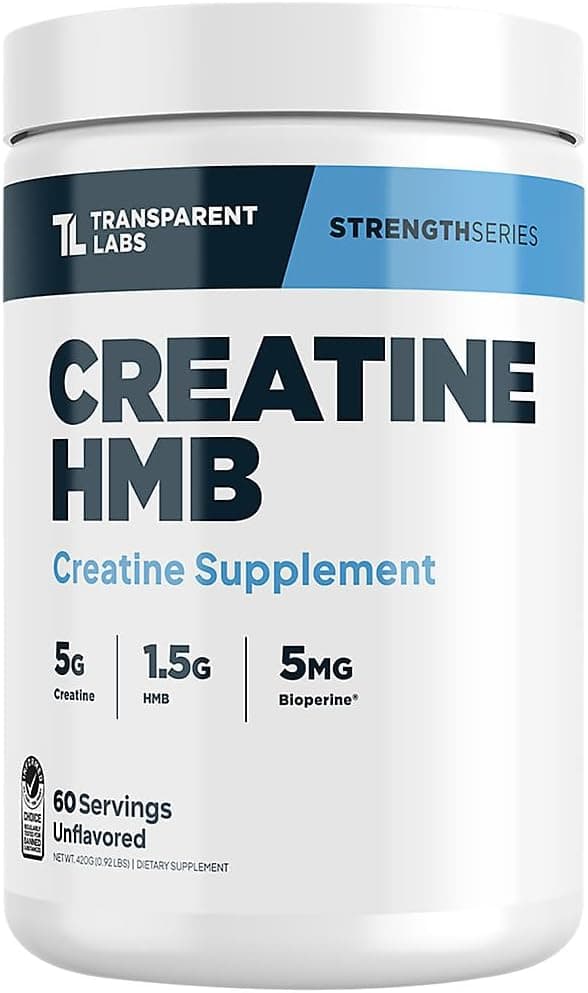
HMB Free Acid (myHMB).
Free acid form absorbs faster than calcium HMB. It's HMB delivered as the plain acid rather than the calcium salt, so it appears in blood faster. It supports keeping the muscle you already have through hard blocks or a deficit.
Reviewed March 2026
- Category
- Amino acid
- Also filed under
- Muscle preservationAnti catabolicRecovery
What HMB Free Acid (myHMB) is, and what it does.
- Does it work
- Suits people who want the faster-rising format, particularly around training. If you take yours once a day with food, the calcium salt's flatter curve fits that pattern instead.
- How much to take
- Start with 1,000 to 3,000mg a day, the daily maintenance band. The 6,000mg figure comes from a research condition rather than a daily target.
- Time to feel it
- Plasma levels rise faster than with the calcium salt, inside about half an hour, while the muscle-preservation effect itself still builds over two to four weeks.
- The first dose
- Day one is absorbed and cleared quickly, with nothing you would notice. The effect accumulates across daily use rather than landing in a single session.
- With regular use
- Over two to four weeks alongside training it is studied for retained lean mass and strength. Long-run head-to-head data against the calcium salt is thin.
- How well tolerated
- Well tolerated in the trials on record, with no consistent side effect pattern. Check with a doctor first if you're pregnant, breastfeeding or on prescription medicine.
- How it feels
- Not something you feel. It reads out as retained strength and lean mass on a measurement, with some people noticing slightly less soreness after hard sessions.
- The overlooked benefit
- The two forms are declared differently: calcium salt weight includes calcium and water, so the same milligram number of free acid delivers more of the acid itself.
1,500 to 3,000mg a day is where HMB Free Acid (myHMB) works.
Source: Wu et al. 2015 J Nutr meta-analysis (n=9 RCTs); Nissen & Sharp 2003 J Nutr
The proof, claim by claim.
These words describe the research, not the molecule's worth. Research strength is how much work stands behind one claim, and it is never a product score.
HMB Free Acid (myHMB) has emerging evidence, with 10 cited human studies on this page.
- Plasma appearance rate compared with the calcium saltRandomised trial
- Lean mass and strength alongside resistance trainingRandomised trial
- Markers of muscle damage after intense trainingRandomised trial
- Muscle protein breakdown and mTORC1 signallingNarrative review
- Conversion to an intermediate feeding cholesterol synthesis in muscleAnimal study
Questions people ask about HMB Free Acid (myHMB).
- When should I take it?
- Timing matters less than consistency. Pick a time that works for you and take it daily.
- Should I take it on an empty stomach?
- Most amino acids absorb better on an empty stomach since they don't compete with food proteins for absorption. 30 minutes before meals is ideal.
- Can I get enough from protein?
- If you eat enough protein (0.8-1g per pound bodyweight), you probably get enough aminos. Supplementing specific ones only makes sense for targeted goals.
- Can I take it with other supplements?
- Usually fine. The main thing to watch is not doubling up on the same ingredient from different products. If you're on prescription meds, check with your pharmacist first.
- Who benefits most from this?
- People who've already covered the basics (diet, sleep, exercise) and want to fine-tune. It's not essential, but could be worthwhile for the right person.
Why these belong in the same formula. Each row says what the basis is, from settled biochemistry through to a trial that measured the pair.
Free acid HMB and calcium HMB deliver the identical metabolite, differing in how quickly plasma levels rise rather than in what arrives. Listing both stacks one compound rather than adding a second.
Roughly five percent of dietary leucine is converted to HMB by way of ketoisocaproate, so the two sit on one pathway. Leucine also signals mTOR directly, which HMB does only weakly, so the roles differ.
Leucine is the upstream amino acid from which HMB is formed, and the conversion rate is low enough that direct HMB gives far higher levels than leucine alone. The two are complementary rather than interchangeable.
Valine competes with leucine for the same transporter and aminotransferase, so branched-chain ratios shape how much leucine is available for HMB formation. Formulas that carry HMB usually hold the branched-chain profile alongside it.
Creatine raises phosphocreatine availability for short bursts of work while HMB acts on protein turnover and membrane cholesterol synthesis in muscle. Neither competes for the other's pathway, which is why they appear together.
Creatine supports the immediate energy system while HMB acts on the balance between muscle protein synthesis and breakdown. The two occupy separate points in the training response.
Skeletal muscle carries vitamin D receptors and adequate vitamin D status is associated with normal muscle fibre function and protein synthesis signalling. HMB acts on the turnover side, so the pair is routinely built together for older adults.
Vitamin D status shapes how muscle responds to a protein or anabolic signal, while HMB acts on the breakdown side of the balance. Formulas for maintaining lean mass in older adults commonly carry both.
Glutamine is the most abundant intracellular amino acid in muscle and supports nitrogen transport and cell volume, a separate axis from the turnover signalling HMB affects. The two have been formulated together in recovery stacks for decades.
Arginine supplies nitric oxide substrate and contributes to nitrogen balance, and it has been paired with HMB and glutamine in lean mass formulas since the 1990s. The mechanisms are separate rather than overlapping.
Branched-chain aminotransferase converts leucine to alpha-ketoisocaproate using pyridoxal 5-phosphate as its cofactor, and that ketoacid is the direct precursor of HMB in the body. Adequate B6 is therefore a condition of endogenous HMB production. Supplemental HMB bypasses that step entirely, which is part of why it is taken as a finished metabolite.
Alpha-ketoisocaproate can go down the main mitochondrial route, where methylcrotonyl-CoA carboxylase requires biotin, or down the minor cytosolic route that yields HMB. The two branches draw on the same substrate. That makes biotin status a determinant of how leucine is partitioned rather than an enhancer of supplemental HMB.
Whey supplies leucine, only a small fraction of which is converted to HMB endogenously, so a supplemental dose of the metabolite delivers far more of it than protein intake does. The two are typically taken together in the same formula for that reason. They act on overlapping signalling, so the combined effect should not be assumed to add up.
HMB's described actions are on the signalling and breakdown side. Building tissue still requires amino acid substrate to be present. A slowly digested protein keeps that substrate available over a longer window. The pairing is a formulation rationale, not a measured combined result.
Beta-alanine raises muscle carnosine and works on hydrogen ion buffering during high-intensity effort, while HMB acts on protein turnover during recovery. The two address different constraints in the same training programme. Combining them is a programme design decision, not a chemical interaction.
Taurine is a muscle osmolyte and antioxidant with no shared pathway with HMB. Products pair them for breadth rather than for a described interaction. The row records the co-formulation and its lack of a mechanistic basis.
Citrulline escapes the first-pass metabolism that limits oral arginine and raises plasma arginine more effectively, which supports nitric oxide production and muscle perfusion. Better perfusion means better delivery of the substrate that HMB signalling acts on. The link is indirect and has not been measured as a pair.
Collagen peptides supply glycine, proline and hydroxyproline for connective tissue, which is not the pool HMB signalling addresses. Formulas combine them to cover both. This is complementary coverage, not synergy.
Every ATP-dependent step of protein synthesis uses magnesium-bound ATP, so magnesium status is a background condition for the process HMB is aimed at. That makes it permissive rather than synergistic. The relationship is generic to protein synthesis and not specific to HMB.
Zinc finger transcription factors and numerous synthetic enzymes depend on zinc availability, which places it upstream of any anabolic signalling. That makes it a permissive nutrient rather than a partner with a specific mechanism. Stated so the pairing is not read as a targeted synergy.
Calcium HMB monohydrate delivers calcium alongside the metabolite, while the free acid does not. A formula stacking calcium HMB with a separate calcium ingredient should count both contributions. This is dose accounting, not an interaction.
Nothing specific on file for HMB Free Acid (myHMB). Match the label to the daily amount above, and tell your doctor what you take.
Not medical advice. Show the label to your pharmacist.What HMB Free Acid (myHMB) actually does.
Your body makes HMB from leucine, but only a small fraction of leucine ever takes that route, which is why supplement doses are far larger than anything protein intake alone produces.
The free acid is a sticky liquid at room temperature that pulls in moisture, so it comes in gel capsules or liquid form rather than as a loose powder, which is the format difference from the calcium salt.
The two forms are declared differently on labels. The calcium salt's weight includes the calcium and its water, so a stated milligram figure of it delivers less of the acid itself than the same figure of free acid.
The free acid is the raw, un-neutralised form, while the calcium salt has to split apart first. A faster, higher blood peak has been reported for the free acid, with the salt giving a flatter curve.
Where HMB Free Acid (myHMB) comes from.
It is made in a factory from an acetone-derived chemical in a couple of steps. Both versions come off the same line: the calcium powder is the normal end point, and the free acid is that powder converted back to the plain acid.
Chemically synthesised. The molecule is identical to the one a plant or an animal makes, and building it deliberately means a known purity, a fixed dose and no crop contaminants. For several nutrients this is the only route that reaches a usable amount.
The commonly described industrial starting material, itself made by the aldol condensation of acetone. The route is petrochemical. HMB is not isolated from a food source at commercial scale.
Diacetone alcohol is oxidised with sodium hypochlorite, which cleaves the methyl ketone and leaves the carboxylic acid, giving beta-hydroxy beta-methylbutyrate in solution.
The reaction mixture is neutralised with a calcium base and the calcium salt is crystallised out, which is the standard way the material is isolated and purified because it handles as a stable dry powder.
For the free acid product the salt is acidified and the acid recovered, giving the un-neutralised material with no counter-ion attached.
Content and purity are confirmed by chromatography. Because the free acid is hygroscopic, it is stabilised and filled into a moisture-barrier format rather than dried to a powder.
The free acid is filled into softgels or supplied as a liquid. The calcium salt is supplied as a crystalline powder for capsules, tablets and dry blends.
Labels rarely state which route was used or whether a free acid product was made directly or liberated from the salt, and branded free acid ingredients treat their stabilisation system as proprietary.
Getting HMB Free Acid (myHMB) from food.
The whole-food sources on file. A supplement closes the gap, it does not replace dinner.
A gram-for-gram figure (how much of each you would eat to match a dose) will appear here once it is sourced and reviewed. This page will not print a number it cannot cite.
The forms it comes in.
The essence, in one line each.
- Pooled across seven randomized trials in adults aged 65 and older, HMB was associated with greater muscle mass gain than control, a standardized mean difference of 0.35, with no change in fat mass.Meta-analysis. Wu et al., 2015 (Archives of Gerontology and Geriatrics). PMID 26169182 ↗
- Across ten trials in healthy adults, HMB lowered post-exercise creatine kinase by about 61 U/L and lactate dehydrogenase by about 15 U/L, markers that rise with muscle damage after strenuous exercise.Systematic review and meta-analysis. Rahimi et al., 2018 (Journal of the American College of Nutrition). PMID 29676656 ↗
- In young adults doing resistance training, HMB across 11 trials produced a small increase in total body mass but no detectable change in fat-free mass or strength.Systematic review and meta-analysis. Jakubowski et al., 2020 (Nutrients). PMID 32456217 ↗
- Pooling 13 randomised trials and 561 adults aged 50 and over, HMB added to resistance training did not measurably change muscle mass (SMD 0.05), muscle strength (SMD 0.04) or fat mass.Meta-analysis. Wang et al., 2026 (Age and Ageing). PMID 41934514 ↗
- Across 15 controlled trials in 712 adults, HMB raised testosterone (SMD 0.82) with no measurable change in cortisol, IGF-1 or growth hormone.Meta-analysis. Bideshki et al., 2025 (Frontiers in Nutrition). PMID 40612317 ↗
- In 24 adults around 68 years old, adding 3 g calcium-HMB to a 40 g whey drink raised the muscle protein synthesis response to feeding in the women and slowed muscle protein breakdown late in the fed period.Randomised trial. Smith et al., 2026 (Nutrients). PMID 42124050 ↗
- In 90 men doing high-intensity functional training, liquid HMB at 90 mg per kg of fat-free mass raised VO2max and the aerobic and respiratory compensation thresholds in the trained subgroup, while maximal isometric strength did not change.Randomised trial. Durkalec-Michalski et al., 2026 (Journal of the International Society of Sports Nutrition). PMID 42441818 ↗
- Acute HMB ingestion changed the human skeletal muscle transcriptome, describing gene expression signatures rather than a change in muscle size or strength.Randomised trial. Wilkinson DJ et al., 2026 (Nutrients). PMID 41683256 ↗
- Preoperative supplementation with HMB, arginine and glutamine was assessed against inflammatory markers before surgery. The intervention was the three-component combination, so no effect can be attributed to HMB alone.Randomised trial. Ogawa M et al., 2025 (Journal of Cardiology). PMID 40914430 ↗
- A secondary post hoc analysis asked whether HMB carried an anti-inflammatory signal in intensive care patients. A post hoc secondary analysis generates a hypothesis and does not establish an effect.Randomised trial. Berger MM et al., 2026 (Clinical Nutrition). PMID 42202485 ↗
These are the studies our verdict leans on, chosen from the 303 we read for HMB Free Acid (myHMB). The full linked list is below.
FDA Disclaimer: These statements have not been evaluated by the Food and Drug Administration. This information is for educational purposes only and is not intended to diagnose, treat, cure, or prevent any disease. Consult your healthcare provider before starting any supplement regimen.