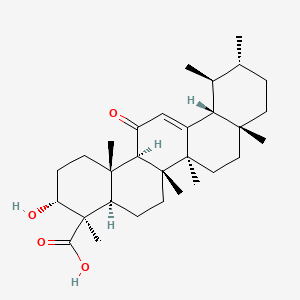
11-keto-beta-boswellic acid.
It's the marker compound of frankincense extract. Boswellic acids damp the 5-lipoxygenase step in the inflammatory pathway, which is why they're used for joint comfort and easier movement.
 Compound
- Category
- Compound
What 11-keto-beta-boswellic acid is, and what it does.
- Does it work
- It suits people who want plant-derived joint comfort support and read labels closely. Which boswellic acid a percentage refers to changes what you get, so the fine print earns your attention.
- How much to take
- No daily figure for the isolated acid is on record. It's a minor fraction of the resin, so the extract amount plus which acid the percentage counts is what tells you what a capsule carries.
- Time to feel it
- Changes in joint comfort with this class are described across two to eight weeks of daily use rather than in the first few days.
- The first dose
- Day one is quiet. The one thing that matters on day one is taking it with a meal containing fat, which is what gets it absorbed.
- With regular use
- Daily use across weeks is how this class is studied, with joint comfort and movement the measured outcomes. Absorption stays the limiting factor throughout.
- How well tolerated
- Generally well tolerated, with mild stomach upset the usual complaint. Anyone pregnant, breastfeeding or taking blood thinning medication should check with a clinician first.
- How it feels
- Most people describe easier movement first thing in the morning rather than any sensation from the capsule itself.
- The overlooked benefit
- A label percentage can mean two different things. Total boswellic acids counts mostly the abundant beta form, while the ketone-carrying acids doing the enzyme work are the smallest slice.
The proof, claim by claim.
What these words mean
These words describe the research, not the molecule's worth. Research strength is how much work stands behind one claim, and it is never a product score.
- joint comfort and everyday movementMeta-analysis
- 5-lipoxygenase inhibition and lower leukotriene formationIn vitro study
2 more claims
- higher absorption when taken with a fat-containing mealRandomised trial
- markers of a healthy inflammatory responseRandomised trial
Why these belong in the same formula, 11 pairings
Why these belong in the same formula. Each row says what the basis is, from settled biochemistry through to a trial that measured the pair.
Curcumin acts largely on the cyclooxygenase and NF-kB side of eicosanoid signalling while boswellic acids act on the 5-lipoxygenase arm. Blocking two branches of arachidonic acid metabolism is the stated rationale for pairing them. A randomised comparison found the combination performed better than curcumin alone on joint comfort and mobility measures in adults with age-related joint wear.
KBA is one of six boswellic acids in Boswellia serrata resin, and it is usually the marker compound the extract is standardised against. Buying the isolated acid and buying a standardised extract are different products with different accompanying chemistry. The extract carries alpha and beta boswellic acids and AKBA alongside it.
Complexing boswellic acids with phosphatidylcholine into a phytosome improves dispersion and measured plasma exposure compared with the plain extract. Delivery system work is one of the more active areas for this compound class precisely because raw bioavailability is poor. Improved exposure is a pharmacokinetic marker, not proof of a larger clinical effect.
Lecithin supplies the phospholipid needed to form a dispersible complex with a lipophilic triterpene. It is the common non-soy source used for the same purpose. The trade-off is a bulkier dose form for a given amount of active.
EPA competes with arachidonic acid as a substrate for the same enzymes, while boswellic acids inhibit 5-lipoxygenase directly. Reducing substrate and inhibiting the enzyme are complementary rather than duplicative. The combined effect on eicosanoid profile is a biochemical marker, not a demonstrated outcome.
EPA is processed by 5-lipoxygenase into the five-series leukotrienes rather than the four-series products from arachidonic acid. Combining that substrate shift with enzyme inhibition targets the same branch twice. Fish oil also supplies the lipid environment that helps a lipophilic triterpene disperse.
Gingerols show dual cyclooxygenase and lipoxygenase activity in laboratory work, which overlaps with the boswellic acid target. The two are frequently formulated together in joint comfort products for that reason. Human data on the specific combination is thin.
MSM appears alongside boswellic acids in most joint comfort formulations, acting through a different and less well characterised route. The pairing is formulation convention supported by product history rather than by combination trials. Neither compound depends on the other.
Bromelain is a proteolytic enzyme used in soft tissue comfort products and does not share a target with boswellic acids. The combination is additive by intent rather than by mechanism. Enzyme stability alongside a resin extract is a formulation consideration.
Glucosamine addresses cartilage matrix substrate supply while boswellic acids act on eicosanoid signalling. They are complementary in intent and independent in mechanism. Combination trials against each single agent are scarce.
Boswellic acids in an oil-based or softgel format sit in a matrix that can oxidise over shelf life. Tocopherol is the conventional antioxidant added to that matrix. This is a stability role rather than a physiological interaction.
Nothing specific on file for 11-keto-beta-boswellic acid. Match the label to the daily amount above, and tell your doctor what you take.
Not medical advice. Show the label to your pharmacist.What 11-keto-beta-boswellic acid actually does.
It is a large resin molecule from frankincense trees. A single ketone group is what separates it from its plain relative, and adding an acetyl group gives you AKBA.
3 more mechanisms
Getting it into the blood is the hard part. The amounts that reach circulation are much lower than the amounts that work in a test tube, which is the honest caveat on most laboratory findings.
The most common one in the resin is not the most active one. So a big percentage on the label may be measuring the wrong thing.
It blocks an enzyme that turns fat molecules into inflammatory signals, and it does so at a different spot on the enzyme than the usual substrate.
Where 11-keto-beta-boswellic acid comes from.
It comes from frankincense, the resin that seeps out when the bark of a Boswellia tree is cut. The resin gets extracted to pull out the acid fraction, then concentrated. The number on the label depends entirely on which of the boswellic acids the maker chose to measure.
What this route gives you
Made from a plant. What ends up in the capsule tracks the harvest, so batch testing and a stated marker matter more here than with a made molecule.
6 steps on record
Tapped exudate from the bark of Boswellia serrata, and in other trades B. sacra, B. papyrifera or B. frereana. Species determines the boswellic acid profile.
The resin is extracted with ethanol, ethyl acetate or supercritical carbon dioxide to pull the acidic triterpene fraction away from the water-soluble gum.
Polysaccharide gum and volatile essential oil are separated, since neither carries boswellic acid activity.
Higher-AKBA materials are produced by further fractionation or chromatography, because native resin carries only a small percentage.
Released against a chromatographic figure for total boswellic acids or for AKBA specifically. Which marker is used changes the meaning of the number.
Supplied as a dry extract powder, or complexed with phospholipid or dispersed in a lipid vehicle to address solubility.
Species is often left off the label. Boswellia serrata, sacra, papyrifera and frereana have different boswellic acid profiles, and frereana in particular contains very little of the compounds discussed here.
The forms it comes in.
4 more forms
The essence, in one line each.
- In a 12-week randomised trial in adults with a diagnosed joint condition, a combination of curcumin and boswellic acid improved physical performance and joint pain scores compared to placebo, while curcumin alone improved only physical performance scores.Randomised trial, in 40- to 70-year-old patients with osteoarthritis (OA). Haroyan A et al., 2018 (BMC Complementary and Alternative Medicine). PMID 29316908 ↗
3 more findings
- Reviews the anti-inflammatory mechanisms attributed to boswellic acids and identifies poor oral bioavailability as the central translational obstacle.Narrative review. Peng C et al., 2025 (Frontiers in Pharmacology). PMID 41341032 ↗
- Surveys delivery approaches including phytosomes, nanoemulsions and lipid carriers aimed at raising oral exposure to boswellic acids.Narrative review. Rutkowska M et al., 2026 (International Journal of Molecular Sciences). PMID 42196409 ↗
- Reported effects on inflammatory signalling and elevated liver fat measures in a rat model, with outcomes read as tissue and marker changes rather than clinical endpoints.Animal study. Ehtiati S et al., 2025 (Naunyn-Schmiedeberg's Archives of Pharmacology). PMID 40478334 ↗
Chosen from the 4 we read for 11-keto-beta-boswellic acid.
FDA Disclaimer: These statements have not been evaluated by the Food and Drug Administration. This information is for educational purposes only and is not intended to diagnose, treat, cure, or prevent any disease. Consult your healthcare provider before starting any supplement regimen.