5-[2-(4-hydroxyphenyl)ethenyl]benzene-1,3-diol.
A plant stilbene in the resveratrol family. Its phenol groups hand a hydrogen atom to radical species, which is the chemistry behind how this class behaves as an antioxidant.
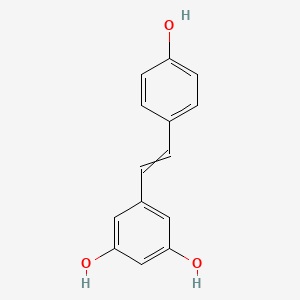 Compound
- Category
- Compound
What 5-[2-(4-hydroxyphenyl)ethenyl]benzene-1,3-diol is, and what it does.
- Does it work
- Suits a formulator who wants the stilbene chemistry named precisely. Only 2 records carry this exact name, so read it as the class rather than a separate story.
- How much to take
- No dose figure is on record for this compound. Stilbenes dissolve poorly, so a daily amount taken with fat or in a phospholipid form is what actually gets absorbed.
- Time to feel it
- Nobody has measured a human time course under this name. Stilbenes peak in blood within a couple of hours, mostly as conjugates rather than the free molecule.
- The first dose
- Day one is an absorption story. What reaches your blood in the first hours is largely glucuronide and sulfate conjugate, and no sensation is described.
- With regular use
- Weeks of daily use have not been studied under this exact name. Where change would show is in oxidative stress markers on a lab panel rather than in a given day.
- How well tolerated
- No human safety dataset sits under this name. Stilbenes as a class are well tolerated at supplement amounts, and anyone on blood-thinning medication should ask a doctor.
- How it feels
- Nobody has described a subjective effect. Where this class registers is a laboratory antioxidant marker rather than anything you would notice.
- The overlooked benefit
- Ultraviolet light flips the stable trans form to cis, so a clear bottle on a sunny shelf changes what is inside. Opaque packaging is doing real work here.
The proof, claim by claim.
What these words mean
These words describe the research, not the molecule's worth. Research strength is how much work stands behind one claim, and it is never a product score.
- Radical scavenging by phenolic stilbenesIn vitro study
- First-pass conjugation limiting stilbene bioavailabilityNarrative review
2 more claims
- Stilbene production by plants as a phytoalexin responseNarrative review
- Light-driven isomerisation of the trans formIn vitro study
Why these belong in the same formula, 7 pairings
Why these belong in the same formula. Each row says what the basis is, from settled biochemistry through to a trial that measured the pair.
Both this stilbene and quercetin are substrates for the same UDP-glucuronosyltransferase and sulfotransferase isoforms in the gut wall and liver. Co-dosing loads those enzymes and can raise circulating free concentrations of either compound. That is a pharmacokinetic interaction rather than a demonstrated benefit, and it cuts both ways.
This compound is a trihydroxystilbene closely related to resveratrol, differing in the position of the phenolic hydroxyls. It goes through the same rapid glucuronidation and sulfation on first pass, which is why systemic exposure to any of these stilbenes is low relative to the dose taken. Combining them does not solve that problem, it shares it.
When a phenolic compound quenches a radical it becomes a phenoxyl radical itself. Ascorbate reduces that species back to the parent phenol, which is standard antioxidant network chemistry and applies to stilbenes as a class. It describes behaviour in solution, not a measured outcome in a person.
Stilbenes are lipophilic and dissolve poorly in gut fluid, which limits how much can be presented for absorption. Phospholipid complexes and lecithin dispersions raise apparent solubility and are a standard formulation answer for this class. The gain is in dissolution, and dissolution is only one of the barriers.
Piperine inhibits intestinal UGT activity, and glucuronidation is the main reason stilbene blood levels stay low after an oral dose. Pairing the two raises systemic exposure of the parent compound. The same inhibition applies to co-administered drugs, which is why the pairing is not a free lunch.
Taking a lipophilic polyphenol with a fat source stimulates bile release and micelle formation, which puts more of the compound into an absorbable state. Fasted dosing of a dry stilbene powder is the worst case for uptake. This is general lipophilic-nutrient handling applied to the class.
Stilbenes often arrive in plant material as glycosides, and gut bacterial glycosidases cleave the sugar to release the free aglycone that can cross the enterocyte. Which bacteria are present therefore shapes how much free compound is generated. Individual conversion capacity varies widely and is not routinely measured.
Nothing specific on file for 5-[2-(4-hydroxyphenyl)ethenyl]benzene-1,3-diol. Match the label to the daily amount above, and tell your doctor what you take.
Not medical advice. Show the label to your pharmacist.What 5-[2-(4-hydroxyphenyl)ethenyl]benzene-1,3-diol actually does.
This compound is a stilbene with three hydroxyl groups spread across two connected rings.
3 more mechanisms
The central double bond can exist in two shapes. The more stable shape can flip to the other under ultraviolet light, which is why stilbene materials are kept away from light.
Phenolic hydroxyl groups on this stilbene donate a hydrogen atom to neutralise free radicals, forming a stable radical themselves. This is the chemical basis for stilbene antioxidant activity seen in the lab.
Stilbenes get heavily modified in the gut wall and liver before entering circulation, so most of what's in blood after an oral dose is a modified form rather than the original compound.
Where 5-[2-(4-hydroxyphenyl)ethenyl]benzene-1,3-diol comes from.
It is a small plant-type molecule in the same family as resveratrol. It can be made in a factory or pulled out of plants, and either way it has to be kept in the dark because light changes its shape.
What this route gives you
The same molecule is reached more than one way. Which route a given product used is a manufacturing choice, and the finished compound is the same either way.
6 steps on record
The botanical route uses stilbene-accumulating plant tissue such as vine, root or bark. The synthetic route starts from substituted benzaldehydes and phosphonium or phosphonate reagents.
The stilbene double bond is formed by a Wittig-type olefination or a palladium-catalysed Heck coupling between an aryl halide and a styrene, followed by removal of protecting groups from the phenols.
Ethanol or ethyl acetate pulls the stilbene fraction from milled plant material. Yields are low because plants make these compounds only in small amounts and mostly under stress.
Recrystallisation removes reaction by-products and non-target polyphenols. Column chromatography is used where a single isomer at high purity is required.
Purity and isomer ratio are set by high performance liquid chromatography with ultraviolet detection, since the cis and trans forms separate cleanly and absorb differently.
Packed in amber or opaque containers under low humidity, because ultraviolet exposure drives trans to cis conversion and moisture accelerates degradation.
Getting 5-[2-(4-hydroxyphenyl)ethenyl]benzene-1,3-diol from food.
The whole-food sources on file. A supplement closes the gap, it does not replace dinner.
A gram-for-gram figure (how much of each you would eat to match a dose) will appear here once it is sourced and reviewed. This page will not print a number it cannot cite.
The forms it comes in.
3 more forms
FDA Disclaimer: These statements have not been evaluated by the Food and Drug Administration. This information is for educational purposes only and is not intended to diagnose, treat, cure, or prevent any disease. Consult your healthcare provider before starting any supplement regimen.