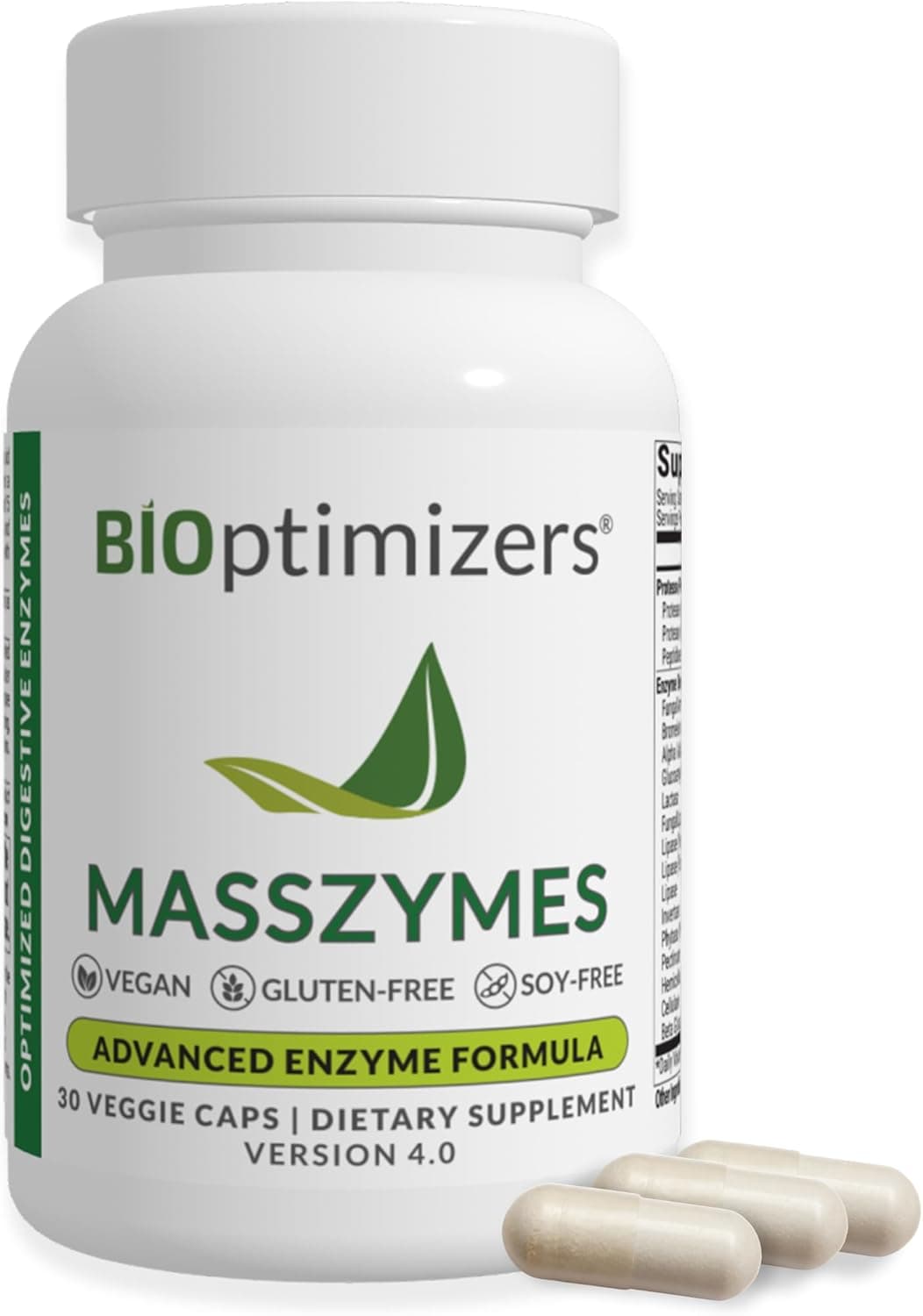
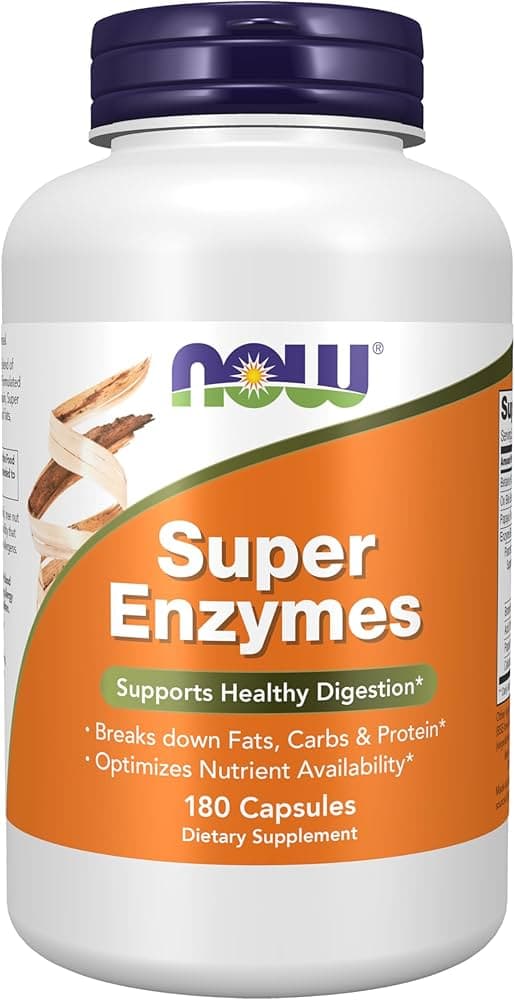
Amylase.
Carbohydrate-digesting enzyme Breaks down complex carbohydrates (starches) into simple sugars for absorption. Helps if your natural amylase production is insufficient.
Reviewed March 2026
- Category
- Enzyme
- Also filed under
- Carb DigestionStarch Breakdown
What Amylase is, and what it does.
- Does it work
- Works well for its specific purpose. If starches give you trouble, this helps. Often included in broader digestive enzyme formulas.
- How much to take
- Start with 5,000 to 15,000 a day split across meals, and read that as activity units, since amylase is sold by starch-splitting power rather than by weight.
- Time to feel it
- It works on the meal it's taken with, so comfort after a starchy plate is a same-sitting thing rather than something that builds over weeks.
- The first dose
- Works with that meal. Better starch digestion.
- With regular use
- It repeats the same per-meal effect rather than building one, so weeks of use mean easier starchy meals each time instead of something that accumulates.
- How well tolerated
- Well tolerated as a food enzyme. Anyone allergic to moulds should check the fungal source, and ask your doctor first if you already take prescribed digestive enzymes.
- How it feels
- Less bloating and discomfort after starchy meals.
- The overlooked benefit
- Amylase leaves beta-linked fibres alone, so cellulose and most non-starch polysaccharides pass through untouched and reach the colon for your bacteria to ferment.
1capsules a day is where Amylase works.
Source: Ianiro G et al. Aliment Pharmacol Ther. 2016;44(7):663-673
The proof, claim by claim.
These words describe the research, not the molecule's worth. Research strength is how much work stands behind one claim, and it is never a product score.
- Starch digestionBasic biochemistry, clinical use
Questions people ask about Amylase.
- When should I take it?
- Timing matters less than consistency. Pick a time that works for you and take it daily.
- Can I take it with other supplements?
- Usually fine. The main thing to watch is not doubling up on the same ingredient from different products. If you're on prescription meds, check with your pharmacist first.
- Any side effects to watch for?
- Most people tolerate it well at recommended doses. GI upset is the most common complaint with any supplement. Start with a lower dose and work up. If something feels off, stop and reassess.
Why these belong in the same formula. Each row says what the basis is, from settled biochemistry through to a trial that measured the pair.
Alpha-amylase cuts starch down to maltose and short oligosaccharides but cannot break the final disaccharide bond. Maltase performs exactly that next cut to free glucose, so the pair completes starch breakdown that either enzyme alone leaves unfinished.
Alpha-amylase works near neutral pH and loses activity in a strongly acidic stomach environment, which is the effect betaine HCL is taken to produce. In the same uncoated dose the acid load works against the amylase, so the two are normally separated or the amylase is delivered in a protected form.
Amylase covers starch only, so it is combined with protease, lipase and disaccharidase activity in a blend that spans all three macronutrient classes. The enzymes act on separate substrates and do not compete.
Amylase releases maltose and short glucose chains from starch while lactase splits lactose, two different disaccharide bonds handled by two different enzymes. Together they cover the common dietary sugars a low brush-border output leaves undigested.
Papain hydrolyses peptide bonds that amylase cannot touch, so a mixed meal of starch and protein is broken down in parallel. Papain also stays active across a wide pH range, which keeps activity going where amylase slows.
Bromelain supplies the protease activity amylase lacks, and the two are routinely dosed together in plant enzyme blends. Neither enzyme consumes the other's substrate.
Pepsin works upstream in the acidic stomach on protein while amylase does its work in the near-neutral small intestine on starch. The pairing hands a partly broken-down meal forward rather than duplicating one step.
Bile salts emulsify dietary fat so lipase can reach it, which is the one macronutrient amylase has no action on. The combination is standard where fat and starch arrive in the same meal.
Grains and legumes carry starch inside a matrix that also holds phytate. Amylase releases the glucose chains while phytase splits the phosphate groups off phytate, loosening the minerals that phytate had bound.
Activated charcoal adsorbs proteins onto its porous surface, and a supplemental enzyme is a protein. Taken in the same dose window it lowers the amylase activity that reaches the meal, so the two belong hours apart.
Psyllium forms a viscous gel that slows the mixing of enzyme and starch and slows gastric emptying, which blunts the rate of starch hydrolysis. The effect works against what supplemental amylase is added to do.
Guar gum raises luminal viscosity so enzyme and substrate diffuse together more slowly, which is why it flattens the glucose rise after starch. Paired with supplemental amylase the two pull in opposite directions.
Banaba leaf ellagitannins and corosolic acid inhibit alpha-amylase and alpha-glucosidase, which is part of how the leaf slows carbohydrate breakdown. Adding it to supplemental amylase cancels the enzyme's intended action.
Amylase works near neutral pH and loses activity in strong acid. A vinegar dose taken with the enzyme drops the local pH below its working range.
Human salivary and pancreatic alpha-amylase both carry a chloride binding site, and chloride occupancy raises catalytic activity. This is textbook enzymology and is why assay buffers for amylase always include chloride. It describes the enzyme's requirement, not a reason to add sodium chloride to a formula.
Every characterised alpha-amylase binds at least one calcium ion that stabilises the folded structure around the catalytic residues. Stripping calcium with a chelator inactivates the enzyme. Supplemental calcium is not the source of that structural ion, so this is a property of the protein rather than a dosing interaction.
Amylase hydrolyses starch, lipase hydrolyses triglycerides, and a mixed meal contains both. Multi-enzyme products combine them for that reason rather than because one helps the other work. Neither competes with the other for substrate or pH range.
Cellulase hydrolyses beta-1,4 glucan linkages, whereas amylase is specific for alpha-1,4 and alpha-1,6 bonds. In plant-heavy meals, breaking the cell wall can expose starch granules that amylase could not otherwise reach. Enzyme blends are built on that sequence logic.
Adding standalone amylase to a pancreatin-containing product raises total amylolytic activity but overlaps with what pancreatin already supplies. Pancreatin is animal derived and its amylase is pH-sensitive, while fungal amylase tolerates lower pH. Total declared activity should be read across both ingredients rather than counted twice.
EGCG and related catechins bind alpha-amylase and reduce its activity in enzyme assays, which is the basis for the starch-blocking interest in green tea extracts. Taken in the same window as a supplemental amylase, the two work against each other. Most of this evidence is in vitro, so the size of the effect at real meal concentrations is not settled.
Hydrolysable tannins bind non-specifically to proteins, including digestive enzymes, and reduce measured amylase activity. This is why tannin-rich feeds and beverages lower starch digestibility in the literature. Separating a tannin-rich intake from a supplemental amylase dose is the practical handling.
Amylase breaks starch into maltose and short dextrins, and alpha-glucosidase then releases glucose from those fragments. DNJ blocks that second step, so pairing it with added amylase pushes in opposite directions on glucose release. The two are usually formulated for opposite goals.
Type 2 and type 3 resistant starches survive amylase because of granule crystallinity or retrogradation, which is exactly what makes them reach the colon for fermentation. Adding amylase to a resistant starch dose can digest part of the fraction that was intended to arrive intact. The degree depends on the resistant starch type and on processing.
Oat beta-glucan raises luminal viscosity, which slows how quickly amylase and starch meet and how fast digestion products reach the mucosa. That is the accepted mechanism behind the flatter glucose curve reported with viscous fibres, and glucose response is a marker. It moderates rather than blocks amylase activity.
Alpha-amylase from the pancreas has a pH optimum close to neutral and is inactivated by gastric acid, so duodenal bicarbonate secretion is what allows it to work. Fungal amylases are more acid-tolerant, which is why they are chosen for oral supplements. This is normal physiology rather than a reason to co-dose bicarbonate.
Invertase hydrolyses sucrose into glucose and fructose, a bond amylase cannot cleave. Mixed carbohydrate meals contain both starch and sucrose. The pairing widens substrate coverage without either enzyme interfering with the other.
Nothing specific on file for Amylase. Match the label to the daily amount above, and tell your doctor what you take.
Not medical advice. Show the label to your pharmacist.What Amylase actually does.
Amylase cuts long starch chains into much shorter sugar fragments.
The enzyme needs a bound calcium ion to hold its shape and works better when chloride is present.
Enzymes on the gut wall finish the job, turning those fragments into glucose the body can absorb.
The body's own pancreatic amylase is inactivated by stomach acid, so supplements use fungal versions that hold up better in acid.
Where Amylase comes from.
Microbes are grown in a tank and make the enzyme, which is filtered out of the broth, concentrated and dried. The finished powder is measured by how much starch it can break down, not by how much it weighs.
Built by fermentation, the same way vitamin B12 and many amino acids are made at scale. Controlled conditions, consistent output.
Starch, dextrose or a similar carbohydrate source plus a nitrogen source feeds the production strain, typically Aspergillus oryzae for fungal amylase or a Bacillus species for the bacterial enzyme.
The organism secretes alpha-amylase into the medium under controlled pH, temperature and aeration.
Cells are removed by filtration or centrifugation, leaving the enzyme in the cell-free broth.
The broth is concentrated by ultrafiltration and clarified, then may be precipitated or polished depending on the grade.
Activity is measured against a starch substrate and the concentrate is diluted with maltodextrin, starch or a similar carrier to a declared DU, SKB or FCC unit strength.
Dried to a stable low-moisture powder, since enzyme activity falls with heat and humidity.
Getting Amylase from food.
The whole-food sources on file. A supplement closes the gap, it does not replace dinner.
A gram-for-gram figure (how much of each you would eat to match a dose) will appear here once it is sourced and reviewed. This page will not print a number it cannot cite.
The forms it comes in.
The essence, in one line each.
- Oral multienzyme supplementation was reported to alter postprandial plasma nutrient concentrations after a mixed meal in healthy adults. Amylase is one enzyme within the blend, and plasma nutrient concentrations are markers rather than clinical outcomes.Randomised trial. Deutz et al., 2026 (The Journal of nutrition). PMID 41662956 ↗
- Alpha-amylase and coated alpha-amylase supplementation were reported to change growth performance, nutrient digestion and rumen fermentation measures in a ruminant feeding study. Non-human and not transferable to human dosing.Animal study. Zhang et al., 2023 (Frontiers in veterinary science). PMID 38260196 ↗
- Alpha-amylase supplementation was reported to affect production performance, blood metabolites, nutrient digestibility and rumen measures in cattle. An animal feeding study, and the readouts are markers.Animal study. Zhang et al., 2025 (Frontiers in veterinary science). PMID 40765742 ↗
- In reduced-energy broiler diets, alpha-amylase supplementation was reported to improve energy efficiency, mineral digestibility and intestinal measures. The effect is on feed utilisation in birds.Animal study. Andrade et al., 2026 (British poultry science). PMID 41553745 ↗
- Exogenous amylase supplementation was reported to raise the measured nutritional value of pea for broilers, consistent with better starch access from a legume matrix. Non-human.Animal study. Perz et al., 2023 (Animals). PMID 36899673 ↗
- Amylase supplementation was reported to affect individual variation, growth performance and starch digestibility in broilers, with the digestibility measure as the direct readout. Non-human.Animal study. Bassi et al., 2023 (Poultry science). PMID 36871332 ↗
- Amylase supplementation was reported to improve starch and amino acid digestibility of faba bean for broilers. A research note in birds, showing the enzyme's effect on a resistant plant starch matrix.Animal study. Perz et al., 2022 (Poultry science). PMID 36067579 ↗
- Corn kernel hardness, drying temperature and amylase supplementation each affected live performance and nutrient utilisation in broilers, indicating that the enzyme's measurable benefit depends on how resistant the starch source is. Non-human.Animal study. Cordova-Noboa et al., 2021 (Poultry science). PMID 34455310 ↗
- Dietary alpha-amylase supplementation affected nutrient digestibility and endogenous enzyme secretion depending on growth phase, which is the clearest available signal that added amylase can influence the animal's own enzyme output. Non-human.Animal study. Aderibigbe et al., 2020 (Poultry science). PMID 33248602 ↗
- A trial of an ashwagandha formulation reported changes in salivary alpha-amylase alongside self-reported stress, mood and sleep scores. Salivary amylase here is a stress-response marker being measured, not a supplemental enzyme being given.Randomised trial. Mahadevan et al., 2025 (Advances in therapy). PMID 40875185 ↗
These are the studies our verdict leans on, chosen from the 10 we read for Amylase. The full linked list is below.
The studies, linked.
4 sources behind our Amylase verdict: peer-reviewed studies and registered clinical trials. Every one links straight to PubMed, the journal, or ClinicalTrials.gov. Read them yourself.
- Clinical trialA Randomized Clinical Trial to Determine the Effect of a Toothpaste Containing Enzymes Blend of Alpha-Amylase and Gluco-Amylase on Dental Biofilm Plaque Accumulation in Healthy Adults Over a 28-Day Period of Product UseClinicalTrials.gov ↗132 participants, Completed
- Clinical trialComparing the Sedative Effect of Dexmedetomidine and Propofol in Mechanically Ventilated Patients by Using Salivary Alpha-amylase as a Stress Marker: a Randomize Controlled TrialClinicalTrials.gov ↗40 participants, Completed
- Clinical trialThe Effect of Conscious Sedation on Salivary Alpha-Amylase Levels in the Patients Undergoing Impacted Third Molar SurgeryClinicalTrials.gov ↗20 participants, Completed
- Clinical trialEffect of Intraoperative IV Ketamine on Postoperative Morphine Consumption During Intestinal Surgery and Its Effect on Salivary Cortisol and Alpha Amylase LevelsClinicalTrials.gov ↗60 participants, Unknown
Evidence surfaced via Semantic Scholar (Allen Institute for AI) and ClinicalTrials.gov. Ranked by study type and citation weight, not cherry-picked.
Problems people have reported.
Read this carefully. These are 73,266 voluntary, unverified reactions reported to the FDA (openFDA). The number mostly reflects how popular Amylase is, not how risky it is. A report is not proof Amylase caused anything. It is a signal of what to watch for, nothing more.
Source: openFDA adverse-event reports. Voluntary reporting, not an incidence rate.
FDA Disclaimer: These statements have not been evaluated by the Food and Drug Administration. This information is for educational purposes only and is not intended to diagnose, treat, cure, or prevent any disease. Consult your healthcare provider before starting any supplement regimen.