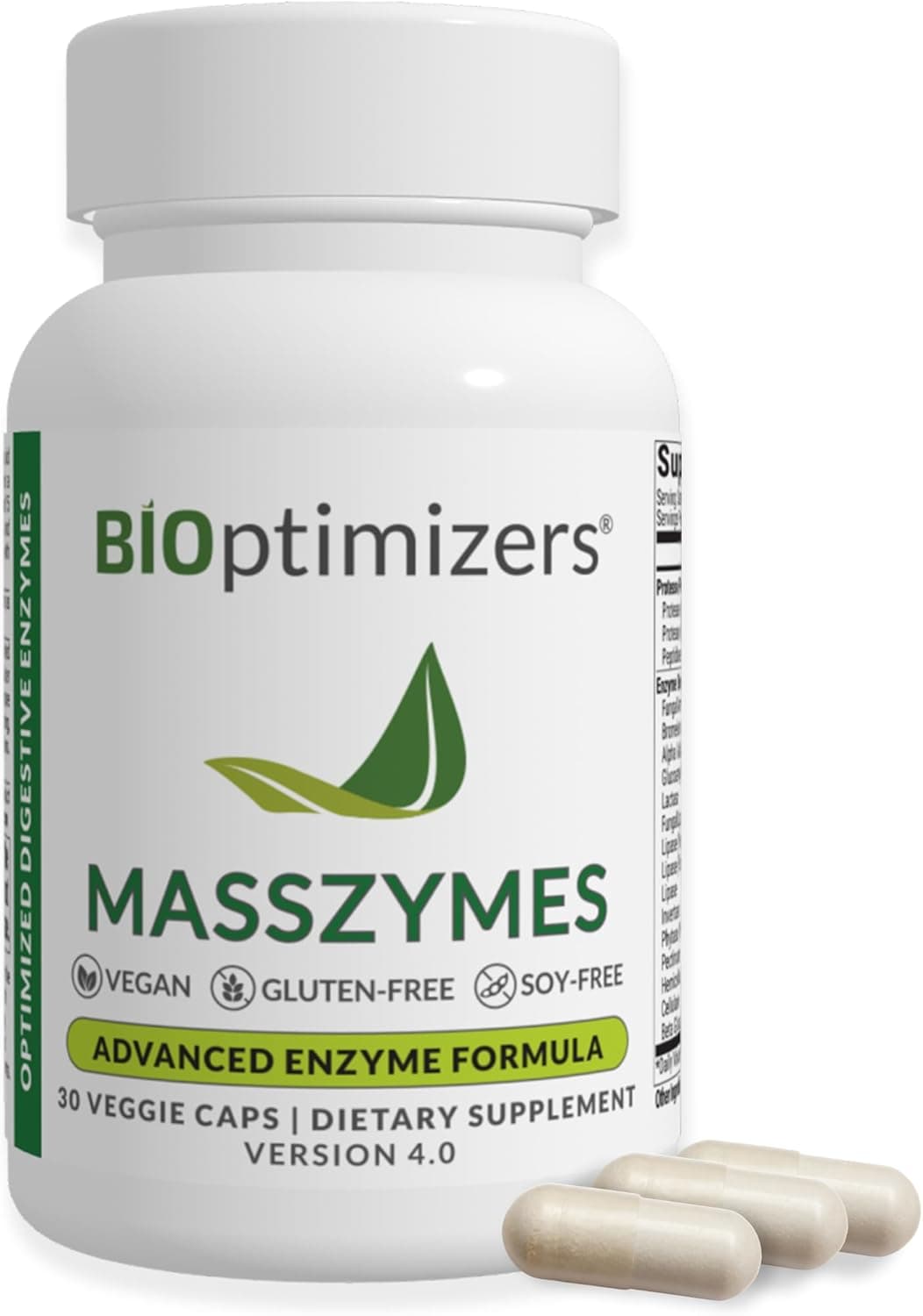
Digestive Enzyme Blend.
Multi-enzyme formula for complete digestive support Adds starch, protein, fat and sugar-splitting enzymes to the meal you take them with, so more of the food is broken down before it reaches the colon to ferment. Meals sit lighter.
Reviewed March 2026
- Category
- Enzyme
- Also filed under
- DigestionBloatingNutrient Absorption
What Digestive Enzyme Blend is, and what it does.
- Does it work
- Suits people who feel heavy or gassy after big, rich or dairy-containing meals, and anyone eating high protein or eating out often. It works on the plate in front of you.
- How much to take
- Start with 200mg to 500mg a day, taken with the meal you want it to work on. Activity units say what a blend can break down, so read those rather than the milligram total.
- Time to feel it
- They act on the meal they arrive with, so comfort after that meal is the first thing you notice, usually within an hour or two.
- The first dose
- The first meal is the test. Comfort after that plate is what turns up, usually inside an hour or two, and there is nothing waiting to build up.
- With regular use
- Weeks of taking one with meals mainly adds up to fewer uncomfortable meals. Enzymes work in the gut and don't accumulate, so the benefit is meal by meal.
- How well tolerated
- Well tolerated by most people. Bromelain and papain can bother a sensitive stomach, and anyone on blood thinners or with a pineapple or papaya allergy should check with a clinician.
- How it feels
- Less heaviness and less gas after a big or rich plate. There's no lift or buzz to it. It shows up as the discomfort you were expecting not arriving.
- The overlooked benefit
- Activity units, not milligrams, tell you what a blend can break down. Two products at the same weight on the label can do very different amounts of work.
1capsules a day is where Digestive Enzyme Blend works.
Source: Ianiro G et al. Aliment Pharmacol Ther. 2016;44(7):663-673
The proof, claim by claim.
These words describe the research, not the molecule's worth. Research strength is how much work stands behind one claim, and it is never a product score.
- Lactose digestionMeta-analysis
- Gas from beans and other raffinose-containing foodsRandomised trial
- Fat digestion with supplemental lipaseRandomised trial
- Protein breakdown into absorbable peptidesIn vitro study
- Bloating and fullness after a mealRandomised trial
- Mineral release from phytateIn vitro study
Questions people ask about Digestive Enzyme Blend.
- When should I take it?
- Timing matters less than consistency. Pick a time that works for you and take it daily.
- Can I take it with other supplements?
- Usually fine. The main thing to watch is not doubling up on the same ingredient from different products. If you're on prescription meds, check with your pharmacist first.
- Any side effects to watch for?
- Most people tolerate it well at recommended doses. GI upset is the most common complaint with any supplement. Start with a lower dose and work up. If something feels off, stop and reassess.
Why these belong in the same formula. Each row says what the basis is, from settled biochemistry through to a trial that measured the pair.
Pepsin needs a low gastric pH to unfold dietary protein before pancreatic proteases can finish the job. Betaine hydrochloride restores that acidity, so the protease fraction of a blend meets substrate that is already partly denatured.
Lipase can only act at the surface of a fat droplet, and bile salts are what break dietary fat into fine droplets with enough surface area. Without adequate bile the lipase in a blend has little interface to work on.
Lipase hydrolyses triglycerides to free fatty acids and monoglycerides, the fat-handling arm that a carbohydrase-heavy blend can be light on. Adding it rounds out coverage of a mixed meal.
Lactase cleaves the beta-galactoside bond of milk sugar, which the proteases and amylases in a general blend do not touch. Dairy-containing meals need that specific activity.
Alpha-galactosidase releases the raffinose-family sugars in legumes and cruciferous vegetables that human enzymes leave intact for gut bacteria. It covers a substrate class a standard blend usually misses.
Phytic acid in grains and legumes chelates zinc, iron and calcium and holds them unavailable, and phytase hydrolyses it. Adding phytase to a blend improves mineral release from the same plant meal the other enzymes are breaking down.
Bromelain stays active across a broader pH span than pancreatic protease, so it works in the stomach as well as the small intestine. That extends the window over which dietary protein is being cut.
Papain cleaves at different residues than pancreatic trypsin and chymotrypsin, so combining them cuts protein at more points. Plant and animal proteases are routinely blended for that reason.
Pancreatin already supplies protease, lipase and amylase, so stacking it with a general blend duplicates those activities rather than adding new ones. Total declared activity units should be read across both.
Activated charcoal adsorbs proteins and small molecules non-selectively in the gut lumen, so enzymes taken with it lose activity before reaching substrate. Separate the two by several hours.
Bentonite carries a high negative surface charge that binds proteins and cations in the gut, including supplemental enzymes and the minerals a meal is releasing. Taking it alongside a blend works against both.
Enzymes break substrate down in the upper gut while probiotic organisms ferment what reaches the colon, so less undigested material arrives for gas-producing fermentation. The pairing is standard in digestive formulations.
Amylase hydrolyses the alpha-1,4 bonds of starch and dextrin, a step no protease or lipase performs. A blend that already carries protease and lipase covers a different substrate class, so adding amylase widens the range of macronutrients the product acts on rather than increasing any single activity. Activity is expressed in FCC dextrinising units, which is why two labels with the same milligram figure can differ.
Pepsin is the stomach's own protease and works in a narrow acidic window, roughly pH 1.5 to 3.5. Fungal and pancreatic proteases in a blend act further along, at higher pH, so the two cover sequential stages of protein breakdown. The pairing is common in formulas aimed at heavy protein meals.
Calcium carbonate consumes gastric acid and raises stomach pH, and pepsin-type activity falls sharply as pH rises above about 4. Taken in the same dose window as an acid-dependent enzyme component, it works against it. Separating the two by a couple of hours is the usual formulation answer.
Bicarbonate neutralises gastric acid on contact, which removes the low-pH environment gastric proteases need. Pancreatic-type enzymes are less affected because they are built for the alkaline small intestine. The interaction is about timing, not about either ingredient being wrong.
Protease cleaves whey into di- and tripeptides and free amino acids, the forms the PepT1 transporter and amino acid carriers actually move. Whey is already rapidly digested in most people, so the practical effect is largest in a large single serving. This is a digestion step, not a change in how much protein the body retains.
Casein clots in gastric acid and empties slowly, which is the reason it is described as a slow protein. Added protease acts on that clot and on the peptides released from it. The pairing targets comfort with a slow-clearing protein load rather than a faster amino acid rise.
Collagen peptides are sold already hydrolysed, typically in the 2 to 5 kDa range, so much of the proteolytic work has been done before the capsule. A protease blend can cleave them further but has less to do than with an intact protein. Worth saying plainly so the pairing is not oversold.
Medium-chain triglycerides are absorbed with far less dependence on pancreatic lipase and bile micelles than long-chain fats, and the resulting medium-chain fatty acids move largely by the portal route. Adding lipase to MCT changes little for that reason. The same blend matters much more alongside long-chain fats.
EPA and DHA in a triglyceride oil must be cleaved by pancreatic lipase to free fatty acids and monoglycerides before uptake. Lipase within a digestive blend acts on that same step. This is a mechanistic pairing about the digestion of the oil, not a claim about any downstream effect.
Lipase acts only at the oil-water interface, so it works faster on a finely dispersed emulsion than on a coalesced oil layer. Phospholipids from lecithin emulsify dietary fat and enlarge that interface. Lecithin is a formulation partner here rather than a second enzyme.
Cholecalciferol is lipophilic and reaches the enterocyte inside mixed micelles formed from digested fat and bile salts. Efficient lipolysis is therefore part of the path. The relationship is about the vehicle for absorption. It does not change how much vitamin D a given dose supplies.
Retinyl esters are hydrolysed by pancreatic and brush-border esterases before retinol crosses the enterocyte membrane, and the whole process runs inside micelles built from digested fat. Lipase-containing blends act upstream of that step.
Tocopherol uptake tracks with the amount of fat digested alongside it, because it travels in the same mixed micelles. Fat digestion supported by lipase is part of that pathway. Tocopheryl acetate additionally needs esterase cleavage.
Carotenoids are among the most fat-dependent nutrients for uptake, needing lipid and bile to enter micelles. Lipase activity liberates the fatty acids that build those micelles. This describes transport into the body, not an outcome.
Lutein esters in marigold-derived material need esterase hydrolysis, and free lutein still needs a lipid micelle to cross the gut wall. A blend carrying lipase and esterase activity acts on both steps. Marker of absorption, not a functional endpoint.
Human amylases and brush-border enzymes cannot hydrolyse beta-2,1 fructan bonds, and typical fungal or pancreatic blends do not carry inulinase either. Inulin therefore passes to the colon for bacterial fermentation whether or not enzymes are taken with it. The pairing is about covering two different fates of carbohydrate, not about enzymes digesting the fibre.
Short-chain fructooligosaccharides resist human digestion for the same bond-specificity reason inulin does, and are fermented in the colon. Gas from that fermentation is sometimes mistaken for enzyme failure. Naming the mechanism helps a formulator set expectations.
GOS carries beta-galactosidic links that human enzymes largely leave intact, though a microbial lactase in a blend has beta-galactosidase activity and can cleave some of them. That makes the pairing partly overlapping rather than cleanly separate. Worth flagging on a label that promises prebiotic delivery.
Lactobacilli carry their own beta-galactosidase and peptidases, so they contribute enzyme activity in the gut lumen on a different timescale from a swallowed enzyme dose. The two are usually co-formulated for that reason. Bile and gastric acid limit how much of either survives, which is a delivery question for the formulator.
S. boulardii is a yeast rather than a bacterium and secretes its own proteases and phosphatases while transiting the gut. It is also unaffected by the acid-stability problems that limit some bacterial strains. Pairing with an enzyme blend gives lumenal and transient microbial activity in one dose.
Glutamine is the preferred oxidative fuel of the small-intestinal enterocyte, the same cell that presents brush-border enzymes and transporters. It supports the tissue rather than the digestion step. The pairing addresses two different parts of the same surface.
Zinc carnosine dissociates slowly at the mucosal surface, which is why it is used where a local zinc presence is wanted rather than systemic zinc repletion. It sits alongside an enzyme blend as a mucosal-surface ingredient, not as an enzyme. Confidence here reflects secondary-source and mechanistic grounding rather than a combination trial.
Ginger constituents shorten gastric emptying time in reported human work, which changes how fast a meal reaches the enzymes of the small intestine. That is a delivery-rate interaction rather than an enzymatic one. The direction is plausible and the size in any given person is not established.
Menthol relaxes gastrointestinal smooth muscle, and enteric-coated peppermint is designed to release below the stomach. Taken uncoated it can relax the lower oesophageal sphincter, which is a comfort trade-off rather than an enzyme effect. Coating and timing decide which behaviour a product gets.
Psyllium forms a viscous gel that slows the mixing of enzymes with their substrates and slows gastric emptying. Neither ingredient is degraded by the other. The interaction is physical. Taking a large psyllium dose in the same mouthful as an enzyme capsule is the case where it matters.
Slippery elm mucilage hydrates into a viscous layer at the mucosal surface. That layer can slow diffusion between enzyme and substrate in the same way any viscous polysaccharide does. It is used for surface comfort, and the physical trade-off with an enzyme dose is worth stating.
Phytate from grains and legumes binds iron in the gut lumen and holds it in an unabsorbable complex. A blend carrying phytase hydrolyses phytate and releases that mineral. Iron bisglycinate is comparatively less phytate-sensitive than an ionic salt, so the size of the effect depends on the form taken.
Zinc absorption falls as the dietary phytate to zinc molar ratio rises, a textbook relationship. Phytase activity in an enzyme blend lowers that ratio in the meal itself. The mechanism is about the mineral in food, not about the supplemental zinc dose passing separately.
Nothing specific on file for Digestive Enzyme Blend. Match the label to the daily amount above, and tell your doctor what you take.
Not medical advice. Show the label to your pharmacist.What Digestive Enzyme Blend actually does.
Amylase breaks the chemical bonds in starch, cutting it down into smaller sugars like maltose and glucose.
Proteases break protein into small chains, and those small chains cross into gut cells through one transporter while single amino acids use their own separate ones.
Lipase only works where fat meets water, splitting fat molecules into fatty acids and partial fats, which then combine with bile salts to form absorbable particles.
Lactase splits milk sugar into two simpler sugars. Without that step, the sugar travels to the colon instead, where bacteria ferment it.
Where Digestive Enzyme Blend comes from.
Two starting points. Most of these enzymes are grown, not mined: a specific mould or bacterium is fed a grain or sugar substrate in a tank, it releases the enzyme into the liquid, and the liquid is filtered, concentrated and dried onto a powder carrier. The other route takes pig pancreas from meat processing and extracts the enzymes it already makes. Bromelain comes from pineapple stems and papain from papaya. Each enzyme is then tested for how much work it can do and diluted to hit the number on the label, which is why the activity units matter more than the milligrams.
The same molecule is reached more than one way. Which route a given product used is a manufacturing choice, and the finished compound is the same either way.
Microbial routes start from a carbohydrate substrate such as wheat bran, soy meal, corn steep or dextrose. Animal routes start from porcine pancreas recovered as a by-product of meat processing.
Aspergillus, Rhizopus, Bacillus or Trichoderma strains are grown in submerged tanks or on solid substrate and secrete the enzymes into the medium. Pancreatic material is instead defatted and autolysed to release enzyme protein.
Biomass is removed by filtration or centrifugation and the enzyme-bearing liquid is concentrated, commonly by ultrafiltration that retains protein and passes salts and water.
Enzymes are precipitated with salt or solvent, or spray- or freeze-dried onto a carrier such as maltodextrin or starch. Purity steps aim to remove residual mycotoxin risk and process solvents.
Each enzyme is assayed against a defined substrate and diluted with carrier to a declared activity: FCC or DU for amylase, HUT for protease, FIP or LU for lipase, ALU for lactase, GalU for alpha-galactosidase, FTU for phytase.
The assayed blend is filled into vegetarian or gelatin capsules, tableted, or coated for delayed release, then held to a stability specification because activity declines with heat and humidity.
Most blends do not disclose the production organism per enzyme, the carrier proportion, or whether the protease fraction is microbial, plant or pancreatic, so the source of a given activity is often unstated.
Getting Digestive Enzyme Blend from food.
The whole-food sources on file. A supplement closes the gap, it does not replace dinner.
A gram-for-gram figure (how much of each you would eat to match a dose) will appear here once it is sourced and reviewed. This page will not print a number it cannot cite.
The forms it comes in.
The essence, in one line each.
- In a double blind trial, adults with recurring fullness and upper abdominal discomfort after meals reported greater symptom relief on a digestive enzyme blend than on placebo.Randomised trial. Ullah et al., 2023 (Biomedicine & pharmacotherapy). PMID 37976892 ↗
- In broilers, microencapsulated essential oils with seaweed meal were reported to change growth performance alongside measured intestinal digestive enzyme activity.Animal study. Elolimy AA et al., 2025 (Journal of Animal Science). PMID 40151066 ↗
- Lysophospholipid and inulin supplementation altered performance and gut measures in broilers in a way that depended on the fat source fed, consistent with lipid-emulsification chemistry.Animal study. Rahimpour M et al., 2026 (Poultry Science). PMID 41637788 ↗
- L-glutamine with L-glutamic acid was reported to raise antioxidant status measures and alter gene expression markers in the study animals.Animal study. Carneiro CLDS et al., 2026 (Journal of Animal Physiology and Animal Nutrition). PMID 42365622 ↗
These are the studies our verdict leans on, chosen from the 1,615 we read for Digestive Enzyme Blend. The full linked list is below.
The studies, linked.
3 sources behind our Digestive Enzyme Blend verdict: peer-reviewed studies and registered clinical trials. Every one links straight to PubMed, the journal, or ClinicalTrials.gov. Read them yourself.
- Clinical trialA Randomized, Double-blind, Placebo-controlled, Crossover Clinical Trial to Investigate the Effect of Digestive Enzyme Supplementation on Postprandial Responses to a High-macronutrient MealClinicalTrials.gov ↗Phase 2, 24 participants, Completed
- Clinical trialA Study Evaluating the Impact of Regular FODMAP-targeting Digestive Enzyme Blend Use on Gastrointestinal Symptoms in Individuals With Self-Reported BloatingClinicalTrials.gov ↗150 participants, Recruiting
- Clinical trialEfficacy of a Digestive Enzyme Blend: A Randomized, Double-Blind, Placebo-controlled TrialClinicalTrials.gov ↗50 participants, Unknown
Evidence surfaced via Semantic Scholar (Allen Institute for AI) and ClinicalTrials.gov. Ranked by study type and citation weight, not cherry-picked.
FDA Disclaimer: These statements have not been evaluated by the Food and Drug Administration. This information is for educational purposes only and is not intended to diagnose, treat, cure, or prevent any disease. Consult your healthcare provider before starting any supplement regimen.