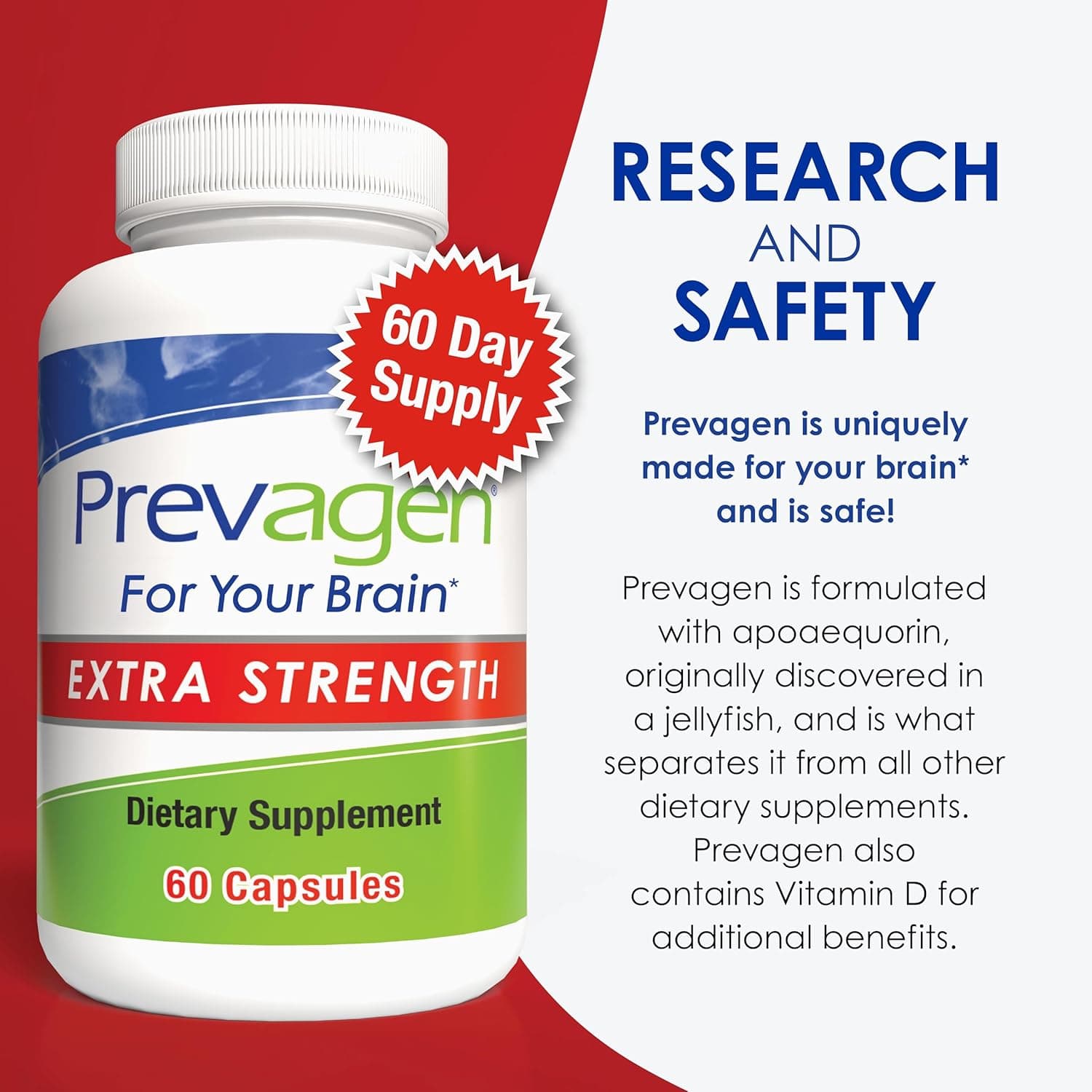
Apoaequorin.
A jellyfish-derived calcium-binding protein marketed as a brain health supplement for memory support. A jellyfish calcium-binding protein, now made by bacteria, sold for memory support. Like any dietary protein, digestion breaks it into amino acids before absorption.
Reviewed March 2026
- Category
- Compound
- Also filed under
- Marketed for memory supportCalcium binding protein (in lab settings)
What Apoaequorin is, and what it does.
- Does it work
- Suits someone curious about the one branded protein studied for recall. If you want ingredients with a mapped route to the brain, citicoline and phosphatidylserine have more human data.
- How much to take
- Prevagen uses 10mg. But since the protein is likely digested before any brain effects could occur, the dose question is somewhat irrelevant.
- Time to feel it
- The trial that reported a change ran 90 days. Nothing shorter than that has been measured, so there is no earlier timeline to give.
- The first dose
- Nothing. Even if this worked (unlikely), brain supplements don't produce overnight results.
- With regular use
- The Madison Memory Study claimed improvements after 90 days, but only in a post-hoc subgroup analysis. The primary endpoints failed.
- How well tolerated
- Well tolerated to take. It won't hurt you. But for the price, it won't help you either.
- How it feels
- No noticeable sensation is reported by most people. What was measured in the trial was performance on a computerised recall task, not a felt difference.
- The overlooked benefit
- No jellyfish are harvested for it: the gene is expressed in bacteria. And aequorin's real day job is as a laboratory calcium reporter, which is where its deep science sits.
10mg a day is where Apoaequorin works.
Source: Moran DL et al. Adv Mind Body Med. 2016;30(1):4-11
The proof, claim by claim.
These words describe the research, not the molecule's worth. Research strength is how much work stands behind one claim, and it is never a product score.
- Improves memory
- Protects brain cells from calcium damage
- Clinically tested
Questions people ask about Apoaequorin.
- Didn't the FTC sue Prevagen?
- Yes. The FTC and New York Attorney General challenged Prevagen's memory claims in 2017. The case had mixed outcomes, but the science remains weak.
- If it's a protein, doesn't stomach acid destroy it?
- Almost certainly, yes. Proteins get broken down into amino acids during digestion. There's no good evidence that intact apoaequorin reaches the brain.
- Why do so many people buy it?
- Massive advertising budget. Prevagen spends tens of millions on TV ads targeting older adults worried about memory. Great marketing, weak science.
- What should I take for memory instead?
- Omega-3 fish oil, exercise, and sleep have far better evidence for brain health. If you want a supplement, look at phosphatidylserine or lion's mane.
- Is the 'Extra Strength' version better?
- It has more apoaequorin (20mg vs 10mg), but more of something that doesn't work still doesn't work. You're just paying more.
- Do any doctors recommend this?
- Very few. Most neurologists and geriatricians don't recommend apoaequorin because the evidence doesn't support the claims.
Why these belong in the same formula. Each row says what the basis is, from settled biochemistry through to a trial that measured the pair.
Apoaequorin is a roughly 22 kDa globular protein, and any ingested protein is denatured by gastric acid then cleaved by pepsin, trypsin, chymotrypsin and brush-border peptidases into amino acids and short peptides. Added proteases push that hydrolysis further and faster. This is the central pharmacokinetic fact about the ingredient and it applies whether or not enzymes are co-dosed.
Low gastric pH unfolds globular proteins and exposes their peptide bonds to pepsin, which works optimally in acid. Adding an acid source accelerates the unfolding of a protein such as apoaequorin. Anything that depends on the protein arriving intact is working against this chemistry.
Apoaequorin carries three EF-hand motifs that bind calcium ions with high affinity, which is the property that made the protein useful as a laboratory calcium reporter. That binding is measured in solution and inside cells that have been loaded with the protein. Whether any calcium binding occurs after oral intake is a separate question, because the protein is digested before absorption.
Citicoline supplies choline and cytidine for membrane phospholipid synthesis, a substrate mechanism with nothing in common with a calcium-binding protein. The two appear together in cognitive-support formulas. The pairing is a formulation convention and not a tested combination.
Phosphatidylserine is a membrane phospholipid used for cognitive support with its own separate literature. Nothing about it changes how a protein is digested. Regard the combination as common practice.
Bacosides act on cholinergic and antioxidant pathways over weeks of daily use, a slow-onset botanical mechanism. It is combined with protein and phospholipid ingredients in memory formulas. No combination data exists in the sources available here.
Ginkgo flavone glycosides and terpene lactones act on vascular tone and platelet function, which is a different lever again. It is a frequent co-ingredient in cognitive blends. Its platelet effect is the part that warrants a clinician conversation for anyone on medication affecting clotting, independently of the pairing.
Theanine is a free amino acid that crosses into the brain and modulates alpha-wave activity and glutamatergic signalling. Being an amino acid it is absorbed intact, unlike a protein. The pairing is conventional rather than studied.
Talk to a doctor before taking Apoaequorin if any of these apply to you: FTC sued manufacturer for false advertising, Protein gets digested before reaching the brain, Key clinical study had methodological flaws, Very expensive for unproven benefit. These are flags to check first, not effects Apoaequorin is known to cause.
Not medical advice. Show the label to your pharmacist.What Apoaequorin actually does.
It is the protein part of the glowing molecule found in a jellyfish.
Calcium latching onto the protein sets off a light-emitting reaction, but only when its partner molecule coelenterazine is also present.
Scientists put this protein inside cells to watch calcium move, which only works because they get it into the cell first.
Swallowed protein gets taken apart into amino acids before it is absorbed, the same way protein in food is.
Where Apoaequorin comes from.
Bacteria are given a copy of the jellyfish gene and grown in a tank until they make the protein. The cells are broken open, the protein is cleaned up through a series of columns, dried, and mixed with a carrier so it can be put into capsules.
Produced by a cultured organism rather than harvested. The strain is selected and the conditions are controlled, so batches sit closer together than a field crop.
A bacterial host, typically an Escherichia coli production strain, carries an expression plasmid encoding the apoaequorin sequence. It is grown on a defined sugar and nitrogen medium.
The culture is grown to target density then induced so the host synthesises the apoprotein. No jellyfish material enters the process. The gene sequence is the only thing that came from the animal.
Cells are separated from the broth and broken open mechanically or chemically to release soluble protein.
The apoprotein is separated from host proteins, nucleic acids and endotoxin by chromatography, then buffer-exchanged. Purity and identity are confirmed by electrophoresis and protein assay.
The purified protein is dried, commonly by lyophilisation or spray drying, then assayed and blended with a carrier for encapsulation.
The production strain, plasmid construct, induction conditions and purification sequence for a branded apoaequorin are proprietary and are not disclosed on labels.
Getting Apoaequorin from food.
The whole-food sources on file. A supplement closes the gap, it does not replace dinner.
A gram-for-gram figure (how much of each you would eat to match a dose) will appear here once it is sourced and reviewed. This page will not print a number it cannot cite.
The forms it comes in.
The essence, in one line each.
- A review of the 18 most common ingredients in 103 over the counter memory products found no compelling human evidence that apoaequorin supports memory.Review. Hersant et al., 2023 (CNS Drugs). PMID 37603263 ↗
- A systematic review of enriched diets and nutraceuticals examined for cognitive function in ageing companion animals. Apoaequorin is named among the ingredients catalogued, and the review is animal evidence that does not establish an effect in people.Systematic review. Blanchard et al., 2025 (GeroScience). PMID 39827310 ↗
These are the studies our verdict leans on, chosen from the 20 we read for Apoaequorin. The full linked list is below.
Problems people have reported.
Read this carefully. These are 441 voluntary, unverified reactions reported to the FDA (openFDA). The number mostly reflects how popular Apoaequorin is, not how risky it is. A report is not proof Apoaequorin caused anything. It is a signal of what to watch for, nothing more.
Source: openFDA adverse-event reports. Voluntary reporting, not an incidence rate.
FDA Disclaimer: These statements have not been evaluated by the Food and Drug Administration. This information is for educational purposes only and is not intended to diagnose, treat, cure, or prevent any disease. Consult your healthcare provider before starting any supplement regimen.