Boswellic Acid.
The active acids from frankincense resin. They act on the pathways that build the body's lipid signalling messengers, which is why they turn up in joint comfort formulas.
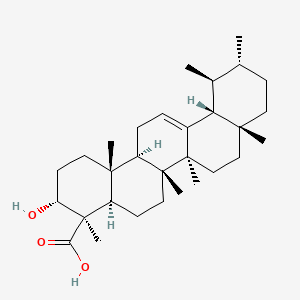 Compound
- Category
- Compound
What Boswellic Acid is, and what it does.
- Does it work
- Suits people building a joint comfort routine who can take it with a meal containing fat. Absorption without fat is much lower.
- How much to take
- No daily figure is on record here. What is clear is that taking your serving with a fat-containing meal raises how much reaches your blood.
- Time to feel it
- Weeks, not days. Studies of these extracts typically run eight weeks or longer, so that's the honest timescale to plan around.
- The first dose
- Day one is quiet. Any change in joint comfort builds over weeks, so the first day is mostly about getting the fat-containing meal habit right.
- With regular use
- Weeks of daily use with food is where the joint comfort and mobility work happens, and it's what the trials measure.
- How well tolerated
- Generally well tolerated, with occasional stomach upset. Because these extracts shift drug-handling enzymes in lab systems, ask a pharmacist if you take prescription medicines.
- How it feels
- No immediate sensation. What people describe is easier movement in stiff joints after several weeks, rather than anything you feel going down.
- The overlooked benefit
- A high total boswellic acid percentage on a label doesn't tell you the AKBA content, which is the fraction most extracts are standardised on.
The proof, claim by claim.
What these words mean
These words describe the research, not the molecule's worth. Research strength is how much work stands behind one claim, and it is never a product score.
- joint comfortRandomised trial
- joint mobility and everyday movementRandomised trial
3 more claims
- higher plasma exposure when taken with a fatty mealRandomised trial
- lipid mediator generation via microsomal prostaglandin E synthase-1 and cathepsin GIn vitro study
- 5-lipoxygenase inhibitionIn vitro study
What the trials show about these together.
Outcomes the engine found studied for these actives as a combination, not one at a time. Each is a finding a named trial measured, cited and dated, never written by the brand.
- PromisingBoswellic Acid + CurcuminJoint
In a randomized trial in adults with osteoarthritis, curcumin taken together with boswellic acid reduced joint pain and improved physical function more than curcumin alone.
Haroyan et al., 2018 (BMC Complement Altern Med)PMID 29316908
How these rows are read
Research strength. Research strength says how much work stands behind the combination. It is never a product score.
Fail closed. Where actives were studied on their own rather than together, each shows on its own evidence, never a combined effect no trial measured.
Independent record. Every finding is cited to a named trial, dated, and never written by the brand.
Findings from trials that studied these actives as a combination. Context for how the actives were tested together, not a statement about any individual and not a claim about this product.
Why these belong in the same formula, 10 pairings
Why these belong in the same formula. Each row says what the basis is, from settled biochemistry through to a trial that measured the pair.
Boswellia and Curcuma extracts have been formulated and studied as a fixed combination for joint comfort and mobility, and the pairing is one of the most common in that category. Both act on eicosanoid and inflammatory signalling, though at different points, so the rationale is convergent rather than identical. Because the combination was assessed as a single product, the contribution of each part cannot be separated. Both also share the same core problem of poor oral absorption.
Boswellic acids are large lipophilic pentacyclic triterpene acids with poor aqueous solubility and low oral availability, and AKBA is the worst of the set. Taking the extract with a fat-containing meal rather than on an empty stomach raises plasma concentrations substantially. This is why lipid-based delivery is the main thrust of the formulation work on this ingredient. Simple and free: take it with food that has fat in it.
Boswellic acids interfere with leukotriene generation, and long-chain omega-3 fats shift the substrate pool that leukotrienes are made from. The two arrive at overlapping territory by different routes, which is the mechanistic case for combining them. The fat in fish oil also serves as the lipid vehicle boswellic acids need. Human work on the combination specifically has not been done.
MSM and Boswellia appear together in most joint formulas on the shelf, and the two have separate small evidence bases for joint comfort and mobility. Nothing has tested them head to head or in combination against either alone. The pairing is category convention.
The two are combined because their proposed mechanisms do not overlap, so a formulator can argue for both. Glucosamine acts as a substrate for glycosaminoglycan synthesis, Boswellia on eicosanoid signalling. No trial has isolated what adding one to the other does.
Collagen peptides supply amino acid building blocks and possible signalling peptides, Boswellia works on the inflammatory side. The combination is convention rather than a tested pairing. Both have their own separate small trial bases and neither substitutes for the other.
Gingerols and shogaols affect both cyclooxygenase and lipoxygenase pathways in laboratory work, and boswellic acids act on the lipoxygenase side and on downstream prostaglandin E synthase. Stacked, the two land on the same signalling network. The evidence for the combination is mechanistic. Ginger also carries its own mild antiplatelet tendency, which is the relevant caution.
Piperine inhibits glucuronidation and some efflux transport, which raises exposure to several co-dosed botanical constituents. Boswellic acid clearance involves glucuronidation, so the rationale carries over. It has not been measured for these triterpene acids specifically, and lipid delivery has better support for this particular molecule. The same enzyme inhibition applies to medicines.
Both act on platelet function through lipid mediator pathways, one by lipoxygenase inhibition and one by substrate shift. Neither is strong alone at usual doses. The reason to flag it is cumulative: anyone stacking several agents that nudge clotting, or approaching a procedure, should count both.
A label listing both Boswellia serrata extract and boswellic acids is naming a material and its own marker compound, not two ingredients. The percentage figure on a Boswellia extract refers to the boswellic acid content of that same extract. Reading the two as additive overstates what is in the capsule. This matters when comparing products on total milligrams.
Nothing specific on file for Boswellic Acid. Match the label to the daily amount above, and tell your doctor what you take.
Not medical advice. Show the label to your pharmacist.What Boswellic Acid actually does.
Boswellic acids are a group of plant compounds from Boswellia tree resin. One form, AKBA, is what most extracts are standardized to.
3 more mechanisms
The main forms of these compounds don't absorb well when taken orally. AKBA in particular only reaches modest blood levels after a normal dose, and levels rise a lot when it's taken with a fatty meal. This gap between lab potency and actual blood levels is the central problem with this ingredient.
Researchers originally thought these compounds directly blocked a key inflammation-related enzyme. More recent work points to other targets that are reached at levels closer to what oral dosing actually achieves. It's better described as acting on inflammation-related signaling broadly than as hitting one specific enzyme.
The resin also contains a sizeable essential oil portion and gum sugars. Extracts vary in how much of each they keep, and some products deliberately add resin oil back in, which changes both the makeup and how well it absorbs compared to a plain extract.
Where Boswellic Acid comes from.
The active acids in frankincense resin, the same material burned as incense for thousands of years. They are hard to absorb, so taking them with a meal that contains fat makes a real difference to how much gets in.
What this route gives you
Made from a plant. What ends up in the capsule tracks the harvest, so batch testing and a stated marker matter more here than with a made molecule.
6 steps on record
The tree is tapped by cutting the bark, and the oleo-gum-resin exudes and hardens into tears over weeks. Sourced mainly from dry forest in India, with related species tapped in the Horn of Africa and Arabia.
Hardened tears are sorted by colour and size and cleaned of bark. Species substitution between Boswellia serrata, sacra and papyrifera happens at this stage and changes the triterpene profile.
Ethanol or ethyl acetate pulls the acidic triterpene fraction. The polysaccharide gum, which makes up much of the raw weight, stays behind.
Alkaline partitioning separates the acidic triterpenes from neutral constituents, concentrating the boswellic acids. Further steps enrich AKBA where that is the target.
Label figures are set by HPLC. A product declaring only total boswellic acids has not declared its keto acid content, which is the number the mechanistic literature cares about.
Dry extracts go into capsules and tablets. Lipid and phospholipid systems go into soft gels. Topical bases use the extract or the resin oil fraction.
The forms it comes in.
3 more forms
The essence, in one line each.
- The review surveys delivery systems built for boswellic acids and identifies low oral availability as the central formulation problem the field is working around.Narrative review. Rutkowska M et al., 2026 (International Journal of Molecular Sciences). PMID 42196409 ↗
4 more findings
- A mechanistic and translational review of boswellic acids in inflammatory signalling, with bioavailability described as the main barrier between laboratory activity and clinical effect.Narrative review. Peng C et al., 2025 (Frontiers in Pharmacology). PMID 41341032 ↗
- In a 30-day trial in adults with a diagnosed joint condition of the knee, a defined Boswellia serrata extract improved measures of joint comfort and mobility, with improvements in pain scores seen as early as five days.Randomised trial, in subjects with osteoarthritis (OA) of the knee. Karlapudi V et al., 2023 (Journal of the American Nutrition Association). PMID 35512759 ↗
- In a rat model of elevated liver fat, the authors reported effects on the inflammatory and metabolic measures they tracked.Animal study. Ehtiati S et al., 2025 (Naunyn-Schmiedeberg's Archives of Pharmacology). PMID 40478334 ↗
- A review of plant-derived compounds acting on immune mechanisms in eye inflammation, naming boswellic acids among the compounds surveyed.Narrative review. Lu W et al., 2026 (Current Issues in Molecular Biology). PMID 42042027 ↗
Chosen from the 7 we read for Boswellic Acid.
The studies, linked.
4 sources behind our Boswellic Acid verdict, every one linked to PubMed, the journal or ClinicalTrials.gov.
- Clinical trialDouble Blind, Placebo Controlled Trial to Evaluate the Effects of a Nutraceutical Containing High-Molecular-Weight Hyaluronic Acid (HA) and Acetyl-11-Keto-Beta-Boswellic Acid (AKBA) in Patients Affected by Knee OsteoarthritisClinicalTrials.gov ↗72 participants, Completed
3 more linked trials
- Clinical trialEvaluation of Frankincense Essential Oil Supplements on Markers of Inflammation and Cellular HealthClinicalTrials.gov ↗67 participants, Completed
- Clinical trialTreatment of Renal Stones With Frankincense (Boswellic Acid): A Clinical Randomized TrialClinicalTrials.gov ↗Phase 1, 100 participants, Unknown
- Clinical trialEvaluation of the Efficacy of Natural JAK_ STAT Pathways Inhibitors in Treatment of Patients With Rheumatoid Arthritis as a Complementary MedicineClinicalTrials.gov ↗75 participants, Unknown
From clinical trials and PubMed, ranked by study type and citation weight, not cherry-picked.
FDA Disclaimer: These statements have not been evaluated by the Food and Drug Administration. This information is for educational purposes only and is not intended to diagnose, treat, cure, or prevent any disease. Consult your healthcare provider before starting any supplement regimen.