Cascaroside.
The molecules in cascara bark that do the work. They stay inert on the way down until colonic bacteria strip the sugar off, and water is then drawn into the stool.
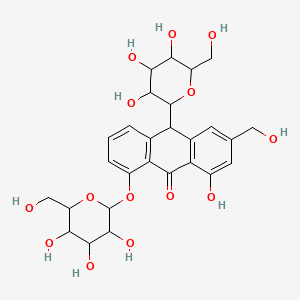 Compound
- Category
- Compound
What Cascaroside is, and what it does.
- Does it work
- Matters most if you compare bark products, since cascarosides A to D are what a standardised extract is assayed against. The use case is occasional regularity.
- How much to take
- No dose figure is on record. Standardised extracts declare their cascaroside content, so read that number and start at the low end of the label range.
- Time to feel it
- Six to twelve hours, and it varies person to person because your gut bacteria set the timing, not the amount you swallowed.
- The first dose
- Nothing through the stomach and small intestine, because the sugar group blocks absorption. Later in the day, an urge, sometimes with mild cramping.
- With regular use
- Short courses rather than a nightly habit. Prolonged anthranoid use is linked with potassium depletion and a reversible dark pigmentation of the colon lining.
- How well tolerated
- Tolerated for brief use in adults. Cramping is the common complaint. Check with a clinician if you're pregnant, breastfeeding, under 12, or on diuretics or heart medicines.
- How it feels
- Unremarkable for hours, then unmistakable. Same amount, different week, different intensity, because the bacterial step is the variable.
- The overlooked benefit
- An assay number is not an effect. Two extracts with identical cascaroside content can behave differently in two people, because the activation happens in the colon.
The proof, claim by claim.
What these words mean
These words describe the research, not the molecule's worth. Research strength is how much work stands behind one claim, and it is never a product score.
- Bacterial cleavage to the active anthroneIn vitro study
- Colonic water secretion and propulsive motilityNarrative review
2 more claims
- Occasional bowel regularityNarrative review
- Potassium depletion with prolonged anthranoid intakeNarrative review
Why these belong in the same formula, 8 pairings
Why these belong in the same formula. Each row says what the basis is, from settled biochemistry through to a trial that measured the pair.
Cascarosides are glycosides and are largely inert until colonic bacteria cleave the sugar and reduce the aglycone to the active anthrone. A person's gut microbial population therefore determines how much active compound is generated from a given dose. This is why the same amount produces different effects in different people, and why recent antibiotic use changes the response.
Anthranoid stimulant laxatives increase water and electrolyte movement into the colonic lumen, and prolonged use is associated with potassium loss. Low potassium in turn slows bowel motility, which sets up a cycle of escalating dose. This is the main reason anthranoid preparations are described for short-term use only.
Glycyrrhizin from licorice promotes potassium loss through a mineralocorticoid-like effect on the kidney. Anthranoid laxatives promote potassium loss through the gut. Combining them pushes potassium in the same direction from two organs at once, which is a combination to avoid rather than to formulate.
Poorly absorbed magnesium salts draw water into the lumen osmotically, while cascaroside-derived anthrones act on colonic secretion and motility. Together the effect is greater than either alone and is easy to overshoot. Anyone already taking a magnesium oxide or citrate dose should account for it before adding an anthranoid.
Psyllium works by holding water and increasing stool mass, which is a mechanically different route from stimulant anthranoids. Bulk-forming fibre is the conventional first step and anthranoids the short-term one. Using the fibre with adequate fluid often removes the reason to reach for the stimulant at all.
Non-haem iron absorption depends on contact time with the upper small intestine. A stimulant laxative that shortens transit narrows that window. Anyone correcting low iron status should not be taking the two in the same window.
Calcium is absorbed slowly by both active and passive routes across the small intestine. Accelerated transit reduces the time available for both. The interference applies to any slowly absorbed nutrient taken at the same time, not to calcium alone.
Demulcent botanicals such as slippery elm and marshmallow root are combined with cascara in traditional bowel formulations, on the reasoning that the mucilage buffers the cramping the stimulant can cause. The combination is formulation convention rather than a tested pairing. No controlled work quantifies the buffering.
Nothing specific on file for Cascaroside. Match the label to the daily amount above, and tell your doctor what you take.
Not medical advice. Show the label to your pharmacist.What Cascaroside actually does.
Cascarosides are a group of compounds found in cascara bark, and they're what the bark is standardized against in testing.
3 more mechanisms
These compounds mostly pass through the small intestine unchanged and get broken down by colon bacteria into the active form, so how much your gut bacteria can do this matters, not just the dose you take.
The active form acts on the colon lining to pull water and electrolytes into the gut and push movement along, and it kicks in hours after you take it because it has to be converted by bacteria first.
Fresh cascara bark has reactive compounds that cause severe cramping and vomiting, which is why it's aged for at least a year or heat treated before use, turning those reactive compounds into gentler forms.
Where Cascaroside comes from.
Cascarosides come from the bark of a Pacific Northwest tree. They do nothing on the way down: gut bacteria have to unwrap them in the colon before anything happens, which is why the effect arrives hours later and hits different people differently. Fresh bark is brutal, so it is aged for a year before anyone uses it.
What this route gives you
Made from a plant. What ends up in the capsule tracks the harvest, so batch testing and a stated marker matter more here than with a made molecule.
5 steps on record
Bark stripped from the cascara buckthorn tree of the Pacific Northwest of North America, traditionally harvested in spring when it separates from the wood.
Bark is stored for at least a year, or artificially aged with heat and air, to oxidise the free anthrones responsible for violent cramping in fresh material.
Aged bark is extracted with ethanol and water to recover the cascaroside fraction along with accompanying anthraquinone glycosides.
Extracts are assayed against cascarosides A through D and declared as a percentage of total cascarosides or of hydroxyanthracene derivatives.
Supplied as cut or powdered bark, as plain or aromatic fluid extract, or as a spray-dried standardised extract for capsules and tablets.
The forms it comes in.
3 more forms
FDA Disclaimer: These statements have not been evaluated by the Food and Drug Administration. This information is for educational purposes only and is not intended to diagnose, treat, cure, or prevent any disease. Consult your healthcare provider before starting any supplement regimen.